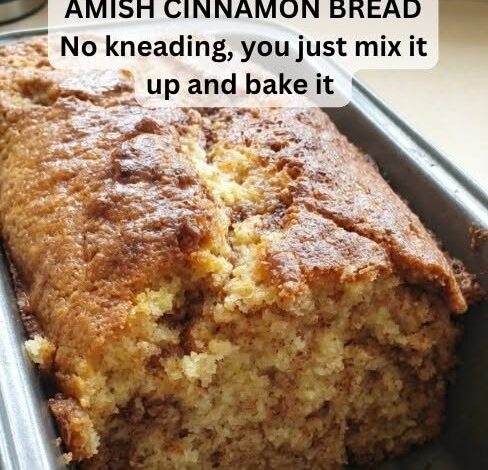
You don’t have to live in the countryside or own a century-old farmhouse to enjoy the comfort of Amish-inspired cinnamon bread.
There is no need for a wood-burning oven, hand-milled flour, or generations of family baking traditions.
What gives this beloved loaf its enduring appeal isn’t elaborate technique or hard-to-find ingredients. It’s the beauty of simplicity—an incredibly soft, buttery batter layered with generous swirls of cinnamon and sugar that bake into a rich, caramelized ribbon running through every slice.
The result is somewhere between a quick bread and a tender coffee cake.
Moist, fragrant, and topped with a lightly crisp cinnamon crust, it’s the kind of homemade treat that fills the entire house with an irresistible aroma long before it ever reaches the table.
That’s part of its magic.
Long before the first bite, the scent of butter, vanilla, cinnamon, and warm sugar drifts through every room, transforming an ordinary afternoon into something that feels comforting and familiar. It’s the kind of smell that naturally draws people into the kitchen without anyone needing to call them.
Children wander in asking when it will be ready.
Someone starts another pot of coffee.
Conversations slow down as everyone waits for the loaf to cool just enough to slice.
Few recipes create that kind of anticipation with so little effort.
Unlike traditional yeast breads that require kneading, proofing, and careful timing, this style of cinnamon bread comes together quickly using pantry staples found in most kitchens. Flour, sugar, butter, eggs, milk, baking powder, vanilla, and plenty of cinnamon are transformed into a batter that’s layered with a sweet cinnamon mixture before baking.
As the loaf rises in the oven, those layers gently swirl together, creating beautiful ribbons of cinnamon throughout the bread.
Every slice is slightly different.
Some reveal dramatic spirals.
Others hide little pockets of melted cinnamon sugar that seem to disappear the moment they touch your tongue.
The contrast in textures is part of what makes each bite memorable.
The crumb stays soft and tender, while the cinnamon topping develops a delicate, lightly crisp finish that adds just enough sweetness without overwhelming the loaf.
It’s delicious fresh from the oven while still slightly warm, when the butter is rich and the cinnamon filling is wonderfully soft.
But it doesn’t stop there.
The bread is equally enjoyable the next morning, paired with a hot cup of coffee, tea, or a glass of cold milk. Lightly toasted, it develops crisp edges while the center remains wonderfully moist, making leftovers feel almost like a completely new treat.
Many families quickly discover that one loaf rarely lasts very long.
Someone cuts “just a small piece” after dinner.
Another reaches for a slice before breakfast.
By afternoon, only a few crumbs remain on the serving plate.
It’s one of those recipes that quietly disappears without anyone realizing just how much they’ve eaten.
That simplicity is part of its charm.
It doesn’t rely on elaborate decorations or trendy ingredients to impress.
Instead, it celebrates familiar flavors prepared with care—a reminder that some of the most satisfying recipes are often the least complicated.
The loaf also stores well when wrapped tightly once completely cooled, helping preserve its moisture for several days. It can even be frozen for longer storage, making it a convenient recipe to prepare ahead for busy weeks or unexpected guests.
Of course, many home bakers never get the chance to test its storage life.
It’s usually gone long before that becomes necessary.
Beyond its flavor, this bread has a way of changing the atmosphere of a home.
A loaf cooling on the counter encourages people to slow down.
Breakfast becomes something shared instead of hurried.
An afternoon coffee break feels a little more relaxing.
Even ordinary weekdays seem warmer when the kitchen carries the comforting scent of cinnamon and vanilla.
In a world filled with individually wrapped pastries, drive-through breakfasts, and rushed mornings, taking an hour to bake something from scratch feels almost restorative.
Not because homemade bread solves every problem.
But because it creates small moments that are easy to overlook in busy lives—gathering around the counter, cutting generous slices, sharing conversation, and enjoying food made with care.
Sometimes those ordinary moments become the ones we remember most.
That’s why recipes like this continue to be passed from one generation to the next.
Not because they’re difficult.
Not because they’re expensive.
But because they remind us that comfort often begins with the simplest ingredients, a warm oven, and the willingness to slow down long enough to enjoy them.
One loaf.
One swirl of cinnamon.
One kitchen filled with the unmistakable aroma of something homemade.
Sometimes that’s all it takes to turn an ordinary day into one worth savoring.