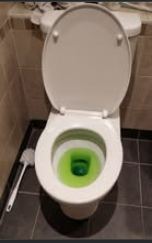
Few household emergencies create panic quite like watching the water in a clogged toilet begin to rise.
You flush.
The water climbs.
And for several terrifying seconds, all you can think is:
Please stop. Please stop. Please stop.
Sometimes it does.
Now you’re left staring at a toilet filled far higher than normal, wondering whether one more wrong move will send everything over the edge.
Before reaching for harsh chemicals—or repeatedly flushing and making the situation worse—there’s a simple household trick that may help with some ordinary clogs.
And the main ingredient could already be beside your kitchen sink.
Dish soap.
It sounds almost too simple, but there’s a practical reason people try it.
Dish soap is slippery. When added to the toilet bowl, it can help lubricate some soft obstructions and the inside of the trap, potentially making it easier for the blockage to move through.
The first rule, however, is important:
Don’t flush again if the water is already dangerously high.
Give the water time to drop.
If necessary, remove some water carefully so there’s enough room in the bowl for what comes next.
Then pour a generous amount of ordinary liquid dish soap into the toilet.
You don’t need to attack the clog immediately.
Wait.
Give the soap roughly 10–20 minutes to work its way downward and around the obstruction.
This is the part people often rush.
They pour in the soap and immediately flush.
Instead, let gravity help.
While you’re waiting, prepare some hot water.
But there’s an important warning here:
Do not use boiling water.
Toilets are made from porcelain, and exposing a cold bowl to extreme temperature changes can potentially damage it. Very hot tap water is a safer choice than a pot of aggressively boiling water.
Carefully pour the hot water into the bowl, leaving enough space to prevent an overflow.
Then wait again.
The warmth may help soften certain organic clogs while the soap provides lubrication.
After several minutes, watch the water level.
If it begins dropping noticeably, that’s encouraging.
You may be tempted to celebrate with an immediate flush.
Don’t rush.
If you’re uncertain whether the blockage has cleared, test cautiously rather than sending a full tank of water into a bowl that might still be clogged.
For many ordinary blockages, a proper toilet plunger remains one of the best tools. A flange-style plunger is specifically shaped to form a seal around a toilet drain, allowing repeated pressure and suction to work on the obstruction.
Sometimes the combination of warm water, dish soap, patience, and plunging is enough.
And when it works?
The relief is enormous.
One moment you’re imagining contaminated water spreading across the bathroom floor.
The next, you hear that beautiful draining sound.
Problem solved.
Floor dry.
Plumber avoided.
But this trick has limits.
Dish soap isn’t magic.
It won’t dissolve a toy.
It won’t remove a toothbrush.
It won’t necessarily fix a blockage deep inside the plumbing system.
And it won’t solve a sewer-line problem affecting multiple drains.
If the toilet repeatedly clogs, won’t drain after reasonable attempts, backs up into another fixture, or causes water to appear somewhere it shouldn’t, stop experimenting and contact a plumber.
Also avoid repeatedly adding different drain-cleaning chemicals to the bowl. Mixing household chemicals can create dangerous fumes or reactions, and some products aren’t intended for toilets in the first place.
Sometimes the smartest DIY decision is knowing when DIY has reached its limit.
Still, for a straightforward toilet clog, dish soap and hot—not boiling—water can be a low-cost first attempt before escalating the problem.
There’s something satisfying about that.
No frantic trip to the hardware store.
No mysterious concoction.
No repeated flushing while praying physics suddenly changes its mind.
Just a familiar kitchen staple, some warm water, and patience.
The next time the water starts climbing, remember the most important step first:
Don’t panic—and don’t flush again.
Give the bowl room.
Give the clog time.
Try the gentler solution.
Then bring out the plunger if necessary.
Because sometimes the difference between a minor inconvenience and a bathroom disaster isn’t an expensive tool.
It’s knowing what not to do during those first panicked seconds.