I discovered a strange thing on the roadside and assumed it was a brain, but the truth was even worse.

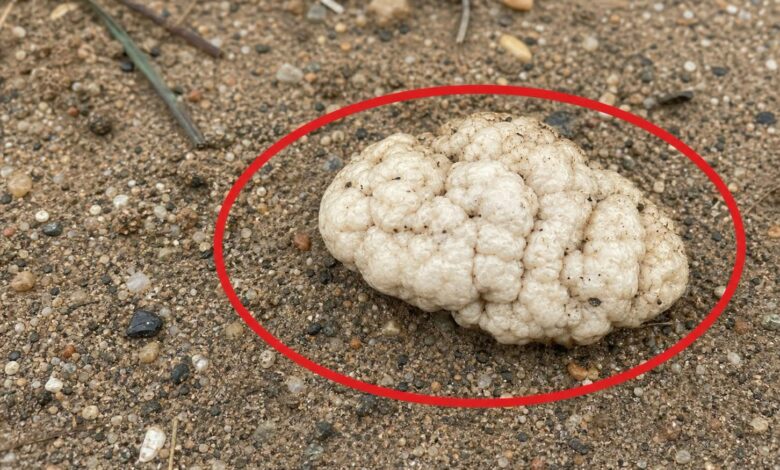
I was completely convinced I had found part of a brain on the side of the road.
Not “maybe.”
Not “it kind of looked like one.”
I mean convinced.
The shape was wrong in exactly the right way.
Pale.
Folded.
Grooved.
Wet-looking enough to make my stomach turn.
It sat near the edge of the pavement like something that absolutely did not belong there, and the longer I stared at it, the more horrific it became.
My mind did what frightened minds do best.
It filled in the missing story.
An accident.
An animal attack.
Something criminal.
Something I had stumbled upon that I was not supposed to see.
I remember standing there thinking:
Should I call the police?
That sounds absurd now.
At the time, it felt responsible.
Because once fear gives an object a name, everything afterward bends around that name.
I was no longer looking at an unidentified lump.
I was looking at a brain.
And if it was a brain, then there had to be a body.
If there had been a body, then something terrible had happened.
If something terrible had happened, I had an obligation to report it.
The logic felt airtight.
It wasn’t.
I took a picture.
That may have been my smartest decision, because photographing it gave me something I could examine without continuing to stand over the thing itself.
It also gave me the ability to ask other people.
So I posted it.
The responses came quickly.
Some people were as horrified as I was.
“What is THAT?”
“Oh my God.”
“Call somebody.”
Others began guessing.
Animal tissue.
Some kind of organ.
Discarded food.
Something decomposing.
One person seemed convinced it was exactly what I feared.
That did not help.
Every dramatic answer fed the panic.
Then one stranger left a comment so blunt that it almost offended me.
Something along the lines of:
That’s dog poop.
I stared at the screen.
No.
Absolutely not.
I had seen dog feces before.
This was not that.
Then the person explained.
Dogs sometimes eat things they cannot properly digest.
Paper towels.
Tissues.
Other fibrous material.
That material can pass through partially intact and give the stool bizarre shapes and textures.
Suddenly, details I had ignored became visible.
The strange pale folds did look fibrous.
The object had the general shape and placement of something an animal might leave behind.
There were no other signs of the gruesome event I had invented.
No blood.
No remains.
No evidence of anything except one extremely unfortunate pile on the roadside.
I zoomed in on the photograph.
And there it was.
Paper.
Half-digested paper towels embedded in dog feces.
Not a brain.
Not a mystery organ.
Not evidence of some horrifying crime.
Poop.
For a few seconds, relief was so strong that I almost felt dizzy.
Then relief transformed into embarrassment.
Hot, immediate embarrassment.
I had been mentally preparing to involve law enforcement because somebody’s dog apparently ate paper towels and then went to the bathroom.
There are moments when reality does not merely correct you.
It humiliates you with efficiency.
I imagined the conversation I had almost created.
“911, what’s your emergency?”
“I found a brain.”
“A brain?”
“Yes.”
“Where?”
“By the road.”
Then an officer arrives.
Looks down.
Looks at me.
Looks down again.
“Ma’am, that’s dog poop.”
I would have had to move.
Possibly change my name.
Instead, I started laughing.
Not elegant laughter.
The kind that comes when your body has already spent all its adrenaline and has nowhere else to put the energy.
I laughed because the alternative was admitting how thoroughly my imagination had betrayed me.
The funniest part was how convincing fear had made everything.
Before somebody explained the object, I couldn’t see any interpretation except catastrophe.
Afterward, I couldn’t understand how I had ever seen a brain.
The object had not changed.
Only the story surrounding it had.
That stayed with me.
We like to believe seeing comes first and interpretation comes second.
Often, they happen almost simultaneously.
You see something unfamiliar.
Your brain races to categorize it.
Once a category wins, perception begins supporting the verdict.
That’s a snake.
That’s a weapon.
That’s blood.
That’s a person following me.
That’s a brain.
Sometimes the instinct protects us.
Human beings survived partly because our ancestors did not spend fifteen minutes conducting calm philosophical analysis every time grass moved suspiciously.
Better to briefly mistake a stick for a snake than a snake for a stick.
Fear is designed to favor false alarms.
The problem is that modern life gives those false alarms extraordinary places to run.
The internet, for example.
If I had kept the photograph to myself, I might have eventually decided I was overreacting.
Instead, I posted it to a crowd.
Crowds can help.
The stranger who identified the likely explanation rescued me from my own imagination.
But crowds can also amplify panic.
For every person saying, “Relax, it’s probably harmless,” there is another saying, “My cousin’s neighbor saw something exactly like that right before a murder investigation.”
Fear loves witnesses.
The more people react emotionally, the more legitimate the original panic feels.
That is how uncertainty becomes certainty without gaining any actual evidence.
One person guesses.
Another repeats.
Someone adds detail.
Soon the story sounds established.
This happens with far more consequential things than roadside dog waste.
A photograph circulates without context.
Somebody identifies the location incorrectly.
Another person assigns a motive.
A third claims to know who is involved.
Within hours, thousands are arguing about an event that may never have happened in the form being described.
My “brain” was a ridiculous miniature version of that process.
Step one:
See something strange.
Step two:
Choose the most dramatic explanation.
Step three:
Interpret every detail as support.
Step four:
Look for people who agree.
Step five:
Feel increasingly certain.
The missing step is usually the most important one.
Ask:
What else could this be?
That question is difficult when fear has already arrived.
Fear doesn’t enjoy alternatives.
It wants action.
Immediately.
Run.
Call someone.
Warn people.
Do something before it is too late.
Sometimes that’s appropriate.
If the potential danger is serious and immediate, caution matters.
But when there is time to investigate safely, a few extra questions can prevent a remarkable amount of foolishness.
What am I actually looking at?
What do I know versus what am I assuming?
Is there evidence supporting the worst-case interpretation?
Is there a simpler explanation?
Can someone with relevant knowledge identify it?
Those questions would have saved me several minutes of believing I was standing beside evidence of a horror movie.
Still, I’m glad I made the mistake.
I would not have said that while staring at the thing.
But the embarrassment gave the lesson staying power.
Abstract advice is easy to forget.
“Don’t catastrophize.”
“Consider alternative explanations.”
“Verify before reacting.”
Fine.
Reasonable.
Boring.
But whenever I hear those ideas now, I do not picture a psychology textbook.
I picture poop shaped like a brain.
That image is impossible to forget.
And it has become unexpectedly useful.
When an email arrives with a vague subject line and my stomach drops before I even open it, I think about the roadside.
When somebody says, “We need to talk,” and my mind instantly invents five disasters, I remember it.
When a strange sound wakes me at night and my imagination begins designing an intruder, a structural collapse, and possibly a supernatural event, the same thought appears:
Maybe it’s another brain.
Which really means:
Maybe you don’t know what you’re looking at yet.
That doesn’t eliminate anxiety.
It creates a small gap between sensation and conclusion.
Sometimes that gap is enough.
Because most fear arrives faster than evidence.
The heart speeds up.
The body becomes alert.
The imagination produces an explanation.
Evidence has to catch up afterward.
Learning to wait for it is a skill.
It is also deeply unnatural.
The brain prefers completed stories.
Uncertainty is uncomfortable.
“I don’t know” leaves the door open.
“This is definitely terrible” closes it, even if the conclusion is frightening.
Certainty can feel safer than ambiguity.
That is one reason people cling to alarming explanations even when simpler ones appear.
Admitting “I misread that” requires giving up the security of having understood the situation.
In my case, reality was persuasive enough.
Dog feces.
Paper towels.
End of mystery.
But even then, there was a tiny part of me that resisted for a moment.
Really?
That’s all?
After everything my imagination had built?
Yes.
That was all.
Reality is under no obligation to match the drama our minds produce.
Sometimes the mysterious noise is plumbing.
The shadow is a coat.
The suspicious lump is trash.
The terrible medical symptom has an ordinary explanation.
The alarming message was poorly worded.
And the brain beside the road is what happens when a dog eats something it shouldn’t.
Of course, the opposite can happen too.
Sometimes strange things are genuinely dangerous.
The lesson is not to dismiss everything.
It’s to separate caution from certainty.
If I had genuinely believed I was looking at human remains, contacting authorities would not have been ridiculous.
What was ridiculous was how quickly I promoted a visual resemblance into a fact.
I had skipped investigation and gone directly to narrative.
There is a difference between:
“This looks alarming.”
And:
“I know what this is.”
The first leaves room for evidence.
The second starts closing doors.
That distinction has made me more careful.
Not fearless.
Careful.
Fearlessness is not particularly useful when something may actually be wrong.
What matters is calibration.
Enough concern to investigate.
Enough humility to remain uncertain.
Enough patience not to turn every unfamiliar thing into catastrophe.
And, when the evidence arrives, enough humor to admit you were spectacularly wrong.
Humor may be the best part.
Embarrassment can harden people.
They become defensive.
Pretend they never really believed the thing they very clearly believed.
Attack whoever corrected them.
I understand the instinct.
Being wrong feels exposing.
Laughing makes it survivable.
Yes.
I thought dog poop was a brain.
There.
I survived saying it.
In fact, telling the story became more enjoyable than whatever dignity I would have preserved by pretending it never happened.
People laugh.
Then they tell their own versions.
A shadow mistaken for a person.
A coat rack that caused a scream.
A strange object mistaken for an animal.
A medical panic caused by something completely ordinary.
Almost everyone has one.
That’s comforting.
We are all walking around with brains designed to keep us alive by occasionally making us look ridiculous.
Perhaps that’s a fair trade.
What matters is what happens after the alarm.
Do we investigate?
Update?
Admit the evidence changed the story?
Or do we become so attached to the first explanation that reality starts feeling like an inconvenience?
The stranger online gave me a gift far larger than identifying a pile of feces.
They interrupted a story.
One sentence was enough.
Dogs can’t digest paper.
Suddenly, the whole terrifying narrative collapsed.
No victim.
No crime scene.
No emergency.
Just a dog with questionable eating habits and an owner who had failed to pick up the aftermath.
I still wonder what the dog had been doing with all those paper towels.
That mystery can remain unsolved.
Some questions are safer than others.
Now, whenever I encounter something strange, I try to remember the sequence.
Notice.
Pause.
Ask.
Verify.
Then react.
Not perfectly.
My imagination still loves sprinting ahead.
But now it has competition.
A small, embarrassing memory standing at the roadside saying:
You have been very sure before.
Remember how that went?
I do.
I remember the horror.
The photograph.
The comments.
The stranger’s blunt explanation.
The instant when the terrifying shape became something disgusting but harmless.
And I remember laughing because reality had suddenly become so much kinder than my imagination.
That is why the memory stayed.
It is not really a story about dog waste.
It’s about how fragile our certainty can be.
One unfamiliar shape was enough to transform an empty roadside into a crime scene in my mind.
One piece of information transformed it back.
The world had remained the same throughout.
Only my interpretation moved.
That realization has made me a little slower to panic and a little quicker to ask questions.
Not every strange discovery is evidence of disaster.
Not every silence means rejection.
Not every unfamiliar symptom means catastrophe.
Not every alarming headline tells the whole story.
And not every thing that looks like a brain belongs anywhere near a police report.
Sometimes the truth is much less dramatic.
Much more embarrassing.
And infinitely easier to clean up.
Sometimes it’s just a mess somebody forgot to pick up.