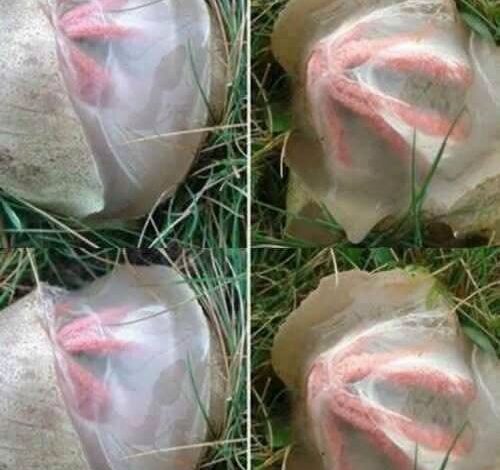
It caught the eye immediately.
A vivid splash of bright red stood out against the muted greens and browns of the garden, looking so out of place that it seemed almost unnatural. It wasn’t a flower. It wasn’t a berry. It wasn’t anything familiar. It was simply…there—a small, smooth growth emerging from the soil, bold enough to stop anyone in their tracks.
For a few uncertain moments, imagination did the rest.
Questions arrived faster than answers.
Was it poisonous?
Was it dangerous to pets?
Could it be the sign of a plant disease spreading beneath the surface?
Or was it something entirely unknown?
The object itself hadn’t changed, but the mystery surrounding it made it feel far more threatening than its size suggested. The human mind has a remarkable ability to fill empty spaces with possibilities, and when those possibilities involve something unfamiliar, they’re often far darker than reality.
That reaction is perfectly natural.
Our brains evolved to notice unusual shapes, unexpected colors, and anything that appears out of place in familiar surroundings. Thousands of years ago, responding cautiously to the unknown could mean the difference between safety and danger. Even today, an unfamiliar object in the garden can trigger the same instinctive alertness, despite living in a world where most mysteries have far less dramatic explanations.
So instead of rushing to conclusions, it helps to slow down.
A closer look often tells a different story.
Many unusual growths that appear in gardens after periods of rain or changing weather turn out to be fungi, slime molds, or other naturally occurring organisms. Their colors can be surprisingly vivid—scarlet, orange, yellow, purple, or even electric blue—and their shapes can seem almost otherworldly.
Some resemble tiny coral reefs.
Others look like delicate cups, bright buttons, or pieces of wax carefully placed on the ground.
To someone encountering them for the first time, they can seem almost impossible to explain.
Yet these organisms are simply carrying out their role within the ecosystem.
Fungi, in particular, play an essential part in nature by breaking down dead organic matter and recycling nutrients back into the soil. Without them, forests, gardens, and fields would gradually become buried beneath layers of fallen leaves, branches, and decaying plants. What appears unusual on the surface is often evidence of a healthy, active environment working exactly as it should.
Recognizing that possibility changes everything.
The bright red growth no longer feels like an ominous warning.
Instead, it becomes something fascinating.
The curiosity that replaces fear opens the door to learning rather than worrying. Suddenly, questions shift from “What if this is dangerous?” to “I wonder what species this is?”
The garden itself hasn’t changed.
Only the perspective has.
That small moment reveals something much larger about the way people experience the world.
An unfamiliar shape.
An unexpected sound.
A strange texture.
A surprising headline.
Our first reaction is often driven by uncertainty rather than evidence.
Psychologists sometimes refer to this tendency as a negativity bias—the brain’s inclination to give greater attention to potential threats than to ordinary explanations. It’s a useful survival mechanism, but it can also encourage us to imagine worst-case scenarios before we’ve gathered enough information to understand what’s actually happening.
Fortunately, curiosity offers an antidote.
Taking a moment to observe carefully, asking questions, consulting reliable sources, or seeking expert advice when needed allows uncertainty to give way to understanding. That doesn’t mean ignoring genuine risks; it means replacing assumptions with information.
In a garden, that might involve identifying an unfamiliar mushroom before touching it, since some fungi can indeed be toxic and should never be eaten unless identified with certainty. Admiring unusual growth from a safe distance while learning more about it is often the wisest approach.
More broadly, the lesson extends far beyond gardening.
Life constantly presents situations that appear unfamiliar or unsettling at first glance. Sometimes those moments genuinely require caution. More often, however, they simply require patience.
A pause.
A closer look.
An open mind.
Those few extra moments can transform anxiety into appreciation.
The bright red fungus remains exactly where it was, quietly performing its role in the living world beneath our feet.
The soil hasn’t changed.
The weather hasn’t changed.
The garden hasn’t changed.
Only the story we tell ourselves has.
And perhaps that’s the most valuable discovery of all.
Reality is often gentler than the version our imagination creates in the first few seconds of uncertainty. When we replace fear with informed curiosity, the unfamiliar becomes less intimidating and far more interesting.
Sometimes the greatest transformation doesn’t happen in nature.
It happens in the way we choose to see it.