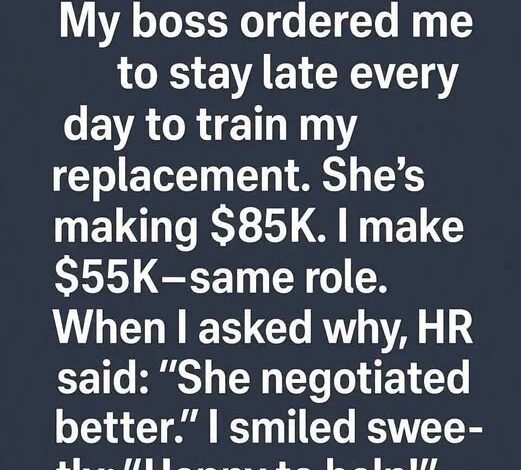
For years, I believed that working harder would eventually speak for itself.
I arrived early, stayed late, solved problems no one else noticed, and quietly handled responsibilities that had never appeared in my job description. Whenever something slipped through the cracks, I caught it. Whenever a crisis threatened to derail a project, I stepped in before anyone else even realized there was a problem.
No one asked me to do all of it.
Eventually, everyone simply expected it.
The extra work became invisible because it was always done.
Deadlines were met.
Clients stayed happy.
The office kept moving.
And somewhere along the way, my willingness to help transformed into an unspoken obligation.
The hardest part wasn’t the workload.
It was the assumption that it would never stop.
When I finally decided to accept another opportunity, management acted surprised.
They spoke about loyalty.
About teamwork.
About how difficult my departure would be.
What they didn’t acknowledge was that much of the value I provided had never been recognized in the first place.
During my notice period, my manager introduced the person who would be taking over my position.
He seemed capable, eager, and understandably nervous.
As we sat together for the transition meeting, my boss smiled confidently.
“Just show him everything you do.”
I nodded.
Then I walked to my desk.
Instead of opening my computer immediately, I placed two neatly organized stacks of documents on the table.
The first stack was modest.
Clean.
Manageable.
“This,” I explained, “is my official job.”
Inside were the duties listed in my employment agreement.
The responsibilities I had actually been hired to perform.
The second stack landed with a much heavier sound.
It was several times larger.
Inside were detailed notes covering everything else I had gradually absorbed over the years.
Emergency procedures.
Client escalations.
Internal reporting.
Training materials.
Spreadsheet systems I had built myself.
Problems I routinely solved before anyone else even noticed they existed.
Tasks that had quietly become “my responsibility” simply because I had always handled them.
The room became very quiet.
My replacement stared at the larger stack.
My manager looked back and forth between the two piles without saying a word.
Finally, he asked the obvious question.
“Who usually handles all of this?”
I smiled politely.
“I do.”
A longer silence followed.
Then I added the sentence that changed the entire conversation.
“None of it is included in my position.”
For the first time, everyone in the room could actually see what had previously been invisible.
Not because I had exaggerated.
Because I had documented everything.
There were no dramatic speeches.
No raised voices.
No accusations.
Just facts.
Page after page.
Responsibility after responsibility.
The illusion disappeared almost instantly.
For years, management had unconsciously relied on one dangerous assumption:
That my extra effort was unlimited.
That it would always be there.
That it cost nothing.
Now it sat on the desk in black and white.
My replacement looked overwhelmed.
Not because he lacked ability.
Because he suddenly understood that one employee had quietly been doing the work of several people.
Over the following days, reality arrived even faster than I expected.
Emails that normally received immediate responses remained unanswered.
Routine issues turned into urgent problems.
Questions that people once sent directly to me began circulating through multiple departments because no one knew who actually owned them.
Meetings multiplied.
So did confusion.
My manager spent increasing amounts of time trying to untangle responsibilities that had quietly rested on my shoulders for years.
For the first time, he wasn’t seeing my work.
He was experiencing its absence.
Interestingly, I didn’t rush back in to rescue the situation.
Not out of bitterness.
Out of professionalism.
I continued performing every responsibility that officially belonged to my role.
I completed projects on schedule.
Documented everything carefully.
Answered questions.
Supported the transition.
What I didn’t do was continue donating unpaid labor simply because everyone had grown accustomed to receiving it.
There is an important difference between being helpful and being indispensable because an organization refuses to distribute work appropriately.
I had finally learned it.
On my last day, I packed my desk without resentment.
There was no dramatic farewell.
No final confrontation.
Just handshakes.
Good wishes.
And the quiet satisfaction that comes from leaving with integrity intact.
A few weeks later, I began my new position.
The salary was higher.
The responsibilities were clearly defined.
More importantly, the culture encouraged employees to communicate openly about workload instead of quietly absorbing more and more responsibility without recognition.
For the first time in years, I realized something surprising.
I wasn’t simply being paid more.
I was being valued differently.
That difference changed everything.
Looking back, I don’t think the two stacks of paper were really about documents.
They represented something much larger.
The first stack showed what I had been hired to do.
The second revealed everything I had convinced myself was simply part of being “a good employee.”
In reality, much of it belonged elsewhere.
To management.
To better staffing.
To clearer planning.
To organizational responsibility.
Not to one person’s endless willingness to compensate for every gap.
Leaving that company taught me a lesson I wish I had learned much earlier.
Hard work deserves recognition.
Generosity deserves boundaries.
And loyalty should never require sacrificing your own worth.
The greatest negotiation I ever made wasn’t for a larger paycheck.
It was with myself.
I decided that from that moment forward, I would never again confuse being undervalued with being indispensable.
Because knowing your worth means more than recognizing your abilities.
It means refusing to build your future in a place that depends on you giving more than it is ever willing to acknowledge.
Sometimes the most powerful statement you can make isn’t an argument.
It’s a clear record of the value you’ve quietly been creating all along—and the courage to take that value somewhere it will finally be appreciated.