I was taking a walk around a small lake near my village when I spotted this strange object by the water’s edge. I’ve asked several people, but no one seems to know what it is

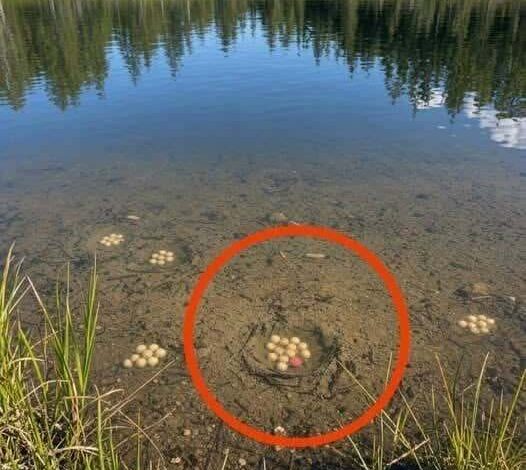
At first, nobody wanted to touch them.
Scattered across the shallow edge of the lake were dozens of strange, pale spheres, some gathered together in gelatinous clusters and others resting in small depressions beneath the water.
They looked almost too perfect to be natural.
“Are those eggs?”
Someone else had a more disturbing suggestion.
“What if they’re some kind of parasite?”
Within minutes, an ordinary walk beside the water had turned into a mystery.
The lake itself wasn’t particularly remarkable. It was an artificial body of water surrounded by vegetation, walking paths, and the familiar sounds of birds and insects. People passed it regularly without giving much thought to what might be living beneath the surface.
But that morning, the water was unusually clear.
And in one shallow section, something caught the light.
At first glance, the formations looked like translucent beads.
There were dozens of them.
Perhaps hundreds.
Some appeared almost completely transparent, while others contained tiny dark centers.
The closer people looked, the stranger they seemed.
Nobody could immediately explain what they were seeing.
Pollution?
Fish eggs?
An invasive organism?
Some unusual fungus?
The uncertainty made the discovery feel far more sinister than it really was.
Photographs were taken.
People searched online.
Descriptions were compared with images of aquatic organisms.
And eventually, the mystery began to unravel.
Those strange clusters weren’t evidence that something had contaminated the lake.
They were evidence that something had chosen it as a nursery.
They appeared to be amphibian eggs.
Suddenly, everything looked different.
The translucent material wasn’t some mysterious substance spreading through the water.
It was protective jelly.
And those dark shapes visible inside?
Developing embryos.
What had looked unsettling only minutes earlier was actually one of nature’s oldest beginnings happening in plain sight.
Amphibians such as frogs and salamanders often lay eggs in water, although the exact appearance varies considerably by species. Some produce rounded masses of eggs. Others create strings, smaller clusters, or attach eggs to underwater vegetation.
Unlike the hard-shelled eggs of birds, many amphibian eggs are surrounded by soft, gelatinous layers.
That jelly performs several important functions.
It helps protect the developing embryo while allowing oxygen and water to move through the surrounding environment.
And when sunlight passes through it, the entire structure can take on an almost glass-like appearance.
Look closely enough and something even more extraordinary may become visible.
Life is changing inside.
Early in development, an egg may look like little more than a dark dot suspended inside a transparent sphere.
Then that dot begins transforming.
Cells divide.
Structures develop.
The embryo lengthens.
Eventually, depending on the species, a recognizable tadpole-like form begins to emerge.
What appears motionless from several feet away is actually undergoing an astonishing biological transformation.
And the location of the eggs makes sense.
Shallow water can provide valuable conditions for developing amphibians.
Sunlight can warm the water.
Aquatic plants and microorganisms can support the ecosystem around them.
In suitable habitats, shallow areas may also offer young amphibians places to develop away from some larger aquatic predators.
But this nursery is anything but safe.
Amphibian eggs are extraordinarily vulnerable.
Water levels can fall.
Temperatures can change.
Predators can discover them.
Pollution can interfere with development.
People can unknowingly step on them or remove them from the water out of curiosity.
Even when hundreds of eggs are laid, many individuals may never reach adulthood.
That’s part of what makes the sight so remarkable.
Every tiny sphere represents possibility rather than certainty.
Inside each viable egg is an animal attempting one of life’s most dramatic transformations.
If conditions remain favorable, the embryos eventually hatch.
Then the lake begins to look different again.
Tiny tadpoles may appear.
At first, they’re almost impossibly small.
Dark shapes darting through vegetation.
Little commas moving through the water.
They feed and grow.
Their bodies change.
For frogs and toads, hind legs emerge.
Then front legs.
The tail gradually shrinks as the animal’s anatomy reorganizes for life beyond the purely aquatic world.
Lungs develop and become increasingly important.
The body that entered the world as a swimming larva becomes something capable of moving onto land.
It’s metamorphosis—a word so familiar that it’s easy to forget how extraordinary the process actually is.
An animal changes not merely in size, but in basic form.
Its method of movement changes.
Its breathing changes.
Its diet may change.
Its relationship with its environment changes.
And all of it begins inside something small enough to overlook during an afternoon walk.
Perhaps that’s why the original discovery felt so powerful.
The people standing beside the lake had initially interpreted the unfamiliar as threatening.
That’s a deeply human response.
When we don’t recognize something, our imagination tends to fill the gap.
Strange becomes suspicious.
Unknown becomes dangerous.
But nature constantly produces forms that look alien simply because we rarely stop long enough to notice them.
A cluster of insect eggs beneath a leaf.
A chrysalis hanging from a branch.
Fungal networks beneath the soil.
Tiny aquatic organisms moving through a drop of pond water.
Amphibian eggs resting beneath the surface.
Entire worlds can exist beside us without attracting our attention.
Until one day the light hits them differently.
Then we finally see.
There’s also something encouraging about amphibians appearing in unexpected places.
An artificial lake may have been constructed for people, drainage, landscaping, recreation, or some other human purpose.
But nature doesn’t necessarily care about the original blueprint.
If appropriate water, vegetation, shelter, and breeding conditions exist, wildlife may arrive.
Insects discover the plants.
Birds discover the insects.
Aquatic organisms establish themselves.
And eventually, frogs, toads, newts, or salamanders may use the water to reproduce.
A place built by humans becomes part of another species’ life cycle.
Of course, identifying eggs from appearance alone isn’t always straightforward.
Many aquatic egg masses can look similar, and species vary by region. The safest approach is usually to observe without disturbing them and, when identification matters, consult a local wildlife organization or knowledgeable naturalist.
There’s rarely a need to pick them up.
They don’t need to be “rescued” simply because they’re underwater.
For many amphibians, that’s exactly where they’re supposed to be.
Sometimes the best way to help wildlife is wonderfully uneventful:
Leave it alone.
Watch.
Take a photograph from a respectful distance.
Keep pets from disturbing the area.
Avoid introducing chemicals into the water.
Then return later.
You may find that the mysterious dots have changed shape.
Return again, and perhaps the eggs will be empty.
Look carefully along the edge, and tiny tadpoles may now be moving through the shallows.
Weeks later, some may have legs.
Eventually, the animals that began as nearly invisible embryos may disappear into the surrounding vegetation.
And the lake will look ordinary again.
That’s the strange beauty of it.
If nobody had stopped that morning, the entire event could have happened unnoticed.
Eggs laid.
Embryos formed.
Tadpoles hatched.
Young amphibians emerged.
Life continued.
No audience required.
The mysterious spheres were never monsters.
They weren’t pollution.
They weren’t evidence of something invading the lake.
They were beginnings.
Fragile ones.
Temporary ones.
Hundreds of tiny lives suspended in transparent capsules, waiting for warmth and time to do their work.
And perhaps that’s what makes discoveries like this stay with us.
They remind us how often we confuse unfamiliarity with danger.
How quickly fear can become wonder once understanding enters the picture.
And how much of the natural world remains invisible simply because we’re moving too quickly to notice it.
What began as an uneasy question beside the water—
“What are those things?”
—ended with a much more beautiful realization.
The lake wasn’t hiding something frightening.
It was quietly bringing something to life.