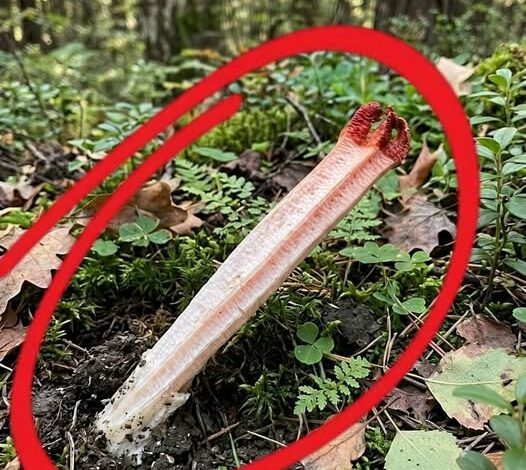
I spotted it just beyond the edge of the trail.
At first, I couldn’t make sense of what I was seeing. Something bright red seemed to be pushing its way out of the forest floor, its strange shape so unnatural that I instinctively stopped walking.
My son noticed it too.
“What’s that?” he whispered.
I didn’t have an answer.
We stood there for a moment, neither of us wanting to get any closer, yet unable to look away. Finally, curiosity won. I took a cautious step forward, then another, keeping my son safely behind me.
Up close, it looked even stranger.
Several rubbery red arms stretched outward like twisted fingers reaching from the earth. Their surfaces glistened with moisture, while a dark, sticky coating covered the inner sides. Flies buzzed around it constantly, landing for a moment before taking off again.
Then I caught the smell.
It was unmistakable.
A sickly, rotting odor drifted through the air, completely out of place in the otherwise fresh woodland.
For a split second, my imagination ran wild.
Had something died nearby?
Was this some kind of animal?
The combination of the smell, the flies, and the bizarre appearance made it feel more like something from a horror movie than a quiet nature walk.
Then an old memory surfaced.
Years earlier, I’d read an article about unusual fungi that mimic the smell of decaying flesh to attract insects. My hands were still a little shaky as I reached for my phone and searched for “red fingers mushroom.”
The photographs appeared almost instantly.
There it was.
Clathrus archeri, commonly called devil’s fingers.
Everything matched.
The bright crimson arms.
The dark, spore-covered inner surfaces.
The flies.
Even the unpleasant smell.
Far from being dangerous or supernatural, this remarkable fungus was simply carrying out one of nature’s cleverest survival strategies.
Unlike mushrooms that rely mainly on wind to spread their spores, devil’s fingers produces an odor that resembles rotting meat. The smell attracts flies and other insects, which land on the sticky spore-covered surface. As the insects move on, they carry the spores to new locations, helping the fungus reproduce.
What had seemed horrifying a moment earlier suddenly became fascinating.
My son stepped a little closer, no longer frightened but full of questions.
“It actually wants the flies?”
“Exactly.”
“And it smells bad on purpose?”
“That’s how it spreads.”
Instead of hurrying away, we spent several minutes quietly observing one of the strangest organisms either of us had ever seen.
Nature often surprises us like that.
Some of its most unusual creations aren’t dangerous at all—they’re simply adapted to survive in extraordinary ways.
If you ever encounter a fungus you can’t identify, it’s best to admire it without touching or picking it. Many wild fungi are harmless, while others can be toxic, and identifying mushrooms accurately often requires expert knowledge.
As we continued our walk, my son kept glancing back at the strange red fungus disappearing into the trees.
“It still looks creepy,” he admitted.
I laughed.
“It does.”
“But now we know its secret.”
That morning reminded me how easily fear can grow from unfamiliarity.
The forest hadn’t been hiding a monster.
It had been introducing us to one of its most remarkable residents.
Sometimes the wild isn’t trying to frighten us.
It’s simply reminding us that nature’s imagination is far stranger—and far more wonderful—than our own.