Some moments in history survive not because they changed governments or ended wars, but because they captured something emotionally unforgettable in a single image.
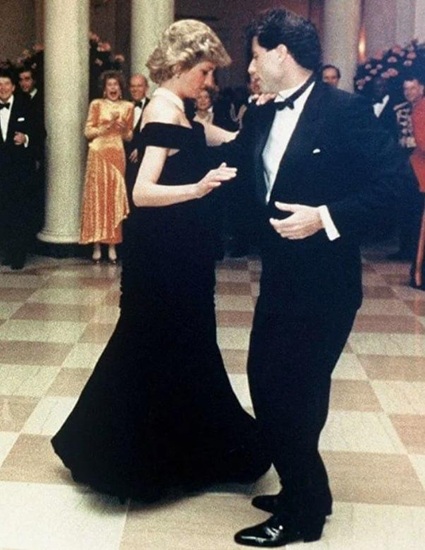
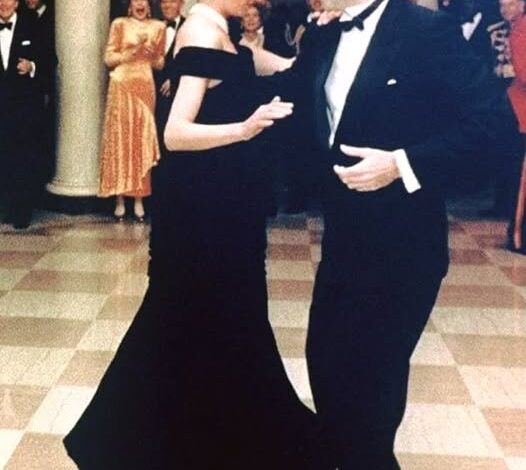
Princess Diana dancing with John Travolta at the White House in 1985 became one of those moments.
Even decades later, the photograph still feels strangely alive:
the sweep of a midnight blue gown across a polished floor,
the glow of ballroom lights,
the elegance of movement suspended between royalty and Hollywood glamour.
But the lasting power of that evening was never only about fashion or celebrity.
It was about presence.
Princess Diana possessed a rare ability to step into highly formal spaces and somehow make them feel emotionally human. Whether visiting hospitals, comforting children, speaking with world leaders, or gliding through state dinners beneath chandeliers and cameras, she carried an openness that people instinctively responded to.
That quality transformed the White House dance from a beautiful social moment into cultural history.
The event took place on November 9, 1985, during the official visit of Prince Charles and Princess Diana to the United States. At the time, the world’s fascination with Diana had already become enormous. She was not simply a member of the British royal family anymore — she had evolved into a global phenomenon.
Every appearance generated headlines.
Every outfit became conversation.
Every gesture seemed endlessly analyzed.
Yet despite the overwhelming public attention surrounding her, Diana often appeared surprisingly approachable. She moved through highly structured royal environments with a softness and emotional accessibility that contrasted sharply with the distant formality people traditionally associated with monarchy.
The White House state dinner hosted by President Ronald Reagan and First Lady Nancy Reagan represented one of the highest-profile events of the decade. Diplomacy, entertainment, politics, fashion, and celebrity all converged beneath one roof in Washington, D.C.
The guest list itself reflected the unusual cultural blend of the evening:
political leaders,
Hollywood actors,
international dignitaries,
public figures representing both power and fame.
And at the center of it all stood Princess Diana.
That night, she wore what would later become one of the most iconic dresses in royal fashion history:
a midnight blue velvet gown designed by British fashion designer Victor Edelstein.
The dress itself carried remarkable elegance through restraint rather than extravagance. The off-the-shoulder design balanced sophistication with softness, modern enough to feel contemporary while still preserving royal refinement. Under ballroom lighting, the deep blue velvet appeared almost liquid as it moved.
Fashion critics praised it immediately.
But history would eventually attach the gown to something larger than style alone.
Because clothing sometimes becomes symbolic when tied to emotionally resonant moments.
And that evening produced one of the most enduring images of the twentieth century.
At some point during the dinner, First Lady Nancy Reagan reportedly encouraged John Travolta to ask Diana to dance. For Travolta, the moment already carried surreal weight before he even crossed the floor toward her.
At the time, he was one of America’s most recognizable actors, deeply associated with dance culture thanks to films like Saturday Night Fever. Yet even he later admitted feeling overwhelmed by the significance of the moment.
Because asking a princess to dance inside the White House was not exactly an ordinary social interaction.
Travolta later described tapping Diana lightly on the shoulder and introducing himself politely before requesting the dance. According to his recollections, she responded warmly and without hesitation.
Then they stepped onto the dance floor together.
What followed lasted only minutes.
Yet culturally, it became immortal.
Photographers captured Diana moving gracefully across the room beside Travolta while guests watched the scene unfold almost like a movie sequence happening in real time. The U.S. Navy band reportedly played music associated with cinematic romance and elegance, adding to the atmosphere already charged with symbolism.
The ballroom itself seemed suspended between fantasy and diplomacy.
And in the center of it all was Diana:
smiling,
poised,
weightless beneath flashing cameras and collective fascination.
What made the moment so compelling was not merely that a princess danced with a movie star.
It was the way Diana carried herself during it.
She never appeared intimidated by fame or trapped by royal stiffness. Instead, she looked entirely comfortable existing between worlds:
royalty and entertainment,
tradition and modern celebrity culture,
formality and spontaneity.
That balance became central to her public identity.
Historians and cultural commentators often describe Diana as one of the first truly modern royals because she understood media emotionally rather than mechanically. She recognized that public connection depended not only on ceremony, but on relatability.
People did not admire her solely because she was royal.
They admired her because she seemed emotionally reachable despite it.
The dance with Travolta symbolized that perfectly.
It showed a princess participating in a glamorous public moment while still appearing authentic rather than distant or rehearsed. She looked graceful without seeming untouchable.
And audiences around the world responded instantly.
The photographs spread internationally within days.
Newspapers reproduced them endlessly.
Television broadcasts replayed footage repeatedly.
The image entered popular culture almost immediately.
Over time, it became more than documentation of a state dinner.
It became mythology.
Part of that mythology also stemmed from the emotional atmosphere surrounding Diana herself during the 1980s. Public fascination with her extended beyond fashion and royalty into something more personal. Many people projected hopes, vulnerability, and emotional longing onto her image.
She appeared simultaneously glamorous and fragile.
Privileged yet lonely.
Admired globally while visibly struggling beneath the pressures surrounding royal life.
That emotional complexity made moments like the White House dance feel symbolic beyond their immediate context.
People saw elegance.
Freedom.
Charm.
Possibility.
For a brief moment, Diana seemed entirely alive inside the role the world imagined for her.
John Travolta later reflected on the dance with extraordinary warmth. In interviews years afterward, he described the experience as one of the most memorable moments of his life, emphasizing Diana’s kindness and emotional ease. He repeatedly noted how gracious and approachable she seemed despite the immense global attention surrounding her.
His recollections carried genuine affection rather than celebrity nostalgia.
And others present that evening echoed similar impressions.
Official White House photographer Pete Souza later discussed the event’s historical significance, recognizing how immediately iconic the images became. He understood in real time that the evening represented more than routine diplomacy.
It captured a cultural moment impossible to recreate.
Interestingly, Diana also danced with other guests that evening, including President Reagan and actor Tom Selleck. Yet none of those interactions carried the same emotional resonance publicly.
The dance with Travolta endured because it contained visual storytelling almost too perfect to seem accidental:
the princess,
the Hollywood star,
the White House,
the velvet gown,
the glow of cameras,
the illusion of timeless glamour.
Over the decades, the dress itself acquired legendary status.
In 2020, the gown was auctioned to support charitable causes and sold for a substantial sum, reflecting not merely fashion value but emotional and historical significance. The dress had evolved into a preserved artifact connected to one of the most recognizable moments of Diana’s life.
Today, it exists not simply as clothing, but as cultural memory made tangible.
And perhaps that reflects something larger about Diana herself.
Because long after her death, public fascination with her remains unusually emotional. People continue revisiting photographs, interviews, documentaries, and stories connected to her life not only because of royal curiosity, but because she represented a kind of humanity many felt was missing from institutions surrounding her.
She hugged AIDS patients publicly when stigma still dominated public perception.
She walked through minefields advocating humanitarian causes.
She comforted grieving families.
She spoke with visible empathy rather than ceremonial detachment.
These actions mattered deeply.
The White House dance exists within that broader legacy.
Not because dancing itself changed history, but because it reinforced the image of Diana as someone capable of moving fluidly between worlds while remaining emotionally recognizable within all of them.
In many ways, the fascination surrounding that evening reveals how strongly people crave moments of grace inside public life.
Not scandal.
Not conflict.
Not spectacle rooted in humiliation.
Grace.
Beauty connected to sincerity.
And perhaps that is why the image still resonates decades later.
Even younger generations unfamiliar with the political context of the 1980s often respond emotionally when seeing the photographs. Something about them transcends the era itself.
Maybe it is the elegance.
Maybe the nostalgia.
Maybe the visible joy on Diana’s face.
Or maybe it is simply the reminder that certain moments briefly unite culture through admiration rather than division.
A princess dancing beneath White House chandeliers with a movie star should not necessarily have become one of the defining images of an era.
Yet somehow, it did.
Because history is not remembered only through laws, elections, or crises.
Sometimes it is remembered through moments that capture imagination so completely they become emotionally permanent.
Princess Diana’s dance with John Travolta remains one of those moments:
a rare intersection of glamour,
humanity,
celebrity,
diplomacy,
and emotional symbolism frozen forever inside a single sweep across a ballroom floor.
And even now, decades after her passing, the image still carries the same quiet power it did that night:
the feeling that for a few unforgettable minutes, the world stopped simply to watch elegance move. :::