Kate Middleton’s reaction to Harry and Meghan’s UK return has everyone asking the same question

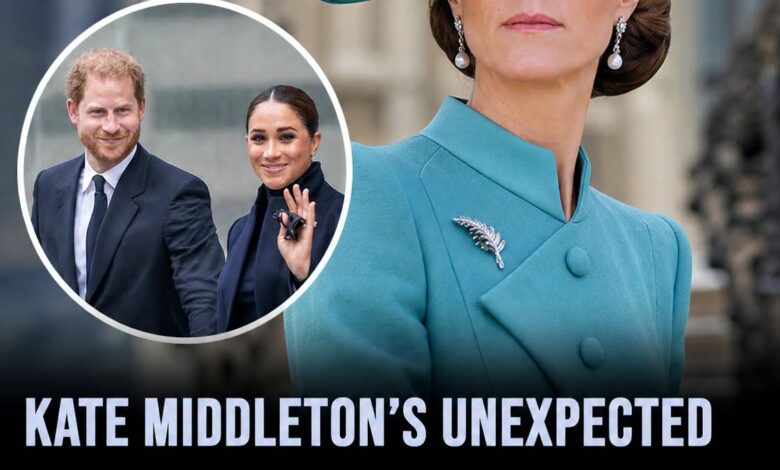
Behind palace doors, the possibility of Prince Harry and Meghan Markle returning to Britain carries far more weight than an ordinary family visit.
There are old wounds.
Public accusations.
A bestselling memoir.
Television interviews watched around the world.
Private conversations that somehow became public controversies.
And at the center of everything are two brothers who once appeared inseparable but now seem separated by far more than an ocean.
For Prince William, any meaningful reunion with Harry would require confronting years of hurt that cannot simply be erased by a handshake and a carefully staged photograph.
For Catherine, Princess of Wales, however, the calculation may be different.
Not necessarily warmer.
Different.
Reports and royal commentary have repeatedly portrayed Kate as someone inclined toward calm and family unity, but claims about private palace strategy should always be treated cautiously unless confirmed by the people involved.
Still, the possibility raises a fascinating question.
What if reconciliation doesn’t have to mean forgiveness?
What if the royal family’s most realistic goal isn’t restoring the relationship Harry and William once had?
What if it’s simply stopping the war?
That would be a far less romantic outcome.
It might also be a far more achievable one.
Harry’s memoir, Spare, changed the landscape dramatically.
The book didn’t merely describe Harry’s frustrations with royal life.
It brought intensely personal family conflicts into public view.
Arguments.
Resentments.
Private moments.
Harry’s account of his relationship with William was particularly painful because it challenged the image many people had carried for decades.
The brothers weren’t simply taking different paths.
According to Harry’s telling, their relationship had deteriorated badly.
For William, the damage would be difficult to separate from the question of trust.
How do you speak freely with a brother when you fear the conversation could someday become material for another interview, documentary, or book?
How do you rebuild intimacy when intimacy itself feels risky?
That may be the greatest obstacle facing any genuine reconciliation.
Not anger.
Trust.
Anger can cool.
Trust has to be rebuilt.
And rebuilding it generally requires something royal families rarely possess:
Privacy.
Harry and Meghan’s relationship with the monarchy has unfolded under extraordinary public scrutiny.
Every appearance becomes evidence.
Every seating arrangement is interpreted.
A facial expression becomes a headline.
If Harry stands near William, commentators announce a thaw.
If he stands several feet away, they announce a feud.
If Kate smiles, reconciliation is underway.
If she doesn’t, the relationship is supposedly beyond repair.
Under those conditions, even an ordinary conversation becomes almost impossible.
Imagine attempting to repair a complicated family relationship while millions of strangers analyze where everyone placed their hands.
That is the environment surrounding any possible return.
The public may imagine a dramatic scene.
Harry walks through a palace door.
William is waiting.
The brothers look at each other.
Years of resentment dissolve.
They embrace.
Everything is forgiven.
Real families rarely work like that.
Especially families in which the disagreement has been reinforced by years of public statements.
A realistic first step would probably look almost disappointingly ordinary.
Politeness.
A greeting.
Perhaps a brief private conversation.
No accusations.
No demand for immediate emotional resolution.
Just the ability to occupy the same room without creating another crisis.
That is where Kate’s potential role becomes interesting.
She doesn’t need Harry and William to become best friends again.
She doesn’t need to recreate photographs from their youth.
She may only need the relationship to become manageable.
There is an enormous difference between reconciliation and coexistence.
Reconciliation asks people to repair emotional intimacy.
Coexistence asks them to stop causing further damage.
For the monarchy, coexistence may be enough.
William’s future responsibilities make endless public conflict increasingly inconvenient.
As Prince of Wales and heir to the throne, his public image cannot revolve indefinitely around his younger brother.
Every new confrontation pulls attention away from his work.
Every accusation invites another cycle of responses, anonymous briefings, speculation, and counterclaims.
The institution benefits when the story becomes boring.
That may sound cold.
But monarchy is an institution as well as a family.
The two realities constantly collide.
A brother may want to confront another brother.
An institution may prefer silence.
A husband may feel protective of his wife.
A future king may need to consider how that anger looks publicly.
A family may want emotional honesty.
A palace may want stability.
Kate sits directly at the intersection of those pressures.
If she were encouraging civility, it wouldn’t necessarily mean she had forgotten what happened.
She herself became part of the Sussexes’ public story.
Harry described tensions involving Kate and Meghan in Spare, while the couples’ relationships became subjects of relentless public speculation.
There is therefore no reason to assume Kate emerged from the experience untouched.
She may have her own boundaries.
Her own frustrations.
Her own reasons for caution.
But maturity doesn’t always require pretending you were never hurt.
Sometimes it means deciding the hurt no longer gets to dictate every future interaction.
That is what a ceasefire could accomplish.
Not:
“Everything is forgiven.”
Instead:
“We are not doing this publicly anymore.”
For the royal family, that alone would be significant.
Imagine Harry returning to Britain for an important family occasion.
William greets him.
Kate greets Meghan, if she is present.
Everyone behaves courteously.
No dramatic embrace.
No visible hostility.
No leaks afterward about explosive confrontations.
No competing television interviews.
No public scorekeeping.
Then everyone goes home.
To viewers accustomed to years of royal drama, that might look anticlimactic.
Institutionally, it could be a major victory.
Because conflict requires fuel.
The Sussex-Wales feud has remained culturally powerful partly because every development can be interpreted through the history surrounding it.
A photograph becomes a clue.
A statement becomes an attack.
Silence becomes an attack too.
Eventually, the only way to weaken that cycle may be to stop participating in it.
Kate may understand that instinctively.
Her public persona has generally relied on steadiness.
She rarely responds directly to rumors.
She does not publicly litigate family disagreements.
That approach has limitations, but it carries one enormous advantage inside an institution built on continuity:
Calm photographs well.
This is where the colder interpretation of the supposed strategy emerges.
If Harry and Meghan continue attracting controversy while William and Kate remain publicly restrained, the contrast may benefit the Waleses without them needing to say anything.
They don’t have to attack.
They don’t have to win an argument.
They merely have to avoid appearing dragged into it.
That isn’t necessarily a conspiracy.
It’s basic reputation management.
The person who remains composed during a public conflict often looks stronger than the person constantly explaining themselves.
For a future king and queen, that perception matters.
William and Kate’s long-term task is larger than Harry and Meghan.
They must represent continuity through changing reigns, political climates, public attitudes, and family crises.
The monarchy’s survival has always depended partly on its ability to appear more permanent than whatever controversy surrounds it.
That requires discipline.
And sometimes discipline means refusing the emotional satisfaction of responding.
William may find that particularly difficult.
If reports of his continuing anger toward Harry are accurate, the reasons are understandable.
This isn’t merely criticism from a journalist or stranger.
It came from his brother.
Family betrayal, real or perceived, cuts differently.
Harry, meanwhile, has his own account of the breakdown.
He has spoken about feeling unsupported, trapped by the institution, and damaged by both palace structures and media treatment.
From his perspective, speaking publicly was not necessarily betrayal.
It was telling his story.
Those two interpretations can exist simultaneously.
Harry can believe he was finally telling truths he had been forced to suppress.
William can believe private family experiences were exposed in ways that made trust impossible.
There doesn’t have to be one cartoon villain for a relationship to collapse.
Sometimes two people experience the same family history differently and become completely convinced of their own version.
That is why forcing emotional reconciliation can backfire.
If Harry is expected to retract everything he has said before being allowed back into family life, progress may be impossible.
If William is expected to pretend none of it mattered, the same is true.
A ceasefire asks less.
You don’t have to agree.
You don’t have to forget.
You don’t even have to particularly like each other right now.
You simply stop escalating.
That could be Kate’s most valuable contribution if she genuinely has influence over the situation.
Not peacemaker in the sentimental sense.
A stabilizer.
Someone willing to ask:
What outcome can everyone actually live with?
The answer may be boundaries.
Harry could maintain his independent life in the United States.
William could continue preparing for his future role.
The families could communicate privately when necessary.
Children could potentially maintain appropriate family connections without inheriting every adult dispute.
Major events could occur without seating plans becoming international crises.
Nobody would need to pretend the old relationship had returned.
They would simply build a new one.
More distant.
More formal.
But functional.
That may sound sad considering how close William and Harry once appeared.
People remember the boys walking behind Princess Diana’s coffin.
They watched them grow into adulthood.
They saw them joke during interviews.
They watched weddings.
For many members of the public, their brotherhood became emotionally symbolic.
After losing their mother so young, they seemed to have each other.
That is why the rupture has fascinated people so intensely.
It feels like something that wasn’t supposed to break.
But shared trauma doesn’t guarantee lifelong closeness.
Sometimes it binds people.
Sometimes people process the same trauma in radically different ways.
William remained within the institution that defined their childhood.
Harry eventually left it.
Each decision probably reinforced the other’s sense that his own path was necessary.
William may see duty where Harry sees confinement.
Harry may see freedom where William sees abandonment.
Those differences cannot be solved by nostalgia.
Kate, if she is indeed advocating a pragmatic approach, may understand that trying to recreate the past is pointless.
The goal isn’t getting the old Harry back.
The old William doesn’t exist either.
Neither does the old Kate.
Neither does the old Meghan.
Marriage, parenthood, loss, illness, public conflict, and years of separation have changed everyone involved.
Any future relationship has to begin with who they are now.
That is why a British visit could matter.
Not because one trip would heal everything.
It wouldn’t.
But physical presence creates opportunities that statements cannot.
A brief private conversation.
A civil exchange.
A moment between relatives without cameras.
One interaction that doesn’t end badly.
Trust, when severely damaged, is rarely restored through grand gestures.
It returns through boring consistency.
One private conversation that stays private.
Then another.
One visit without an anonymous briefing afterward.
One disagreement that never reaches the newspapers.
One promise kept.
Eventually, perhaps, the nervous system stops expecting every interaction to become a weapon.
Or perhaps it never does.
That possibility must also be acknowledged.
Some family relationships do not fully recover.
Even famous ones.
Harry and William may never regain the closeness people remember.
Kate and Meghan may never become comfortable companions.
There may be too much history.
Too many incompatible expectations.
Too little trust.
But failure to become close again does not mean the only alternative is permanent warfare.
Peace is not intimacy.
Sometimes peace is distance without hostility.
For the monarchy, that could be enough.
For the family, it might even be healthier.
And for Kate specifically, the strategy would offer another advantage.
She wouldn’t need to defeat Harry or Meghan.
She wouldn’t need to answer every claim.
She wouldn’t need to persuade the public that one side was entirely right.
She and William would simply continue.
Appear.
Work.
Raise their family.
Fulfill their roles.
Let time create the contrast.
If the Sussexes thrive peacefully in their own lives, good.
The conflict loses oxygen.
If they generate further controversy, William and Kate benefit from not being participants.
Either way, calm becomes the stronger position.
That may explain why a ceasefire could appeal to someone thinking institutionally rather than emotionally.
The Crown plays a longer game than the news cycle.
Today’s explosive headline eventually becomes archive footage.
The question for William and Kate is what image remains after years of those headlines.
Angry participants in an endless family feud?
Or future monarchs who eventually stopped allowing the feud to define them?
The answer will depend on choices made long before William becomes king.
Perhaps that is the calculation behind any willingness to reopen the door.
Not forgiveness.
Not surrender.
Not some glossy photograph proving everybody loves one another again.
Control.
Control over what the story becomes next.
Harry and Meghan returning to Britain could certainly generate noise.
Photographers would follow every movement.
Body-language experts would analyze every glance.
Commentators would search for signs of tension.
Old accusations would resurface.
For several days, perhaps weeks, the spectacle could become overwhelming.
But spectacles end.
What remains afterward is behavior.
If William and Kate appear composed, courteous, and focused, the frenzy eventually runs out of material.
No explosion.
No dramatic confrontation.
No fresh chapter for the feud.
Just two branches of a complicated family learning to occupy the same world.
Perhaps that is the outcome Kate would consider successful.
Not brothers embracing beneath palace chandeliers.
William simply saying hello.
Harry answering.
Everyone behaving like adults.
Then moving forward.
It isn’t the reconciliation royal watchers dream about.
It may be something more realistic.
Because sometimes the person who saves a fractured family isn’t the one who convinces everyone to love each other again.
It’s the one who finally convinces them that they don’t have to keep fighting.
And if Kate is thinking beyond today’s anger toward the decades William may eventually spend carrying the Crown, she may understand something everyone else is too emotionally invested to see.
The monarchy doesn’t need a fairy-tale reunion.
It needs the war to become boring.
If that happens, the silence afterward may accomplish more than any palace statement ever could.