Lip reader reveals 4-word message Trump said to every Spain and Argentina player after World Cup final

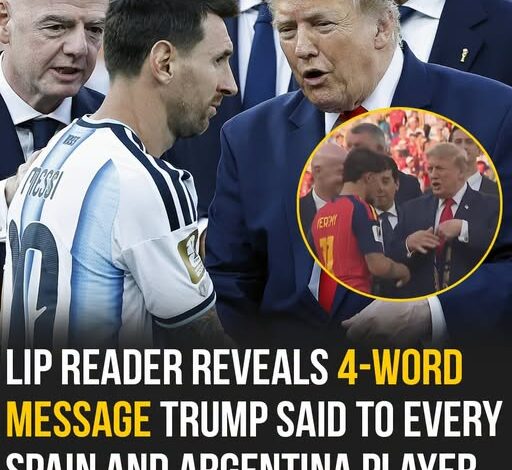
Spain’s World Cup victory should have been remembered for one thing alone.
The players.
The trophy.
The moment a lifetime of work finally became history.
Instead, part of the conversation shifted away from football and onto the medal ceremony, where a series of brief interactions involving U.S. President Donald Trump drew almost as much attention online as the match itself.
Standing alongside FIFA officials as the runners-up and champions received their medals, Trump greeted player after player with the same congratulatory message.
“You are a champ.”
It was a simple phrase, repeated as each footballer stepped forward.
Some players smiled politely before moving on.
Others appeared too emotionally overwhelmed to react much at all, their attention fixed on teammates, family members, or the trophy they had spent years chasing.
One interaction, however, quickly became the focus of social media.
Television footage appeared to show Argentina defender Cristian Romero passing Trump without acknowledging his outstretched hand, prompting widespread debate over whether the moment reflected a deliberate snub or simply the hurried pace and emotion of the ceremony. Neither Romero nor Trump publicly commented on the exchange, leaving viewers to draw their own conclusions.
The atmosphere inside the stadium added another layer to the evening.
As Trump entered the field for the presentation ceremony, sections of the crowd could be heard booing, while others applauded or remained focused on the celebrations. The mixed reaction briefly rose above the surrounding noise, illustrating how major sporting events can become stages not only for athletic achievement but also for public political expression.
Yet the most memorable images of the night were still waiting.
When Spain finally lifted the World Cup trophy, emotions erupted.
Players embraced.
Some collapsed to the ground.
Others screamed in celebration after years of sacrifice had culminated in football’s greatest prize.
For a few moments, however, attention drifted away from the players themselves.
Television cameras showed Trump remaining close to the celebrating squad as the trophy was raised, creating an unusual visual in what is traditionally a moment centered entirely on the champions. Footage then appeared to show FIFA President Gianni Infantino subtly encouraging him to step aside, allowing Spain’s players to occupy the center of the celebration. Neither FIFA nor the White House publicly characterized the interaction as anything unusual.
Whether viewers interpreted those images as an awkward misunderstanding or simply the natural choreography of a crowded medal ceremony depended largely on perspective.
What cannot be disputed is how quickly the clips spread.
Within minutes, social media platforms filled with slow-motion videos, screenshots, and competing interpretations. Supporters debated body language frame by frame, while commentators argued over whether politics had intruded on football’s biggest stage or whether the attention itself had magnified an otherwise ordinary sequence of events.
That conversation reflected a broader reality surrounding modern international sport.
The World Cup is no longer just a football tournament.
It is a global event where heads of state, celebrities, governing bodies, and billions of viewers converge. Every handshake, every expression, and every unscripted moment is captured from multiple angles and analyzed almost instantly.
Sometimes those moments reveal genuine significance.
Other times, they become symbols because millions of people choose to interpret them that way.
Meanwhile, Spain’s achievement remained extraordinary regardless of the surrounding headlines.
After navigating one of the world’s most demanding tournaments, they stood atop international football once again, earning the right to call themselves world champions through talent, discipline, and resilience over the course of the competition. That accomplishment, rather than the politics surrounding the podium, was ultimately the reason everyone had gathered in the first place.
In the end, the medal ceremony offered a reminder of how quickly attention can shift in the age of viral video.
A few seconds of footage generated days of discussion.
A congratulatory phrase, a handshake, the sound of the crowd, and a subtle movement on the podium all became subjects of worldwide debate.
But once the noise fades, the record books will remember something much simpler.
Spain won the World Cup.
The celebrations, the controversy, and every fleeting moment that surrounded them will remain part of the story—but the trophy belongs to the team that earned it on the pitch.