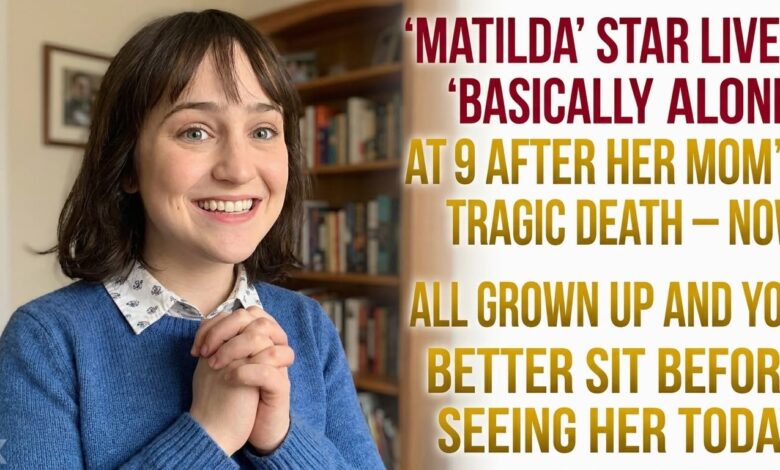
Mara Wilson was still a child when millions of people knew her face.
Before she was old enough to understand what fame could take from a person, Hollywood had already decided what it loved about her.
She was clever.
Expressive.
Funny.
Adorable.
Most importantly, she could carry a movie.
To audiences who grew up in the 1990s, Mara seemed to be everywhere. She appeared alongside Robin Williams in Mrs. Doubtfire, became the determined young heroine of Matilda, and starred in Miracle on 34th Street.
From the outside, it looked like the beginning of a remarkable Hollywood career.
But childhood fame has two versions.
There’s the version audiences see.
Then there’s the version the child has to live.
For Mara, those two realities became increasingly difficult to reconcile.
She had begun acting when she was very young, entering an industry where adults constantly evaluated children according to qualities children should never have to worry about.
Were they cute enough?
Were they charming enough?
Could they cry on command?
Would audiences love them?
Could they sell a movie?
As a young child, Mara fit comfortably into Hollywood’s idea of what a successful child actress should be.
Then she started growing up.
And Hollywood’s affection began to feel conditional.
That realization might have been painful under ordinary circumstances.
Mara was also carrying grief.
Her mother, Suzie Wilson, was diagnosed with breast cancer while Mara was still a child. She died in 1996, around the period when Matilda—the movie that would become one of Mara’s defining performances—was entering the world.
The contrast was brutal.
Professionally, Mara was experiencing something most young actors could only dream about.
Personally, she had lost her mother.
There were premieres, interviews, attention and expectations.
Behind all of it was a grieving child.
That grief did not disappear simply because cameras were present.
If anything, fame could make processing it more complicated.
The world still expected the recognizable little girl from the movies.
Mara was becoming someone else.
As she entered adolescence, she became increasingly aware of how Hollywood viewed appearance.
The qualities that had made her marketable as a child did not guarantee a smooth transition into teenage roles.
This is one of the cruelest patterns surrounding child stardom.
A young performer can be celebrated intensely for several years and then suddenly discover that the industry has changed its mind.
Nothing catastrophic necessarily has to happen.
The child simply grows.
Faces change.
Bodies change.
Voices change.
And an industry that once treated a young actor as exceptional can begin treating that same person as replaceable.
For Mara, acting increasingly stopped feeling like a place where she belonged.
Auditions weren’t exciting.
They became reminders that she was being measured against an image she no longer matched.
She has since spoken and written about the strange experience of growing up while surrounded by messages about attractiveness, desirability and marketability.
Imagine trying to understand your changing teenage body while knowing that strangers are professionally evaluating whether it is good enough for television or film.
Most adolescents already feel watched.
Mara actually was.
Eventually, she stepped away.
And that’s where the conventional Hollywood version of her story often gets things wrong.
It is tempting to describe a child star who disappears from major movies as someone whose career “failed.”
Mara Wilson’s story suggests something much more interesting.
She discovered another way to speak.
Writing.
On a film set, other people controlled much of the story.
Someone else wrote the dialogue.
Someone else chose the costume.
Someone else decided where she stood.
Someone else pointed the camera.
Someone else edited the finished version.
On the page, Mara controlled the frame.
That difference mattered.
She attended New York University’s Tisch School of the Arts and increasingly pursued writing, storytelling and performance outside the narrow structure of mainstream child stardom.
Eventually, she began publicly examining the very experience that had made her famous.
Not nostalgically.
Not bitterly.
But critically.
She wrote about what happens to children when millions of strangers become invested in an image of them.
She wrote about growing up.
About grief.
About anxiety and mental health.
About the strange machinery of celebrity.
About being considered adorable one year and insufficiently desirable a few years later.
Her memoir, Where Am I Now?: True Stories of Girlhood and Accidental Fame, offered something her childhood movies never could.
Mara Wilson explaining Mara Wilson.
That distinction is enormous.
For years, audiences had known characters she played.
Natalie.
Susan.
Matilda.
Now they could encounter the person who had existed behind those characters all along.
Her reflections also challenged one of Hollywood’s most persistent myths: that fame is automatically a gift.
For children especially, fame can become an identity assigned before they’re old enough to decide whether they want it.
Praise feels wonderful.
Attention can feel exciting.
But when a child’s sense of worth becomes connected to applause, box-office numbers, appearance or adult approval, growing up becomes complicated.
Because eventually the applause changes.
The question becomes:
Who are you when strangers stop celebrating the version of you they first loved?
Mara had to answer that question unusually early.
Her answer wasn’t to spend the rest of her life trying to become little Matilda again.
She allowed herself to become someone else.
A writer.
A storyteller.
A voice actor.
A playwright and performer.
A woman capable of looking back at childhood fame without allowing it to own everything that followed.
She didn’t completely abandon entertainment, either.
That is another important part of her story.
Walking away from Hollywood’s conventional star-making machine didn’t require rejecting creativity.
She could still perform.
She could still use her voice.
She could still participate in projects that interested her.
The difference was that acting no longer had to determine whether her life was successful.
That may be one of the healthiest decisions a former child star can make.
Hollywood loves comeback stories because they preserve the idea that returning to visibility is the ultimate victory.
Someone disappears.
Years pass.
Then they return triumphantly to the screen.
But what if returning isn’t the goal?
What if the victory is building a life where being recognized matters less than being understood?
Mara’s story becomes more powerful when viewed that way.
She didn’t need to prove that Hollywood had been wrong to stop seeing her as its ideal child star.
She needed to stop allowing Hollywood’s judgment to define what she saw in herself.
Writing helped her do that.
It gave her language for experiences that childhood fame had often forced her to swallow.
It allowed her to discuss grief instead of performing happiness through it.
It allowed her to discuss mental health without packaging pain into an inspirational movie ending.
And it allowed her to criticize an entertainment culture that can celebrate children intensely while offering them remarkably little preparation for what happens when that celebration ends.
There’s an uncomfortable lesson in that.
Audiences participate in the machinery too.
We call children adorable.
We memorize their lines.
We buy tickets.
Then they grow older.
Sometimes we mock how they’ve changed.
Sometimes we ask why they “disappeared.”
Sometimes we treat adulthood as though it were something a child star did wrong.
Mara Wilson survived that transition by refusing to spend her adult life auditioning for the affection she’d received as a child.
She chose something more durable.
A voice.
Her own.
The little girl audiences remember from Matilda grew up.
That was never the tragedy.
It was the point.
Mara didn’t disappear when the cameras moved elsewhere.
She simply stopped needing a camera to prove she was worth seeing.
And perhaps that is the real ending to the child-star story Hollywood rarely knows how to tell.
Not a comeback.
Not a collapse.
A person walking beyond the edge of the frame and discovering that an entire life was waiting there.