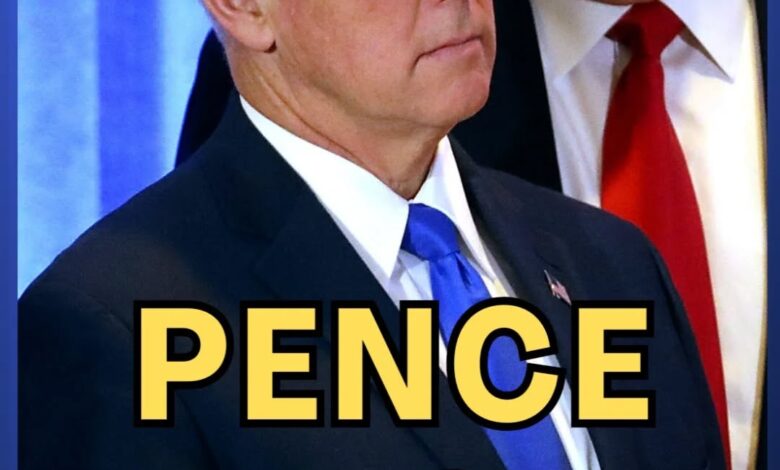
Mike Pence’s latest public break with Donald Trump is about far more than one compensation fund or one disagreement over Jan. 6. It is the continuation of a fracture that has never truly healed inside the Republican Party — a fracture rooted not simply in politics, but in memory, loyalty, power, and competing ideas of what conservatism is supposed to defend.
For years, many Republicans managed to avoid choosing sides fully. They praised Trump’s influence with voters while quietly distancing themselves from his rhetoric. They criticized Jan. 6 in cautious language while still avoiding direct confrontation with the movement that grew around it. But moments like this force clarity.
Because when Pence says people who assaulted police officers or stormed the Capitol should never receive taxpayer compensation, he is not merely debating policy. He is drawing a moral boundary. He is insisting that some actions remain unacceptable regardless of political allegiance, public anger, or later attempts to recast the participants as victims rather than perpetrators.
That matters because Pence himself occupies a uniquely painful place in the story of Jan. 6.
No senior Republican lived the contradiction of Trumpism more personally than he did. For four years, Pence stood beside Trump with near-unshakable loyalty, defending the administration through controversy after controversy. He played the role of disciplined institutional conservative alongside Trump’s chaos, often acting as the reassuring bridge between traditional Republicans and a presidency that constantly tested political norms.
Then Jan. 6 shattered that arrangement in the most public way imaginable.
As rioters stormed the Capitol, some chanting “Hang Mike Pence,” the vice president became something almost unthinkable within Trump’s political world: a target. Not because he betrayed conservatism, but because he refused to overturn the constitutional certification of the election. In that moment, Pence’s loyalty to institutional process collided directly with Trump’s demands for personal loyalty.
And perhaps that experience permanently altered how Pence now speaks about Jan. 6.
To Trump and many of his allies, the event has increasingly been reframed through the language of grievance and persecution. Defendants are described as political prisoners. Federal investigations become evidence of government overreach. Prosecutors, judges, and agencies are portrayed as instruments of a weaponized state targeting ordinary conservatives.
That narrative has become emotionally powerful within large parts of the Republican base because it transforms legal accountability into cultural victimhood. The people arrested after Jan. 6 are no longer presented simply as individuals who crossed legal lines. Instead, they are folded into a larger story about elites punishing dissent, silencing populism, and humiliating Trump supporters.
The proposed $1.8 billion compensation fund fits directly into that emotional framework.
It is not only about money.
It is symbolic recognition.
An attempt to redefine certain Jan. 6 defendants not as offenders, but as casualties of political persecution.
And that is exactly where Pence refuses to follow.
His opposition reveals a deeper philosophical divide now shaping the Republican Party’s future. One side increasingly organizes around Trump personally — his grievances, his enemies, his interpretation of events, his insistence that institutions themselves became corrupted against him and his supporters. In that worldview, loyalty becomes central. Defending Trump often means defending the people who acted in his name.
The other side still clings to older Republican ideals:
constitutional order,
institutional legitimacy,
law enforcement,
traditional conservatism rooted in process rather than personality.
Pence represents that older vision, even if its influence inside the party has weakened dramatically.
And perhaps that is why his comments carry such emotional tension. He is not speaking as an outside critic or liberal opponent. He is speaking as someone who once stood at the center of Trump’s administration and nearly died alongside lawmakers during the Capitol attack.
That experience gives his words unusual moral weight.
When Pence insists there must be a line separating peaceful political frustration from violence against police officers and attacks on democratic institutions, he is effectively arguing that conservatism cannot survive if it abandons all fixed principles in defense of one political figure.
But the difficulty for Pence — and for Republicans who share his view — is that the party’s emotional center has shifted profoundly since 2016.
Modern Republican politics increasingly runs on distrust:
distrust of media,
federal agencies,
courts,
elections,
career politicians,
and institutional authority generally.
Trump did not create all of that distrust, but he amplified and organized it into a political identity powerful enough to reshape the entire GOP.
Within that environment, Jan. 6 itself becomes contested territory.
Was it an insurrection?
A riot?
A protest that spiraled out of control?
A manipulated event?
A symbol of patriotic resistance?
A national disgrace?
How Republicans answer those questions increasingly determines which faction of the party they belong to emotionally.
For Pence, Jan. 6 remains a moral rupture. That distinction is critical.
He continues to frame it as a day when constitutional order was threatened and law enforcement officers were assaulted while carrying out their duties. In his view, no amount of political frustration justifies violence against police or attempts to stop the peaceful transfer of power.
That position once would have sounded entirely mainstream within Republican politics.
Now it often places him at odds with the loudest energy inside the party.
And perhaps that reveals the larger crisis underneath this debate.
The Republican Party is no longer only arguing about policy differences like taxes, spending, or foreign affairs. It is arguing about identity itself:
What defines loyalty?
What counts as patriotism?
Are institutions fundamentally broken or still worth preserving?
Does conservatism serve principles first, or movements and personalities first?
These are not temporary disagreements. They are existential questions.
Trump’s rise transformed Republican politics from a traditionally ideological movement into something more emotionally populist and personality-centered. That shift brought enormous electoral energy, but it also blurred older boundaries around rhetoric, institutional trust, and political conduct.
Pence’s resistance to compensating violent Jan. 6 offenders is, in many ways, an attempt to restore one of those boundaries.
He appears to be saying:
You can challenge elections legally.
You can distrust institutions.
You can criticize the government aggressively.
But once violence enters the picture — once police officers are beaten and the Capitol is stormed — the movement loses moral legitimacy.
Whether that argument still carries broad influence inside the GOP remains uncertain.
Trump continues to dominate Republican politics largely because many voters see him not simply as a politician, but as a vehicle for cultural rebellion against systems they believe failed them. To those supporters, criticism of Jan. 6 defendants can feel like criticism of the movement itself.
That emotional fusion makes internal dissent extraordinarily difficult.
Pence knows this personally.
His political standing within the party collapsed after Jan. 6 not because conservatives suddenly became liberal, but because many Trump supporters viewed his refusal to block certification as disloyalty. Constitutional process mattered less than perceived allegiance to Trump’s cause.
And yet Pence continues speaking anyway.
That persistence suggests something important:
he likely understands this battle as larger than his own political future now.
It is about historical definition.
How will Jan. 6 ultimately be remembered?
As justified resistance?
A tragic excess?
An unforgivable assault on democracy?
A manipulated political symbol?
The answer will shape not only Republican politics, but American political culture more broadly for years to come.
Because collective memory determines what future movements feel permitted to repeat.
If violent political acts become reframed primarily as martyrdom or patriotic sacrifice, the cultural barriers against future escalation weaken. If they remain morally condemned across party lines, institutional norms survive more intact.
That is the deeper stakes beneath this seemingly narrow argument over compensation funds.
Pence understands that symbolism matters.
Money communicates legitimacy.
Recognition.
Moral framing.
And in refusing to support compensation for violent offenders, he is trying to preserve a distinction he believes the country cannot afford to lose:
the difference between political grievance and political violence.
Whether the modern GOP ultimately follows his vision or Trump’s remains unresolved.
But one thing is increasingly clear.
The Republican Party is no longer merely debating strategy after Trump.
It is debating conscience.