Miley Cyrus Makes a Surprising Move After Her Godmother Dolly Parton’s Passing – Details & What the Public Is Saying About It Online

Grief can make a person retreat.
Miley Cyrus appears to be doing something more complicated.
She may be transforming.
In the space between public mourning and private heartbreak, Miley has offered only fragments of what Dolly Parton’s death has meant to her. Her tribute was deeply emotional, but it also drew a deliberate boundary around the parts of their relationship she would not surrender to public consumption.
Some memories, she made clear, belonged only to them.
That distinction felt important.
For most of Miley’s life, very little has remained private for long. She grew up before cameras, became famous while still a child, and spent adulthood watching each reinvention become a public debate.
Haircuts became headlines.
Performances became controversies.
Relationships became entertainment.
Even grief could easily become content.
But Dolly was different.
Aunt Dolly was not simply another famous person Miley loved.
She was godmother, mentor, defender, musical influence and something emotionally closer to a second mother.
So when Dolly died, Miley shared enough to let people understand the scale of the loss without opening every private room inside it.
Then, almost immediately, she went back to work.
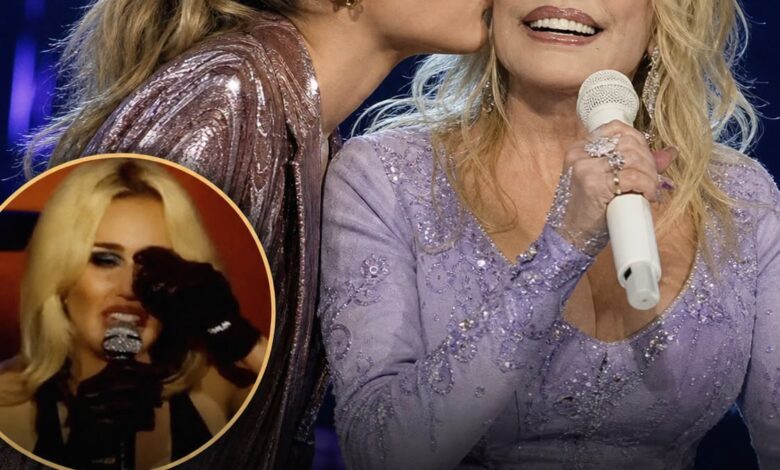
Photographs showed Miley entering a Los Angeles recording studio dressed in black, her face partly concealed, carrying a microphone.
The imagery was difficult to ignore.
She looked less like a celebrity arriving for a promotional appearance than someone trying to move through a day she simply had to survive.
Fans began studying the photographs.
Some focused on what appeared to be a new tattoo, wondering whether it might depict Dolly.
Perhaps it did.
Perhaps it did not.
Without confirmation from Miley, a blurry glimpse of ink cannot tell the whole story.
But the eagerness to believe it was Dolly revealed something about how fans were processing Miley’s grief.
They were searching for permanence.
A tattoo would make sense symbolically: someone gone from the physical world preserved on the body of someone who loved her.
But Miley may not need a portrait on her skin to carry Dolly forward.
The deeper mark is already there.
Dolly helped shape the artist Miley became.
She taught her something essential about survival in public: people will misunderstand you, criticize you, reduce you and occasionally decide they know you better than you know yourself.
Keep going anyway.
Make the song.
That philosophy may explain why Miley’s return to the studio felt less like business than instinct.
For musicians, grief often travels toward sound.
You cannot explain the loss, so you sing around it.
You cannot make someone return, so you build somewhere for the love to go.
Dolly understood that better than almost anyone.
She spent a lifetime transforming heartbreak, poverty, longing, faith and memory into music.
Miley walking into a studio after losing her therefore carried an almost inherited logic.
Pain arrives.
Go create.
Then came the red.
New images appeared saturated in a deep, almost overwhelming red. They were bold, stripped down and difficult to read as casual photographs.
And alongside them came another small detail that immediately generated questions.
The website no longer seemed interested in presenting “Miley Cyrus.”
Instead, there was simply:
MILEY.
One word.
No surname.
No explanation.
It could be exactly what it appears to be: branding.
Pop stars routinely redesign websites and social profiles before new music. A simplified name can signal an album cycle, visual concept or creative era without carrying any deeper autobiographical meaning.
But timing changes how symbols are received.
Coming alongside grief, studio photographs and an apparent visual reset, “MILEY” feels heavier than ordinary marketing.
Because Miley’s name has always contained a story.
She was born Destiny Hope Cyrus.
“Miley” grew from “Smiley,” a childhood nickname connected to the smile she wore so naturally as a little girl.
Eventually, Miley became more than a nickname.
It became her name.
Then her identity.
Then one of the most recognizable names in popular culture.
Removing “Cyrus,” even symbolically rather than legally, therefore creates an interesting impression.
It reduces everything to the word that emerged from childhood.
MILEY.
Before the controversies.
Before the reinventions.
Before adulthood turned identity into something she repeatedly had to defend.
There is something almost circular about that.
After spending years becoming different versions of herself, perhaps the next transformation is not about adding something.
Perhaps it is about stripping things away.
That does not necessarily mean rejecting her family name, her history or her father.
Branding should not automatically be turned into a family drama or legal declaration without evidence.
But artistically, the simplicity is striking.
Miley has reinvented herself many times.
The Disney star disappeared into a provocative young adult determined to destroy the boundaries of her childhood image.
That version evolved again.
Rock influences emerged.
Country returned in unexpected ways.
Glamour replaced deliberate chaos.
Her voice grew rougher, deeper and more central to the identity she presented.
Each transformation seemed to answer a different question:
Who am I now?
This moment feels different because the question may no longer be about escaping an old version of herself.
It may be about figuring out who remains after losing someone who helped her become herself.
Grief does that.
It does not merely remove another person.
It destabilizes pieces of your own identity.
If someone has always been your mentor, who are you when you can no longer call them?
If someone has always defended you, what happens when you must become your own shield?
If someone has always reminded you to keep going, eventually you have to hear their voice without them being there to speak.
That may be where Miley stands now.
Not abandoning Dolly.
Internalizing her.
The difference matters.
Dolly’s influence does not disappear because Dolly is gone. It becomes embedded in choices Miley makes without needing approval.
Write the song.
Enter the studio.
Keep moving.
Become whatever comes next.
That is why metamorphosis feels like the right word for this moment.
Metamorphosis is not pretending nothing happened.
Something did happen.
Something enormous was taken.
Transformation is what comes afterward.
The red photographs may eventually prove to be part of a straightforward album campaign.
The mysterious tattoo may have nothing to do with Dolly.
“MILEY” may simply be clever visual branding.
But taken together, these fragments create the image of an artist moving through grief by creating rather than explaining.
Perhaps that is the boundary Miley needs.
The private memories remain private.
The public receives the art.
Dolly would likely have understood that arrangement.
She spent decades turning real pain into songs without handing strangers every detail behind them.
You can reveal emotion without surrendering ownership of its source.
Miley appears to be learning the same lesson.
Grief has taken something from her that no new album, tattoo or reinvention can replace.
But grief does not get to decide everything that happens next.
She can.
So she walks into the studio.
The microphone comes with her.
The images change.
The name becomes simpler.
MILEY.
Not an explanation.
Not necessarily a goodbye.
Perhaps simply a declaration that after everything she has lost, she is still here.
Dolly taught her how to turn pain into music.
Now Miley has to discover what that music sounds like without Aunt Dolly standing beside her.
Grief took something away.
Metamorphosis is what Miley seems determined to give back.