Moment Venezuela earthquake strikes captured in horror footage as death toll could exceed 10,000

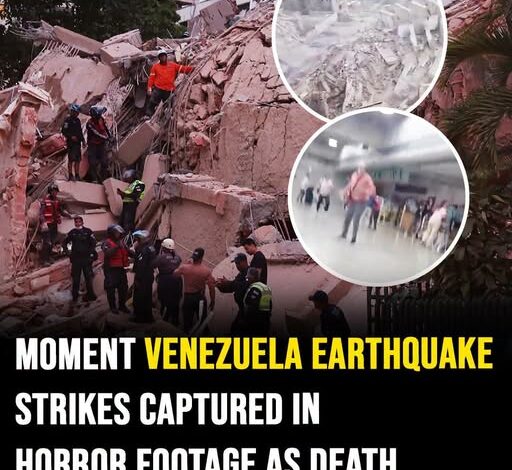
Venezuela is facing a humanitarian emergency after two powerful earthquakes struck the country’s northern region, leaving widespread destruction and thousands of people fearing what rescuers may still uncover beneath the rubble.
Communities closest to the epicenters suffered the greatest damage. Apartment buildings collapsed, homes were heavily damaged, roads cracked apart, and fires broke out in several areas as frightened residents rushed into the streets. Entire neighborhoods were transformed within minutes, replacing familiar skylines with piles of concrete, twisted metal, and dust.
Emergency officials have confirmed deaths and hundreds of injuries, but they continue to stress that the full extent of the disaster remains unknown. Search-and-rescue operations are still underway, and authorities expect casualty figures to change as crews gain access to the hardest-hit locations. Until every damaged building has been searched, the true human cost cannot be determined.
Every hour is critical.
Across the disaster zone, firefighters, civil defense teams, medical workers, and volunteers are working around the clock, carefully navigating unstable structures in the hope of finding survivors. Rescue dogs search through collapsed buildings while heavy equipment removes debris wherever conditions allow. In many places, however, crews must rely on hand tools and patience, listening for the faintest signs of life beneath the wreckage.
Along the northern coast, infrastructure has suffered significant damage.
Transportation routes have been disrupted, making it difficult for emergency responders to reach isolated communities quickly. Damage to public facilities has complicated relief efforts, while engineers continue assessing the safety of roads, bridges, and critical infrastructure before reopening them to traffic.
For thousands of families, home is no longer a safe place.
Many residents have spent the night outdoors in parks, stadiums, parking lots, and open fields, afraid that aftershocks could bring down buildings already weakened by the initial quakes. Schools have suspended classes in affected areas, and community centers, hotels, and public buildings are being used as temporary shelters for those who have nowhere else to go.
Inside these shelters, volunteers distribute food, drinking water, blankets, and medical supplies while helping families reconnect with loved ones separated during the chaos. Children cling to parents, elderly residents wait anxiously for news of missing relatives, and entire communities struggle to process how quickly ordinary life disappeared.
International assistance is beginning to arrive.
Several countries and humanitarian organizations have offered support, sending specialized search-and-rescue teams, emergency medical personnel, relief supplies, and equipment to assist local authorities. Trained rescue dogs, field hospitals, and disaster response specialists are joining Venezuelan emergency workers as the search continues.
The road to recovery will be long.
Even after rescue operations conclude, rebuilding homes, restoring essential services, repairing damaged infrastructure, and helping survivors recover emotionally will take months—perhaps years. Earthquakes leave scars that extend far beyond broken buildings, touching every family forced to rebuild after unimaginable loss.
Yet amid the devastation, stories of courage continue to emerge.
Neighbors are helping neighbors escape damaged homes. Volunteers are working through exhaustion to deliver supplies. Rescue crews refuse to stop searching, driven by the hope that another survivor might still be found beneath the debris.
In moments like these, statistics tell only part of the story.
Behind every damaged building is a family.
Behind every rescue is a community refusing to give up.
And as Venezuela confronts one of its most difficult moments, that determination may become one of its greatest sources of strength.