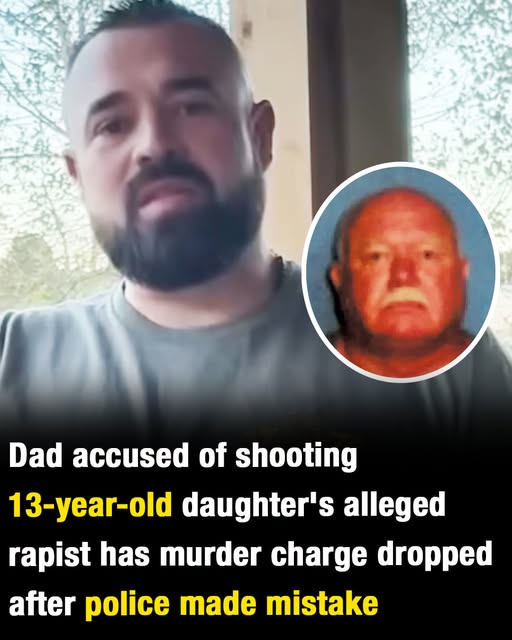
Murder Charge Dropped Against Father After Police Error in Case Involving Daughter’s Alleged Assailant

What began as a criminal case that captured headlines across Arkansas ended with a courtroom decision few expected.
Aaron Spencer, an Army veteran and recently elected sheriff candidate in Lonoke County, had spent months facing second-degree murder charges in the shooting death of 67-year-old Michael Fosler. The case drew intense public attention not only because of the fatal confrontation itself, but because of the circumstances that led to it. At the center of the controversy was Spencer’s teenage daughter and allegations that Fosler had previously been accused of sexually assaulting her.
For many observers, the case raised difficult questions about justice, parental protection, and the limits of lawful force. But in the end, it was not those questions that determined the outcome.
Instead, the case unraveled because of concerns over how critical evidence was handled.
The dramatic turn came when Judge Ralph Wilson Jr. dismissed the murder charge, effectively ending the criminal prosecution before it could ever reach a jury. The decision stunned many who had been preparing for what promised to be one of the state’s most closely watched trials.
According to court records, the events that triggered the case occurred late on the night of October 8, 2024.
Authorities alleged that Spencer discovered Michael Fosler alone with his teenage daughter inside a pickup truck in Lonoke County. What happened next would become the focus of months of legal battles.
Prosecutors claimed Spencer pursued Fosler’s vehicle, forced it off the road, and ultimately shot him. After the incident, Spencer reportedly contacted emergency services and acknowledged his involvement.
The shooting immediately sparked widespread debate.
Some viewed Spencer as a father reacting to a deeply emotional and disturbing situation involving his child. Others argued that regardless of the circumstances, the use of deadly force required careful legal scrutiny.
As investigators built their case, prosecutors charged Spencer with second-degree murder.
A jury trial was scheduled.
Witnesses were expected to testify.
Evidence was being prepared.
Then the focus shifted from the shooting itself to the investigation that followed.
At the heart of the controversy was a dash camera installed in Spencer’s vehicle.
According to defense attorneys, the camera may have recorded crucial footage from the encounter. If the footage existed, it could have provided valuable insight into the moments leading up to the shooting and potentially supported Spencer’s legal arguments regarding self-defense and protection of his daughter.
There was only one problem.
The internal SD card containing the footage was gone.
Court filings revealed significant concerns regarding how the evidence had been collected, stored, and documented by law enforcement. Defense attorneys argued that authorities failed to properly account for the memory card and could not adequately explain when or how it disappeared.
As hearings progressed, the missing evidence became increasingly important.
Spencer’s legal team maintained that the lost footage might have contained information critical to his defense. Without access to it, they argued, he was being deprived of the opportunity to fully challenge the prosecution’s version of events.
Judge Wilson ultimately agreed that the situation was serious.
In his ruling, he described the handling of the evidence as deeply problematic. He noted that dismissal of criminal charges is one of the most severe remedies available to a court and is rarely granted.
Yet he concluded that the circumstances justified exactly that outcome.
The judge determined that the loss of potentially important evidence created an unfair disadvantage for the defense and compromised Spencer’s ability to receive a fair trial.
His ruling effectively ended the murder case before jurors ever had the chance to hear it.
For Spencer and his supporters, the decision represented a major victory.
For prosecutors, it marked the collapse of a case they had spent months preparing.
The ruling also reignited public discussion about evidence preservation and accountability within law enforcement investigations.
While the legal battle centered on missing evidence, the facts surrounding the shooting continued to generate debate.
Court records indicated that Michael Fosler had previously faced multiple sexual offense charges involving Spencer’s teenage daughter. Reports also stated that Fosler was free on bond at the time of the fatal encounter.
Those allegations became a central part of the public conversation surrounding the case.
Although Spencer never denied shooting Fosler, he consistently maintained that his actions occurred within the context of protecting his child.
His attorneys argued that the case could not be viewed in isolation from the circumstances that led to the confrontation.
The defense further contended that the missing dash-camera footage may have provided crucial context about what occurred in those final moments.
Without that evidence, they argued, a fair trial became impossible.
The legal drama unfolded against the backdrop of Spencer’s growing political profile.
Months before the judge’s ruling, Spencer had entered local politics and successfully won the Republican primary for Lonoke County sheriff. His campaign emphasized law enforcement reform, transparency, and concerns about failures within the justice system.
Ironically, many of those themes became intertwined with his own criminal case.
During campaign appearances, Spencer spoke openly about his experiences with the legal system and argued that his case had exposed flaws in investigative procedures and evidence handling.
Supporters viewed him as someone fighting both a personal battle and a broader fight for accountability.
Critics, however, questioned whether his public profile influenced perceptions of the case.
As the legal proceedings continued, emotions remained high on all sides.
For Spencer’s family, the case involved not only a criminal prosecution but also deeply personal allegations involving his daughter. For Fosler’s family, the dismissal meant the case would never proceed to trial, leaving many questions unresolved.
Defense attorney Erin Cassinelli expressed relief following the judge’s ruling.
She argued that Spencer’s constitutional rights had been compromised and stated that no defendant should be forced to stand trial when critical evidence has been lost through investigative failures.
The prosecution had been preparing to present its case before a jury beginning June 22.
That trial will now never take place.
Instead, the case closes with a ruling that focuses less on the shooting itself and more on the integrity of the investigation that followed.
The decision has already become a point of discussion among legal analysts, law enforcement professionals, and community members throughout Arkansas.
Some see it as a necessary reminder that evidence must be handled carefully and transparently if justice is to be served.
Others believe the underlying questions surrounding the shooting remain unresolved.
What is clear is that the case has left a lasting impact on everyone involved.
Aaron Spencer entered the legal system facing a murder charge and the possibility of a jury trial that could have dramatically altered his future.
Instead, the case ended with a judge concluding that the investigation itself had been too flawed to move forward.
With the charges dismissed, Spencer now finds himself in a dramatically different position than he did just months ago.
Yet despite the legal outcome, the broader debates surrounding parental protection, criminal accountability, law enforcement procedures, and the pursuit of justice are likely to continue long after the courtroom proceedings have ended.
For many observers, the case serves as a reminder that criminal trials are not decided solely by what happened during an incident. They are also shaped by what happens afterward—how evidence is preserved, how investigations are conducted, and whether every party receives the fair process the justice system is meant to guarantee.
And in this case, according to the court, that process ultimately failed.