My 12-Year-Old Daughter Cut Off Her Hair for a Girl with Cancer – Then the Principal Called and Said, ‘You Need to Come Now and See What Happened with Your Own Eyes’

The call from the school came just as I was standing at the sink, rinsing out Letty’s cereal bowl and trying not to stare at the empty hook where Jonathan’s keys used to hang. That small, ordinary silence still felt louder than anything else in the house.
“Piper?” the principal said, his voice tight in a way that instantly made my chest lock. “I need you to come to the school right away.”
The bowl slipped from my hands and cracked against the porcelain.
“Is Letty okay?”
“She’s safe,” he said quickly—too quickly. “But there are several men here asking for her by name. They said they worked with your husband. My secretary got nervous. So did I.”
For a second, everything blurred.
Three months earlier, another careful voice had called to tell me Jonathan was gone. Since then, every unexpected phone call felt like the start of something breaking all over again.
“Who are they?” I asked.
“They mentioned the plant where Jonathan worked. When Letty heard his name, she refused to leave the office. Piper… everyone’s a little shaken. You should come now.”
The line went dead.
I stood there with the water still running, my mind racing ahead of me. Letty wasn’t home—her backpack gone, her shoes missing from the entryway. Jonathan was gone too. And fear, I had learned, didn’t wait for permission before moving in.
The night before, I’d found my daughter standing in front of the bathroom mirror, barefoot on the tile, holding a pair of kitchen scissors in one hand and a ribbon-tied bundle of hair in the other.
“Letty?” I said carefully. “What did you do?”
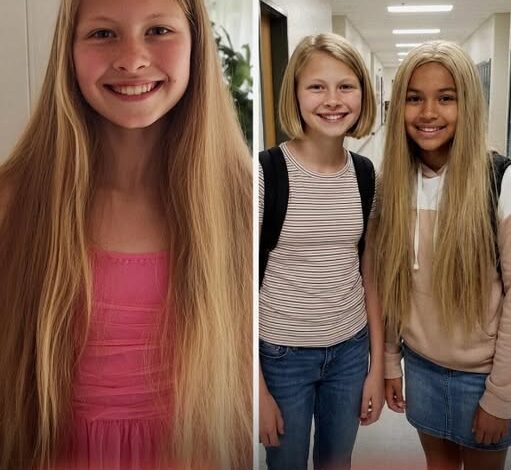
Her hair—once long and soft—was chopped unevenly to her shoulders. Jagged. Crooked. Her chin trembled as she looked at me.
“Please don’t be mad,” she said.
“I’m trying not to be,” I answered, stepping closer. “But you’re going to have to help me understand this.”
She swallowed hard. “There’s a girl at school. Her name’s Millie. She had cancer. She’s in remission, but her hair hasn’t really grown back yet.” Her voice cracked. “Some boys laughed at her today. She was crying in the bathroom. I heard her.”
She held up the bundle of hair like it mattered more than anything. “I looked it up. They can use real hair for wigs. Mine’s not enough by itself, but… it’s something.”
The room went quiet.
Jonathan had lost his hair in clumps on his pillow. Letty had watched it happen. She hadn’t forgotten. Neither had I.
I stepped forward, gently taking the scissors from her hand, and pulled her into my arms.
“No,” I whispered into her hair. “That wasn’t stupid. That was brave. Your dad would’ve been so proud of you.”
She cried for a moment, then sniffed and pulled back. “Can we fix it? I look like I got attacked by a lawnmower.”
We ended up at Teresa’s salon that night. Letty sat in a chair wrapped in a cape while Teresa examined the damage with a sigh that said everything.
Her husband, Luis, walked in halfway through and paused when he saw the hair tied with ribbon on the counter.
“What’s this?” he asked.
Before I could answer, Letty spoke. “A girl at school needs a wig.”
Luis studied her for a moment, then nodded slowly. “That sounds like something your dad would’ve cared about.”
Letty perked up. “You knew him?”
“Worked with him for years,” he said. “He talked about you all the time.”
Teresa shook her head lightly as she trimmed Letty’s uneven ends into something presentable. “He wouldn’t have approved of the haircut,” she teased.
“But he would’ve loved the reason,” Luis added.
That made Letty smile.
By the next morning, Teresa had already started working with donated hair to create a wig. It wasn’t just Letty’s contribution—but it was part of it. That mattered.
We picked up the wig before school.
“Do I look weird?” Letty asked, running a hand over her shorter hair.
“You look like you,” I said. “Just with less brushing involved.”
She grinned, then held the box carefully. “Do you think she’ll wear it?”
“I don’t know,” I admitted. “But she’ll know someone cared. And that counts.”
Two hours later, the principal called.
By the time I pulled into the school parking lot, my hands were slick against the steering wheel.
Mr. Brennan met me outside the office.
“They came in together,” he said quietly. “Work jackets, boots. Asking for Letty by name. It startled everyone.”
“Why is my daughter in there with them?” I asked, already moving.
“Because the moment they said Jonathan’s name,” he replied, “she wanted to stay.”
He opened the door.
And everything inside me shifted.
Letty stood near the window, her hands covering her mouth. Beside her sat a thin girl with a pale face—Millie—wearing the wig.
It fit her beautifully.
Behind her, her mother cried quietly into a tissue.
And on the desk, like it had always belonged there, sat Jonathan’s old yellow hard hat. His name still marked the inside. The purple sticker Letty had added years ago still clung to it.
Six men stood around the room—large, quiet, unsure where to put their hands or their eyes.
Luis stepped forward first.
“Piper.”
My voice shook. “Why is that here?”
Another man—Marcus, Jonathan’s old supervisor—held out an envelope.
“He left this in his locker,” Marcus said. “Told us if the right moment came, we’d know. Yesterday, we heard what Letty did. We figured… this was it.”
My name was written across the front in Jonathan’s handwriting.
I could barely breathe.
“He talked about you both constantly,” Marcus added. “We knew about Letty’s soccer games, your cooking, everything.”
Then he placed a check on the desk.
“When he got sick, he started a fund at work. For families dealing with cancer bills. Said nobody should go through that alone.” He glanced at Millie and her mother. “We think he knew who it was for.”
Millie’s mom shook her head through tears. “I can’t accept that.”
“You can,” I said softly. “Because that’s exactly why he made it.”
The room fell quiet.
Letty looked around at all of them. “You came because I cut my hair?”
One of the men wiped his eyes. “No, kid. We came because that’s exactly what your dad would’ve done.”
Later, in the hallway, I finally opened the letter.
“Piper,” it began. “If you’re reading this, it means someone kept a promise for me.
I know you. You’ve been carrying too much and telling everyone you’re fine.
If Letty ever does something that reminds you who we are—don’t shut that feeling down. Let people show up for you.
Love doesn’t stop. It just finds different ways to reach you.
—Jon”
I pressed the paper to my chest.
Outside, the air felt sharper, clearer.
Millie stood beside her mother, one hand resting lightly against her shoulder like she needed to stay connected.
“Dinner tonight,” I said.
They both blinked at me.
“I mean it,” I added. “No excuses.”
Millie looked at Letty. “Can I come?”
“Only if you stop hiding in the bathroom,” Letty said.
Millie smiled. “Only if you stop cutting your own hair.”
“Deal.”
We all laughed—a little broken, but real.
On the drive home, Letty held Jonathan’s hard hat carefully in her lap.
“Do you think Dad would’ve cried today?” she asked.
I smiled through tears. “Definitely. Then he would’ve denied it.”
He wasn’t there with us.
But somehow, through our daughter—through her kindness, her courage—he still found a way back into the room.