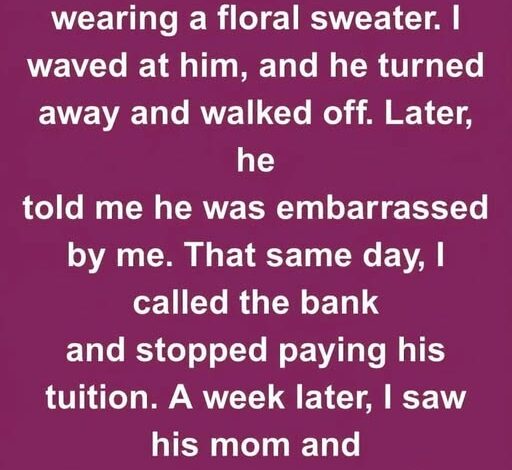
For years, she believed that love meant always saying yes.
Yes to another tuition payment.
Yes to another unexpected expense.
Yes to one more sacrifice that could wait because family came first.
She gave freely, convinced that generosity was the language through which love was best expressed. She never kept score, never asked for recognition, and rarely questioned whether the help she offered was still helping at all.
Then, quietly, something changed.
Not because she stopped loving her family.
Because she finally realized she had stopped protecting herself.
When she decided to stop paying her grandson’s tuition, there were no dramatic confrontations.
No slammed doors.
No raised voices.
She simply closed her checkbook.
To those around her, the decision seemed sudden.
To her, it had been years in the making.
Every overlooked boundary, every expectation treated as obligation, every moment when gratitude quietly gave way to entitlement had led to that single choice.
It wasn’t punishment.
It was self-preservation.
For the first time, she placed her own dignity alongside everyone else’s needs instead of beneath them.
The silence that followed spoke volumes.
Sometimes people don’t notice how much someone has been giving until the giving stops.
The absence of expectation exposed patterns that had been hidden beneath routine.
Then came another painful discovery.
Family jewelry—pieces passed down through generations, carrying memories far more valuable than their monetary worth—had been pawned without her knowledge. These weren’t simply objects of gold or silver.
They were wedding gifts.
Anniversary keepsakes.
Tokens of love that had survived decades.
Learning they had been treated as something easily exchanged for cash cut deeply.
It wasn’t only the loss of the jewelry that hurt.
It was what the decision seemed to say.
That sentiment could be discarded when money became scarce.
That sacrifice was easier to spend than to honor.
The betrayal could easily have hardened her heart.
Instead, she chose a more difficult path.
She refused to plead.
She refused to negotiate away her boundaries simply to restore temporary peace.
But she also refused to let resentment become the defining feature of her remaining years.
Boundaries and bitterness are not the same thing.
One protects.
The other consumes.
She chose protection.
She hoped her family would eventually understand that genuine relationships cannot be sustained by financial dependence alone. Love expressed only through money becomes fragile because it disappears the moment the payments stop.
The strongest family bonds are built on something far more durable.
Mutual respect.
Honest gratitude.
Shared responsibility.
Care that flows in more than one direction.
Holding firm did not mean closing the door forever.
It meant changing the conditions under which it could be opened again.
If her family returned, she wanted it to be because they valued her presence—not her financial support.
Because they wanted conversation, not transactions.
Connection, not convenience.
That distinction changed everything.
Perhaps the greatest lesson was one she wished she had learned years earlier.
Healthy generosity always leaves room for healthy boundaries.
You can love deeply without sacrificing your self-respect.
You can forgive without abandoning wisdom.
And you can leave the door open without allowing yourself to be walked through.
In the end, the greatest gift she gave her family wasn’t another check.
It was the opportunity to rediscover a relationship built not on obligation, but on appreciation.
Whether they accepted that invitation was a choice only they could make.
But for the first time in a very long while, she knew she had honored someone who had been waiting patiently for years to be seen.
Herself.