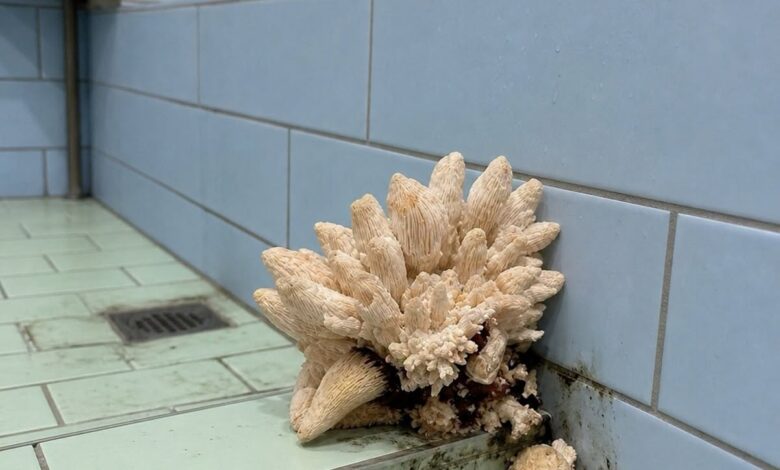
The first thing I wanted to do was close the bathroom door.
Not investigate.
Not clean.
Not take a photograph.
Just close it, walk away, and pretend the pale branching thing growing beside the wall had not been there when we came home.
“What is that?”
“I don’t know.”
“Is it alive?”
That was exactly the question I didn’t want anyone asking.
We had been away long enough for the house to feel abandoned when we returned. The air was stale. The rooms were unusually still. Even familiar smells seemed slightly wrong after days away.
I had expected dust.
Maybe a forgotten garbage bag.
Possibly one very dead houseplant.
I had not expected the bathroom to grow something.
The strange formation spread outward from the edge of the floor near the wall. From the doorway it looked almost beautiful—white, branching, intricate.
Like coral.
Except coral belonged beneath clear blue water, not beside our bathroom tiles.
“Don’t touch it,” I said.
“I wasn’t going to.”
“You were getting closer.”
“So are you.”
That was true.
Disgust and curiosity were fighting, and curiosity was winning.
We crouched several feet away.
Up close, it became even stranger.
The branches weren’t as rigid as they had appeared from the doorway. Some edges looked soft, almost feathery. Other sections seemed thicker where the growth met the floor.
For one ridiculous second, I imagined it pulsing.
I knew that was probably my imagination.
Probably.
Still, I moved backward.
The most disturbing part wasn’t what it looked like.
It was imagining what had happened while we were gone.
The bathroom door closed.
The room humid.
Nobody walking through.
Nobody opening windows.
Nobody noticing a damp patch spreading.
And somewhere in that darkness, something had begun growing.
We did what almost everyone does when confronted with a mysterious household horror.
We searched the internet.
“White branching fungus bathroom.”
“Coral mold tile floor.”
“White fungus growing from wall.”
“Bathroom growth looks like sea coral.”
Each search made us simultaneously more informed and more terrified.
There were photographs of fungi.
Molds.
Mineral deposits.
Mycelial growth.
Mushrooms emerging from walls.
Water-damaged floors being torn apart.
Every picture looked vaguely similar until we compared the details.
“This one.”
“No.”
“That looks exactly like it.”
“It really doesn’t.”
“What about this?”
“That’s growing on a tree.”
“So?”
“Our bathroom isn’t a tree.”
Eventually, we realized we were trying to answer the wrong question.
We wanted a name.
What we needed was a cause.
Whatever the strange material actually was, one fact mattered more than our amateur identification:
Something around that section of the bathroom was damp.
And apparently it had remained damp long enough for visible growth to develop.
That changed the mood.
The bizarre white structure stopped feeling like an inexplicable creature that had invaded our house.
It became evidence.
Evidence of moisture.
We inspected the room more carefully without disturbing the growth.
Around the tub.
Beneath the sink.
Behind the toilet.
Along the grout.
Then we noticed discoloration near the base of the wall.
It was faint.
The kind of thing I might have ignored completely if the coral-like growth hadn’t forced me to look.
Suddenly, the visible growth wasn’t the part that frightened me most.
The wall was.
Had water gotten behind it?
Was something leaking?
How long had the area been damp?
How far did the moisture extend beyond what we could see?
Our original plan had been wonderfully primitive.
Put on gloves.
Put on masks.
Scrape the disgusting thing away.
Clean everything aggressively.
Declare victory.
But the more we learned, the less intelligent that seemed.
A photograph alone couldn’t reliably tell us exactly what species or material we were dealing with. And if it was fungal growth associated with persistent moisture, attacking the visible portion without addressing the dampness would miss the larger problem.
Worse, aggressively scraping unidentified growth could disturb particles and spread material unnecessarily.
So we slowed down.
That turned out to be the most useful thing we did.
We documented what we found before disturbing anything.
We kept children and pets away from the area.
We looked for obvious sources of water.
And we resisted the internet’s favorite home-maintenance strategy: combining increasingly powerful chemicals until the smell convinces you something important must be happening.
Cleaning products aren’t interchangeable, and mixing certain household cleaners can create dangerous fumes.
The goal wasn’t to wage chemical warfare against the bathroom.
It was to understand why something had been able to grow there.
For a small, limited area on an appropriate hard surface, careful cleaning may sometimes be manageable. But significant, recurring, concealed, or unexplained growth—especially where water damage may extend into porous building materials—is a different situation and can warrant professional inspection or remediation.
That distinction mattered because our fear kept pushing us toward immediate action.
Fear likes visible solutions.
Scrape it.
Spray it.
Throw it away.
Problem gone.
Moisture problems don’t always cooperate with that kind of ending.
You can remove what you see and leave behind the conditions that created it.
Then the bathroom looks clean.
Until it isn’t.
By evening, the room had stopped feeling like a horror-movie set.
Mostly.
We had taken sensible precautions, dealt only with what we could safely address, and made plans to investigate the moisture rather than assuming removing the strange formation ended the problem.
But I kept thinking about the days we had been away.
Homes feel permanent because most of their changes happen too slowly for us to notice.
We leave a room and assume it waits for us.
Same walls.
Same floor.
Same towels.
Same toothbrush beside the sink.
But a house doesn’t pause when its owners leave.
Water keeps moving.
Pipes remain under pressure.
Humidity rises and falls.
Sealants age.
Wood absorbs moisture.
Tiny leaks spread.
Microorganisms respond to whatever environment we accidentally provide.
The house keeps happening.
Standing in that bathroom doorway later that night, I looked at the photographs on my phone.
The growth was strangely beautiful when separated from the knowledge that it had appeared inside our home.
Its branching structure really did resemble something from the ocean.
For hours, we had treated that resemblance as the mystery.
What kind of fungus looks like coral?
Eventually, I realized that wasn’t the most important question.
The important questions were much less dramatic.
Why was this area wet?
How long had it stayed wet?
Was moisture hidden behind the surface?
Would the growth return?
Could we safely deal with it ourselves, or did the extent of the problem require someone qualified to inspect it?
Those questions weren’t exciting enough for a viral internet post.
They were far more useful.
I no longer needed the growth to have a frightening name.
I needed the bathroom to become dry.
That distinction turned horror into something manageable.
Not everything strange growing in a damp room is automatically a dangerous “toxic mold.” Not every white branching formation can be identified from appearance alone. And discovering unusual growth doesn’t necessarily mean an entire home is contaminated.
But persistent moisture deserves attention.
Because sometimes the visible thing is merely the announcement.
The real problem is hiding underneath.
I looked into the bathroom one last time before turning off the light.
When we’d arrived home, I thought we had discovered something alien.
By bedtime, I understood that what frightened me was almost the opposite.
There was nothing supernatural about it.
Something had found moisture, darkness, time, and an opportunity.
While we were away living our lives, the conditions inside one forgotten corner of our home had quietly changed.
And the house had responded.
That was the thought I couldn’t shake.
We think our homes remain exactly as we leave them.
They don’t.
Even behind a closed bathroom door, life, water, decay, and time keep moving.
Sometimes we only notice when we come home, switch on the light, and discover what the darkness has been doing without us.