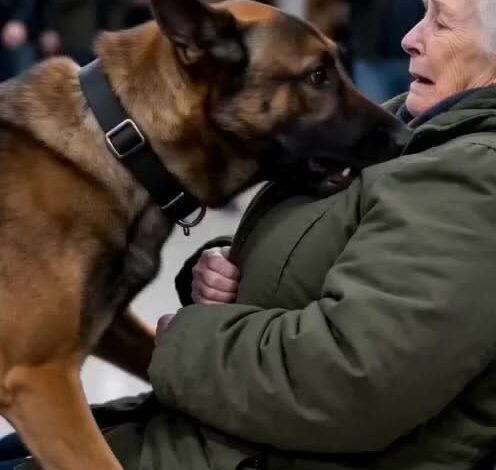
What began as a routine morning at one of the city’s busiest transit terminals quickly transformed into an extraordinary rescue that few who witnessed it would ever forget.
The South Terminal was operating as it always did. Travelers hurried between gates, rolling suitcases echoed across the concourse, and overhead announcements blended into the constant hum of movement. Business travelers sipped coffee while checking schedules, families gathered near departure boards, and commuters rushed to catch connections.
Amid the controlled chaos, Officer David Vance and his K9 partner, Rook, were conducting a standard security patrol.
Nothing seemed unusual.
At least, not at first.
Rook, a highly trained four-year-old Dutch Shepherd specializing in detection and tracking, moved calmly beside his handler as they followed their regular inspection route through the terminal. The dog had worked countless shifts in crowded environments and rarely reacted without reason.
Then everything changed.
Without warning, Rook stopped.
His body stiffened.
His ears locked forward.
His attention focused on something across the terminal.
Officer Vance immediately noticed the shift.
Years of working together had taught him to recognize even the slightest change in the dog’s behavior. This wasn’t curiosity. It wasn’t distraction.
It was an alert.
Rook suddenly pulled hard against the leash, his eyes fixed on a seating area near Gate 4.
“Easy, boy,” Vance said calmly.
The command had no effect.
The dog’s focus only intensified.
Within seconds, Rook surged forward.
Passengers jumped aside as the powerful Shepherd moved through the crowd with determination. Confusion spread instantly as travelers turned to see what had triggered the sudden reaction.
The dog headed directly toward an elderly woman seated alone near a row of terminal windows.
Before anyone could react, Rook reached her.
Gasps echoed through the terminal.
The dog pressed against the woman and positioned himself beside the bench, preventing her from moving away.
The woman screamed.
Several nearby travelers immediately assumed the worst.
“What is that dog doing?”
“Get him off her!”
“Control your dog!”
Voices erupted throughout the terminal.
Phones appeared almost instantly.
People began recording.
To anyone watching from a distance, it looked like a police dog had suddenly become aggressive toward an innocent traveler.
But Officer Vance wasn’t looking at the crowd.
He was looking at Rook.
And what he saw didn’t match the panic unfolding around them.
The dog wasn’t barking.
He wasn’t growling.
He wasn’t showing his teeth.
There was no aggression in his posture.
Instead, Rook remained focused on a single area of the woman’s body: her oversized green winter coat.
The observation struck Vance immediately.
The terminal was warm.
Most travelers had removed heavy outerwear hours earlier.
Yet the woman remained wrapped tightly in a thick winter coat, clutching it close to her chest.
Something about it seemed unusual.
Then he noticed movement.
A slight shift beneath the fabric.
Subtle.
Almost impossible to see.
But enough to catch his attention.
Rook lowered his head and moved closer.
A low whine escaped from the dog’s throat.
Not a warning.
A detection signal.
The officer’s mind immediately returned to a briefing he had attended only days earlier.
A missing child.
Three-year-old Maya Reynolds.
An Amber Alert had been issued after investigators believed the child had been taken during a custody dispute.
Authorities suspected she could be transported through public transit systems where crowds offered anonymity and opportunities to avoid detection.
One identifying detail had stood out during the briefing.
Maya wore a bright pink cochlear implant on her right ear.
The detail had stayed with him.
Now, standing in the middle of the terminal, surrounded by shouting passengers and mounting pressure, that memory suddenly felt important.
The crowd continued growing more agitated.
Additional officers arrived.
Captain Miller pushed through the gathering crowd and quickly assessed the scene.
“What is going on?” he demanded.
“Rook alerted,” Vance replied.
The captain glanced at the woman, then at the increasingly angry travelers surrounding them.
“Pull the dog back,” he ordered.
“Now.”
The situation was becoming public and volatile.
One wrong decision could create legal consequences, media scrutiny, and public backlash.
Officer Vance understood the risk.
But he also understood his partner.
Rook had never given a false alert like this.
The dog remained completely focused.
Completely certain.
Then it happened.
A sound.
So faint that it almost disappeared beneath the terminal noise.
A soft cry.
Muffled.
Weak.
But unmistakably human.
The crowd fell silent.
Every head turned.
The woman froze.
Her hands tightened around the coat.
Officer Vance heard it again.
A child’s cry.
Coming from inside the coat.
The atmosphere changed instantly.
The anger vanished.
Confusion became shock.
Slowly, carefully, officers moved closer.
The woman looked around nervously before lowering her head.
Then, after a long moment, she unzipped the coat.
What everyone saw left the terminal speechless.
Hidden beneath layers of fabric was a small child secured inside a concealed carrier strapped against the woman’s chest.
The toddler looked exhausted and frightened.
Her face was partially hidden.
Then she turned slightly.
And there it was.
A bright pink cochlear implant attached to her right ear.
Maya.
The missing child stood at the center of a nationwide search effort.
For several seconds, nobody spoke.
Passengers who had moments earlier been criticizing the officer and his dog simply stared.
Phones slowly lowered.
The realization spread across the terminal.
Rook had been right.
Emergency responders rushed forward.
The child was carefully removed and evaluated by medical personnel while officers secured the suspect.
Throughout the entire process, Rook remained calm.
The dog stepped back beside Officer Vance and quietly watched as the rescue unfolded.
No aggression.
No excitement.
Just the steady focus of a partner who had completed his task.
As Maya was carried to safety, many of the same travelers who had criticized the dog now applauded.
Some wiped away tears.
Others simply stood in stunned silence.
Captain Miller approached Vance and looked down at Rook.
For a moment, neither man spoke.
Then the captain nodded.
“Good call,” he said quietly.
Officer Vance glanced at his partner.
Rook sat calmly at his side, seemingly unaware of the attention surrounding him.
For the dog, it had simply been another alert.
Another scent.
Another job completed.
But for Maya and her family, it meant everything.
In the days that followed, the story spread throughout the region. News reports highlighted the remarkable detection that led to Maya’s recovery, and many praised the role of working K9 units in protecting vulnerable people.
Yet for Officer Vance, the lesson was simpler.
Trust matters.
Training matters.
And sometimes, when chaos, pressure, and public opinion all point in one direction, the courage to trust a loyal partner can change a life forever.
What began as a routine patrol ended as a rescue.
A missing child was brought home.
A family was reunited.
And a remarkable police dog reminded everyone that heroes do not always wear badges.
Sometimes they walk on four legs.