Dolly Parton spent decades doing something increasingly rare in American public life: refusing to let either political side claim her.
She had opinions.
She had values.
She supported causes.
But she understood that there was a difference between caring about the country and becoming a political mascot.
That boundary was deliberate.
Dolly’s audience crossed almost every imaginable division—Republican and Democrat, rural and urban, religious and secular, conservative and progressive. People who could barely agree on anything could somehow agree on Dolly.
She protected that unusual position carefully.
Even prestigious political recognition could become complicated.
When the Presidential Medal of Freedom entered the conversation, Dolly explained that she had declined opportunities connected with both Donald Trump and Joe Biden. Whatever the circumstances surrounding those decisions, she was clearly sensitive to the possibility that accepting a presidential honor could be interpreted as choosing a political team.
That was precisely the kind of symbolism she spent a lifetime avoiding.
“I’ve got fans on both sides,” was essentially the philosophy behind her restraint.
Her job, as she saw it, was not to tell them how to vote.
It was to give them music.
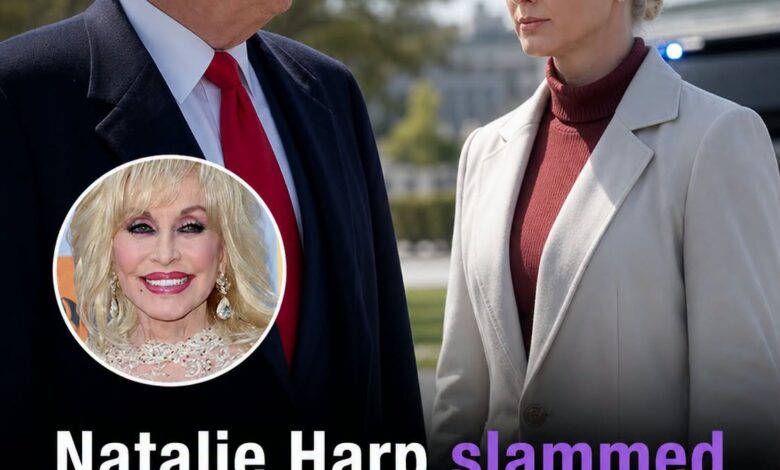
That history is what made an AI-generated image linking Dolly posthumously with Trump feel so jarring to many people.
The problem was not simply that the picture was artificial.
It was what the artificial image appeared to do.
It placed a dead woman inside a political narrative she could no longer accept, reject, clarify or joke her way out of.
Dolly could set boundaries while she was alive.
She could redirect interview questions.
She could decline invitations.
She could explain that she loved everybody and did not want to participate in partisan warfare.
Death removes that ability.
Artificial intelligence can now put it back—but falsely.
That is the disturbing part.
A sufficiently convincing synthetic image can make a person appear to participate in a moment that never happened.
It can manufacture an embrace.
A handshake.
An endorsement.
A friendship.
A symbolic alliance.
And once the person depicted is dead, there is no possibility of asking:
“Did you agree to this?”
For Dolly, whose political caution was itself part of her public identity, that question carries particular weight.
She did not spend decades refusing to become a partisan trophy because she had nothing to say.
She did it because she wanted control over what her name represented.
That distinction matters.
Neutrality can itself be a choice.
Refusing to endorse someone can be a boundary.
Declining to participate in political theater can be an expression of agency.
An AI image can erase all three in seconds.
The backlash therefore extended beyond whether the tribute looked tasteful.
Criticism focused heavily on Natalie Harp, the Trump aide widely nicknamed the “human printer” because of her unusually close role handling printed material and reportedly assisting with the president’s social-media operation.
Online reaction was brutal.
“Fake.”
“Gross.”
“Pathetic.”
Those words reflected anger, but beneath the insults was a more interesting concern.
Who gets to control the image of someone who can no longer control it themselves?
Celebrity estates have wrestled with versions of that question for decades.
Dead musicians appear in advertisements.
Actors are digitally recreated.
Unreleased recordings are completed.
Holograms perform on stages.
Old photographs are repurposed for causes the subject never encountered.
But generative AI changes the scale of the problem.
It no longer merely recycles something a person actually did.
It can manufacture something they never did at all.
That is a profound difference.
Imagine a photograph of Dolly standing beside a politician.
If the photograph is genuine, it proves only that they stood together at a particular moment.
Context would still matter.
But an AI-generated photograph proves something entirely different:
Someone wanted viewers to imagine that moment.
The image is evidence of the creator’s intention, not Dolly’s.
That distinction becomes especially important when politics enters the frame.
Political imagery is rarely neutral.
Who stands beside whom matters.
Who smiles matters.
Who appears embraced, admired or endorsed matters.
Campaigns have understood that power since long before computers could manufacture photographs.
Now a public figure does not even need to have attended the event.
They do not need to have posed.
They do not need to have agreed.
They do not even need to be alive.
Their likeness is enough.
That should make everyone uncomfortable regardless of political affiliation.
Today the synthetic image may feature a celebrity someone loves beside a politician they dislike.
Tomorrow the alignment could reverse.
The ethical principle should remain the same.
Dead people cannot consent to new political endorsements.
And audiences deserve to know when the image in front of them depicts an event that never occurred.
That does not mean AI-generated satire, art or obvious fantasy must disappear.
Context changes everything.
A clearly labeled illustration is one thing.
An image presented or circulated in a way that encourages viewers to treat a fabricated scene as emotionally meaningful reality is another.
The danger increases when people encounter it quickly.
Social media trains users to react before examining.
The photograph appears.
The emotional message lands.
Only afterward—if ever—does someone notice that the scene was generated.
By then the association has already been created.
Dolly plus Trump.
Or Dolly plus Biden.
Or Dolly plus any political figure.
The image has accomplished something Dolly herself repeatedly resisted:
It has placed her inside somebody else’s partisan story.
That is why this debate is larger than one aide, one president or one AI tribute.
It is about what happens to consent after death.
For generations, photographs carried at least one basic assumption: the people pictured had, at some point, physically occupied the scene.
That assumption can no longer be taken for granted.
A photograph-looking image may depict nothing that ever existed.
No meeting.
No handshake.
No room.
No camera.
No moment.
And when synthetic images involve the dead, the ethical burden should arguably become heavier, not lighter.
They cannot correct the record.
They cannot withdraw permission.
They cannot say, “Please don’t use me that way.”
All that remains is what they said and did while alive.
In Dolly’s case, that record matters.
She spent a lifetime building bridges without allowing those bridges to become campaign platforms.
She could joke with presidents.
Meet politicians.
Accept audiences across ideological lines.
Support causes.
And still insist that her music belonged to people who disagreed with one another.
That was not accidental.
It was part of the trust she built.
Perhaps respecting Dolly’s legacy therefore requires something remarkably simple:
Do not make her say things she never said.
Do not make her stand where she never stood.
Do not manufacture political intimacy she never chose.
And do not confuse the technical ability to recreate someone’s face with permission to rewrite their choices.
The rhinestones were Dolly’s.
The songs were Dolly’s.
The opinions she shared—and the ones she deliberately kept private—were Dolly’s too.
AI can imitate her smile.
It can reproduce the hair.
It can place her beside almost anyone.
But it cannot manufacture her consent.
And in an age when even the dead can be digitally recruited into political battles, protecting that distinction may be one of the last meaningful ways we have left to protect the truth.