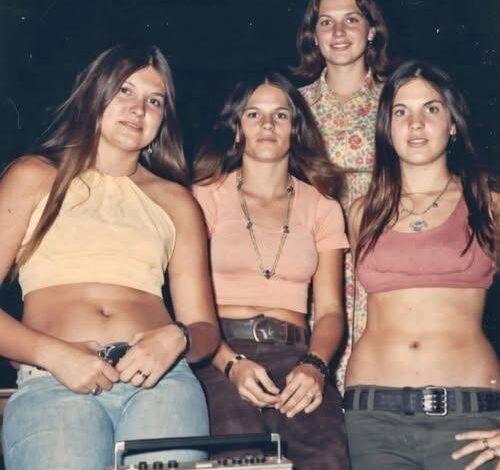
At first glance, it looks like an ordinary photograph.
Four young women standing side by side.
No dramatic poses.
No carefully calculated expressions.
No obvious attempt to impress anyone.
Just a simple moment captured in time.
Yet something about the image feels strangely powerful.
The longer you look, the more difficult it becomes to look away.
Not because of what the photograph contains.
But because of what it doesn’t.
There are no filters softening every feature.
No editing tools removing every wrinkle, freckle, or imperfection.
No carefully engineered image designed to attract attention, generate engagement, or compete for approval from strangers.
What you see is exactly what was there.
Nothing more.
Nothing less.
And in today’s world, that kind of honesty feels almost rare.
The women in the photograph aren’t performing for an audience.
They aren’t trying to become a version of themselves.
They already are themselves.
Their smiles don’t seem rehearsed.
Their confidence doesn’t feel manufactured.
There is no sense that they’re calculating how the image will be received or wondering whether it will measure up to impossible standards.
Instead, there is something much simpler.
They look comfortable.
Comfortable with each other.
Comfortable with the moment.
Comfortable in their own skin.
That quiet confidence may be the most striking thing about the entire photograph.
Modern culture often teaches people that confidence comes from perfection.
The perfect body.
The perfect outfit.
The perfect angle.
The perfect life.
Yet images like this suggest something very different.
They remind us that real confidence often appears when perfection is no longer the goal.
The photograph feels like a glimpse into a time when people experienced life first and documented it second.
Pictures were taken to preserve memories.
Not to create personal brands.
Not to build online identities.
Not to gather approval from people they would never meet.
Photographs served a different purpose.
They captured moments.
Birthdays.
Vacations.
Friendships.
Ordinary afternoons.
The value of the image came from the memory itself, not from the reaction it might receive later.
That difference changes everything.
Today, a photograph is often viewed through multiple layers of expectation.
How many likes will it receive?
Will people approve?
Does it look polished enough?
Is it flattering enough?
Will it compare favorably to countless other images competing for attention?
Those questions rarely existed in the same way for previous generations.
People smiled because they were happy.
They laughed because something was funny.
They stood together because they enjoyed each other’s company.
The photograph was simply evidence that the moment happened.
Nothing more complicated than that.
The clothing, hairstyles, and fashion choices in the image clearly belong to another era.
But those details are not what makes the photograph feel different.
What stands out is the atmosphere.
There is an ease to it.
A lightness.
A sense that nobody is carrying the invisible weight that often accompanies modern life online.
No one appears concerned about being judged.
No one appears trapped inside a performance.
No one seems burdened by the idea that every image must represent an idealized version of reality.
Instead, they appear fully present.
And perhaps that is what so many people notice immediately, even if they cannot quite explain it.
Presence.
The ability to exist in a moment without constantly stepping outside yourself to evaluate how that moment appears to others.
It is a quality that feels increasingly difficult to find.
Social media has created extraordinary opportunities for connection, creativity, and self-expression.
But it has also introduced relentless comparison.
Faces are examined.
Bodies are critiqued.
Lives are measured against carefully curated highlights.
People often feel pressure to present not who they are, but who they believe others want them to be.
The result can be exhausting.
Images like this quietly challenge that mindset.
They remind us that authenticity once came more naturally.
Not because the past was perfect.
It wasn’t.
Every generation faced its own pressures, insecurities, and expectations.
But there was often less emphasis on constant visibility.
Fewer opportunities to compare yourself to thousands of strangers every day.
Less pressure to transform ordinary moments into public performances.
People wore what they liked.
They spent time with friends.
They took photographs for themselves.
And then they continued living.
That simplicity carries a kind of freedom.
Looking at the photograph today feels less like observing four women from another generation and more like glimpsing a state of mind many people miss.
A life less filtered.
Less curated.
Less concerned with external validation.
The image becomes more than a photograph.
It becomes a reminder.
A reminder that confidence doesn’t always come from being flawless.
Sometimes it comes from accepting imperfections.
A reminder that beauty often appears strongest when it isn’t trying to prove itself.
A reminder that authenticity can be more captivating than perfection ever could be.
Most of all, it reminds us that self-worth is not something that should depend on public approval.
The women in the photograph aren’t asking for validation.
They’re simply existing.
And somehow, that makes the image feel timeless.
Because beneath the changing fashions, the passing decades, and the evolution of technology, the photograph captures something universal.
The desire to be accepted without pretending.
The comfort of genuine friendship.
The freedom to exist exactly as you are.
Perhaps that’s why so many people pause when they see it.
They aren’t just looking at four women standing together.
They’re looking at something many people are still searching for today.
A moment untouched by performance.
A life unburdened by comparison.
And the quiet confidence that comes from knowing you don’t need to become someone else to be enough.