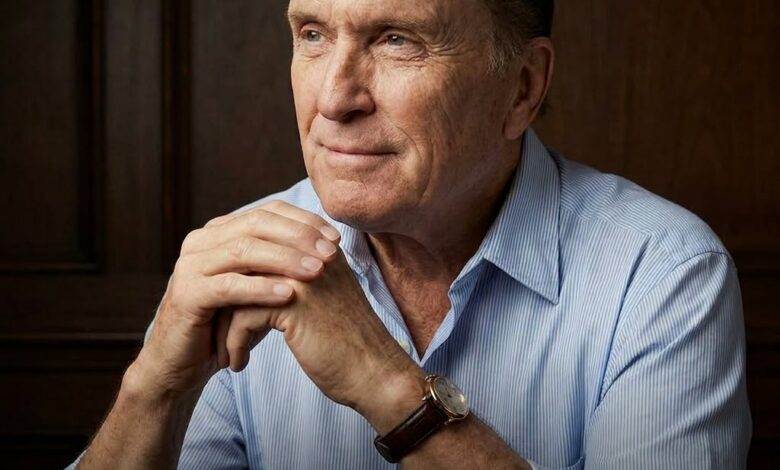
Robert Duvall never needed to raise his voice to own a scene.
Sometimes all he needed was a look.
A pause.
A slight movement of the jaw.
While other actors might reach outward for attention, Duvall had the rare ability to make an audience lean toward him. He understood that some of the most powerful emotions are the ones a character is desperately trying not to reveal.
That quiet intensity became one of the signatures of an extraordinary career.
For generations of moviegoers, Duvall seemed almost inseparable from American cinema itself. He played soldiers, lawyers, police officers, preachers, ranchers, fathers, criminals and broken men searching for one last chance at dignity.
Yet somehow, Robert Duvall rarely appeared to be “playing” any of them.
He simply became them.
That was the gift.
Born in San Diego in 1931, Duvall did not emerge from the machinery of Hollywood as an instant star. His path was slower, built through study, theater and smaller roles that allowed him to develop the disciplined approach that would define his work.
Long before audiences knew his name, he was learning how to observe people.
Their rhythms.
Their silences.
Their contradictions.
That attention to ordinary human behavior became his greatest special effect.
One of his earliest unforgettable film appearances came in 1962’s To Kill a Mockingbird, where he played the mysterious Arthur “Boo” Radley.
Duvall had remarkably little screen time.
He barely spoke.
Yet audiences remembered him.
Standing quietly in the corner of a room, his character transformed from neighborhood legend into something painfully human.
It was an early demonstration of what Duvall could do better than almost anyone.
Stillness could be acting.
Silence could contain an entire biography.
A decade later came the role that made him internationally recognizable.
Tom Hagen in The Godfather.
Surrounded by explosive personalities, Hagen was controlled.
Measured.
Professional.
He was the Corleone family’s consigliere, a man whose calmness made him more intimidating, not less.
Duvall understood exactly what the role required.
Tom didn’t need theatrical menace.
His power came from the fact that he could discuss terrifying things as though reviewing a business contract.
In a film overflowing with legendary performances, Duvall held his ground by refusing to compete for attention.
That restraint became part of the character’s authority.
He returned as Hagen in The Godfather Part II, further cementing his place within one of cinema’s most celebrated ensembles.
But Duvall was never content to become only “the guy from The Godfather.”
He kept moving.
Then came Apocalypse Now.
As Lieutenant Colonel Bill Kilgore, Duvall created one of the most recognizable military characters in film history.
The sunglasses.
The cavalry hat.
The terrifying confidence.
And, of course, the famous declaration about loving the smell of napalm in the morning.
It would have been easy for Kilgore to become a cartoon.
In Duvall’s hands, he became something stranger.
Charismatic.
Absurd.
Funny.
Disturbing.
A man so completely adapted to war that insanity had begun to look like confidence.
The performance earned Duvall another Academy Award nomination and produced images that became embedded in popular culture.
Yet one of his greatest achievements arrived in a much quieter film.
Tender Mercies.
Duvall played Mac Sledge, a washed-up country singer whose life has been damaged by alcoholism, regret and lost relationships.
There are no grand transformations.
No soaring speeches explaining everything.
Mac simply begins trying to live differently.
Duvall stripped the performance down until almost nothing appeared to be happening.
And underneath that apparent simplicity was an enormous emotional landscape.
Grief.
Faith.
Shame.
Love.
Redemption.
For that performance, Duvall won the Academy Award for Best Actor.
It was a fitting victory because Tender Mercies embodied so much of what made him exceptional.
He trusted audiences.
He didn’t need to explain every emotion.
He allowed viewers to discover it.
Over the decades, the performances accumulated.
The Great Santini.
The Apostle.
Lonesome Dove.
A Civil Action.
The Judge.
And many more.
His characters were often difficult men.
Sometimes deeply flawed ones.
Duvall did not seem interested in sanding away those rough edges to make audiences comfortable.
He understood that human beings rarely divide neatly into heroes and villains.
A cruel father could still love his family.
A failed man could still search for redemption.
A person of faith could still be angry.
A powerful man could still be terrified.
Duvall lived inside those contradictions.
That is why his characters felt inhabited rather than constructed.
His work in the television miniseries Lonesome Dove became especially beloved.
As Augustus “Gus” McCrae, he found warmth, humor and melancholy inside the weathered Texas Ranger.
For many viewers, Gus became one of Duvall’s defining characters.
Duvall himself spoke fondly of the role.
It allowed him to combine qualities scattered across many of his other performances—the toughness of the American West, the humor of an aging man who understood his own weaknesses, and the sadness of someone who knew that time eventually takes everything.
That relationship with aging became increasingly visible in Duvall’s later work.
He didn’t attempt to pretend time wasn’t passing.
He used it.
The lined face became part of the performance.
The slower movements mattered.
The weathered voice carried history before the script supplied any.
Many performers spend their careers fighting age.
Duvall seemed to understand that age gave an actor more material.
By the time he reached his later decades, he could enter a scene carrying something no makeup department could manufacture:
A lifetime.
His awards reflected the industry’s admiration.
Seven Academy Award nominations.
An Oscar for Tender Mercies.
Emmys and Golden Globe recognition.
Decades of acclaim.
But trophies never seemed sufficient to explain his reputation among fellow performers.
He was often described as an actor’s actor.
That phrase can become a cliché, but with Duvall it meant something specific.
Other actors studied him.
They watched how little he needed.
How carefully he listened.
How he resisted showing the audience that he was performing.
Duvall approached acting less like celebrity and more like a trade.
Observe.
Prepare.
Listen.
Respond.
Tell the truth.
Then go home.
That philosophy also helped separate Robert Duvall the performer from Robert Duvall the public figure.
He never seemed particularly interested in becoming a permanent fixture of celebrity culture.
Fame followed the work.
It wasn’t the work itself.
Away from movie sets, Virginia became an important refuge, far removed from the machinery of Hollywood.
There was something fitting about that.
One of America’s most celebrated actors built much of his reputation playing people rooted in specific places—ranches, small towns, military camps, churches, family homes.
He understood the importance of landscape.
Of belonging somewhere.
Eventually, every actor reaches a final credit.
But the strange thing about cinema is that actors never completely leave.
Tom Hagen is still sitting quietly beside the Corleone family.
Kilgore is still standing against the smoke and chaos.
Mac Sledge is still searching for grace.
Gus McCrae is still laughing beneath an enormous Western sky.
Boo Radley is still standing silently in the corner.
Press play, and Robert Duvall walks into the room again.
Young.
Old.
Gentle.
Terrifying.
Broken.
Funny.
Human.
That may be the closest thing actors have to immortality.
Not awards locked inside display cases.
Not names carved into monuments.
A performance surviving the person who gave it.
Duvall’s greatest achievement was never simply convincing audiences that he could act.
It was making them forget acting was happening at all.
He showed that masculinity didn’t have to mean emotional emptiness.
That vulnerability didn’t require speeches.
That redemption could happen quietly.
That the smallest gesture could reveal an entire life.
And that sometimes the most commanding person in the room is the one who barely speaks.
The cameras eventually stop.
The sets come down.
The applause fades.
But somewhere tonight, someone will watch The Godfather for the first time.
Someone will discover Tender Mercies.
Someone will meet Gus McCrae.
Someone will wonder how an actor standing almost completely still can make them feel so much.
And there Robert Duvall will be.
Doing what he always did best.
Not demanding to be watched.
Simply making it impossible to look away.