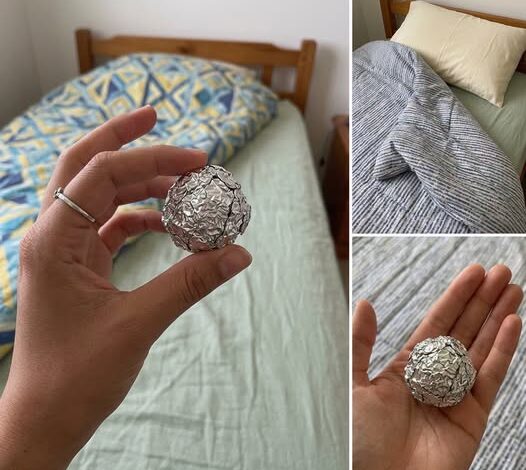
The first night I heard about putting aluminum foil under a pillow, I assumed it was another bizarre internet trick.
Then I noticed how many people swore by it.
Some claimed it helped them sleep.
Others said it created a sense of protection, blocked unwanted “energy,” or made restless nights feel calmer.
The explanations varied wildly, and many went far beyond anything supported by science.
But beneath the strange claims was something surprisingly human.
Perhaps the foil wasn’t the most interesting part of the ritual at all.
Perhaps the ritual was.
We live in a culture that has become exceptionally bad at stopping.
We carry work into our bedrooms.
We scroll through bad news beneath the blankets.
We answer messages at midnight.
We turn off the lamp while our minds continue sprinting through tomorrow’s responsibilities.
Then we become frustrated when sleep doesn’t arrive immediately.
So people create rituals.
They always have.
A particular pillow.
A glass of water beside the bed.
The bedroom door checked twice.
A familiar television show playing quietly.
A prayer.
A book.
A certain blanket positioned exactly right.
And, apparently, for some people, a piece of aluminum foil tucked beneath the pillow.
Scientifically, there’s no good reason to believe ordinary household foil beneath your pillow possesses mysterious powers that neutralize invisible forces or directly improves your body’s sleep mechanisms.
But that doesn’t necessarily mean someone who feels calmer after performing the ritual is lying.
The explanation may simply be psychological rather than metallic.
Your Brain Loves Signals
Human beings are creatures of association.
Repeat the same sequence often enough and the brain begins connecting the actions with what comes afterward.
That’s one reason bedtime routines can be useful.
Dim the lights.
Brush your teeth.
Put away the phone.
Read for a while.
Get into bed.
Eventually, those repeated actions become cues.
The day is ending.
Nothing else needs solving tonight.
Rest is coming.
A harmless personal ritual can become another cue in that sequence.
For one person, it’s arranging the pillows.
For another, it’s switching on a fan.
Someone else might make herbal tea.
And another person may fold a small piece of foil and place it somewhere because they’ve associated that action with feeling secure.
The object doesn’t need supernatural properties for the ritual surrounding it to feel meaningful.
The Placebo Effect Isn’t “Imaginary”
People sometimes hear the word “placebo” and assume it means fake.
That’s an oversimplification.
Expectations can influence how people experience symptoms, comfort, stress, and other subjective sensations.
If someone strongly associates a harmless bedtime routine with relaxation, performing that routine may genuinely help them feel calmer.
That doesn’t prove the explanation attached to the ritual is scientifically correct.
It means the brain responds to context and expectation.
Imagine checking that your front door is locked before bed.
The lock doesn’t chemically induce sleep.
But knowing the door is secure may allow you to stop worrying about it.
The psychological effect is real even though the mechanism isn’t mysterious.
The foil ritual can be understood similarly.
For some people, the act may communicate:
I’m safe now.
The day is finished.
I can stop thinking.
And sometimes that’s exactly the message an overstimulated mind needs.
Why Strange Rituals Can Feel So Powerful
Uncertainty is uncomfortable.
When life feels unpredictable, tiny controllable actions become especially appealing.
You can’t control tomorrow’s meeting.
You can’t control another person’s behavior.
You can’t guarantee that you’ll fall asleep quickly.
But you can fold something.
Place it somewhere.
Turn off the light.
Complete a sequence.
It’s small, but it’s yours.
That sense of control can be comforting.
This helps explain why personal rituals often become stronger during stressful periods.
They’re little islands of predictability.
Same action.
Same order.
Same outcome.
The surrounding world may be chaotic, but this tiny piece of the evening belongs to you.
The Problem Begins When Comfort Becomes a Claim
There’s an important distinction between saying:
“This ritual helps me relax.”
and saying:
“This object scientifically protects your body from invisible harmful forces.”
The first statement describes personal experience.
The second requires evidence.
Aluminum foil has genuine physical properties and plenty of practical uses, but that doesn’t mean placing it beneath a pillow has been demonstrated to cure insomnia, remove toxins, balance mysterious energies, or protect against disease.
Comfort shouldn’t be confused with medicine.
If someone enjoys a harmless ritual, there’s little reason to mock them for it.
But persistent sleep problems deserve more than internet folklore.
Chronic insomnia, repeated nighttime awakenings, significant daytime exhaustion, loud snoring with breathing interruptions, or other ongoing sleep concerns may warrant discussion with a healthcare professional.
No household object should become a substitute for appropriate evaluation.
What Actually Makes a Better Bedtime Ritual?
This is where the strange foil idea accidentally points toward something useful.
You don’t necessarily need the foil.
You need the signal.
Create a sequence your brain can recognize.
Maybe an hour before bed, the overhead lights become softer.
The phone goes away.
Tomorrow’s worries get written on paper instead of rehearsed repeatedly in your head.
You shower.
Read.
Stretch gently.
Listen to something calming.
Then you enter a bedroom that is dark, comfortable, and quiet enough for rest.
Do roughly the same thing tomorrow.
Then again.
The power isn’t in making the routine elaborate.
It’s in making it recognizable.
Your Ritual Can Be Completely Ordinary
One of the nicest things about bedtime rituals is that they don’t need to impress anyone.
Nobody has to see them.
Your ritual might be ridiculously simple.
Maybe you straighten the blanket before climbing into bed.
Maybe you listen to the same song.
Maybe you read five pages of a novel.
Maybe you say goodnight to the dog.
Maybe you stand at the window for thirty seconds and look outside.
These actions don’t force sleep.
They’re transitions.
And modern life desperately lacks transitions.
We often move directly from stimulation to expectation:
Email.
Video.
News.
Messages.
More scrolling.
Lights off.
WHY AM I NOT ASLEEP?
The nervous system doesn’t necessarily operate like a computer shutting down.
Sometimes it needs a runway.
That’s What the Foil Really Represents
Seen this way, the aluminum foil under the pillow becomes less mysterious.
It’s an ordinary object carrying extraordinary meaning because someone assigned meaning to it.
Humans do that constantly.
A childhood blanket is only fabric.
A wedding ring is only metal.
An old photograph is only paper and ink.
Yet nobody would seriously argue that those objects therefore mean nothing.
Meaning isn’t stored inside the material.
It’s created through association.
A bedtime ritual works similarly.
The foil isn’t necessarily doing something magical to the room.
The person may be doing something meaningful for themselves.
They’re drawing an invisible line through the evening.
Before this moment:
Responsibilities.
Noise.
People needing things.
Problems.
After this moment:
Nothing.
Not until morning.
There’s Something Beautiful About That
Perhaps that’s why unusual bedtime traditions survive.
People aren’t always searching for supernatural answers.
Sometimes they’re searching for permission.
Permission to stop.
Permission to leave tomorrow’s problems for tomorrow.
Permission to believe, for eight hours, that they don’t have to remain vigilant.
A small ritual can provide that permission.
It doesn’t need to bend physics.
It doesn’t need to manipulate invisible energy.
It doesn’t need miraculous properties.
It simply needs to become associated with letting go.
So if you’ve heard the claim that aluminum foil beneath your pillow possesses mysterious sleep-enhancing powers, keep the science in perspective.
There’s no need to turn kitchen foil into medicine.
But don’t overlook the more interesting idea hiding underneath the strange advice.
Human beings need transitions.
We need signals that tell us the work is finished.
We need familiar gestures that separate daytime vigilance from nighttime surrender.
For some people, that signal is tea.
For others, prayer.
A book.
A blanket.
A familiar song.
Or perhaps even a strangely folded piece of foil.
The object itself may be ordinary.
The message we attach to it isn’t:
The world can wait.
You have done enough for today.
You are allowed to be still.
And sometimes, before sleep arrives, that’s exactly what we need to hear.