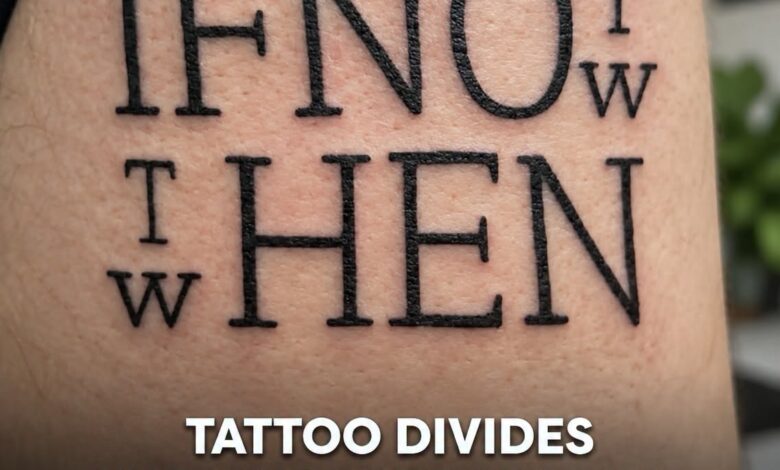
At first glance, the tattoo looked like complete nonsense.
Not offensive.
Not badly spelled.
Not even particularly complicated.
Just unreadable.
People stared at the photograph and tried to force the letters into words. Some tilted their phones. Others rotated the image. A few traced imaginary lines across the design, convinced there had to be a hidden pattern they were missing.
It looked less like an inspirational tattoo and more like a CAPTCHA designed to prove you were human.
Then someone finally saw it.
“If not now, then when.”
Suddenly, everything made sense.
And somehow, that made the tattoo even funnier.
The problem had never been the message.
“If not now, then when?” is about as straightforward as motivational phrases get. It is a reminder against procrastination, hesitation, and endlessly waiting for the perfect moment.
Want to begin something?
Why not now?
Want to change your life?
Why keep waiting?
Want to take the risk?
If not now, then when?
Written normally across a page, the sentence can be understood almost instantly.
But the tattoo wasn’t written normally.
The words had been arranged vertically and broken apart in such an unconventional way that the eye no longer knew where one word ended and another began.
Letters crowded together.
Natural spacing disappeared.
The normal rhythm of reading collapsed.
Instead of moving smoothly from left to right, the viewer had to reconstruct the sentence.
The design effectively transformed a simple phrase into a code.
That was why so many people initially believed there had to be something more complicated happening.
Maybe it was another language.
Maybe the letters formed multiple messages.
Maybe you had to read downward.
Maybe diagonally.
Maybe certain letters belonged together.
Maybe the photograph had been reversed.
People who would have understood the sentence in less than a second suddenly found themselves doing visual detective work.
And that reveals something fascinating about reading.
We tend to think we recognize words because we identify every individual letter.
Usually, we don’t.
Fluent reading relies heavily on patterns.
Spacing helps.
Word shape helps.
Context helps.
Familiar arrangements help.
The brain becomes extraordinarily good at predicting what should come next.
Destroy enough of those visual clues and even familiar language can begin looking foreign.
Consider the difference between:
IF NOT NOW, THEN WHEN?
and the same letters stacked, compressed, divided at unnatural points, and presented without obvious punctuation.
The information hasn’t changed.
The path through it has.
That distinction was enough to confuse thousands of viewers.
Then the internet did what the internet does best.
It investigated.
People began outlining individual words.
Some redrew the tattoo with spaces added.
Others placed colored boxes around different sections so viewers could see which letters belonged together.
Arrows appeared.
Annotations followed.
Someone would post the original image beside a simplified diagram, and suddenly commenters who had spent five minutes seeing gibberish experienced the same revelation:
“Oh.”
Then:
“OH.”
Once you see the phrase, it becomes difficult to understand how you ever missed it.
That is the strange magic of visual puzzles.
Before recognition, the answer seems impossible.
After recognition, it seems obvious.
Nothing in the image changes.
Your brain does.
And the tattoo became entertaining precisely because so many people experienced that transformation together.
One person would comment that they still couldn’t see it.
Another would explain.
A third would redraw the letters.
A fourth would finally understand and immediately begin helping the next confused stranger.
What began as one person’s private body art had accidentally become a worldwide cooperative puzzle.
That doesn’t mean the wearer deserved ridicule.
Tattoos are personal.
A phrase may commemorate a particular moment, philosophy, person, struggle, or decision that strangers know absolutely nothing about.
And unusual typography is not automatically a mistake.
Some designs are intentionally abstract.
Some are meant to require a second look.
Some prioritize visual symmetry over instant readability.
Only the wearer and artist know exactly what was intended.
But the viral reaction demonstrated an important design principle:
Readability is partly architecture.
Words don’t exist independently of their presentation.
Spacing matters.
Alignment matters.
Line breaks matter.
Typography matters.
A perfectly spelled sentence can become nearly incomprehensible if those elements work against the way people naturally read.
Graphic designers understand this.
So do sign makers.
Advertisers.
Publishers.
Website designers.
And tattoo artists.
Imagine a road sign containing exactly the correct instructions but arranged so confusingly that drivers need thirty seconds to decode it.
Technically, the words are right.
Functionally, the communication has failed.
A tattoo doesn’t have the same safety requirement as a road sign, of course. It can be mysterious if the wearer wants it to be.
But when a motivational phrase accidentally requires a decoding manual, the contradiction becomes irresistible.
The message says:
Don’t hesitate.
The design says:
Give me a minute.
Perhaps that’s why the image traveled so widely.
People weren’t merely laughing at a strange tattoo.
They were enjoying the experience of solving something.
Humans love pattern recognition.
We search for faces in clouds.
We solve riddles.
We stare at optical illusions.
We hunt for hidden animals in photographs.
We rearrange letters into words.
Our brains are constantly trying to turn disorder into meaning.
The tattoo offered exactly that challenge.
At first:
Chaos.
Then:
Pattern.
Then:
Recognition.
And finally:
Satisfaction.
There is also something wonderfully appropriate about strangers refusing to give up on the phrase.
They could have scrolled past.
Instead, they stopped.
Squinted.
Rotated.
Compared.
Outlined.
Explained.
They kept working until the unreadable became readable.
In a strange way, the internet treated the tattoo with more patience than the tattoo’s own message seemed to recommend.
And perhaps the most interesting part is that the original meaning survived.
“If not now, then when?” is supposed to interrupt hesitation.
It challenges the habit of postponing life.
Tomorrow.
Next month.
When things calm down.
When I’m more confident.
When I have more money.
When I’m less afraid.
When everything is perfect.
The question exposes the problem:
What if the perfect moment never arrives?
Ironically, viewers had to slow down before they could receive that message.
They couldn’t rush.
They couldn’t understand it through a casual glance.
They had to examine what was in front of them.
Maybe that wasn’t the intended lesson.
But it isn’t a bad one.
Sometimes action matters.
Sometimes you shouldn’t wait.
And sometimes the wiser response is the opposite:
Stop.
Look again.
Make sure you’ve understood what you’re seeing.
The viral tattoo somehow managed to communicate both ideas at once.
Its words urged urgency.
Its design demanded patience.
Years from now, most people who saw the image probably won’t remember who wore it.
They may not remember where they first encountered it.
They may even forget the exact arrangement of the letters.
But they’ll remember the feeling.
That moment when nonsense suddenly became language.
The instant their eyes stopped seeing random shapes and recognized a sentence that had been sitting there all along.
That is what turned an ordinary motivational tattoo into something far more memorable.
It wasn’t the quotation itself.
It was the struggle to reach it.
A few awkward line breaks transformed private encouragement into public mystery.
And thousands of strangers responded not by giving up, but by working together until the hidden meaning emerged.
Perhaps that’s an unexpectedly fitting legacy for a tattoo asking when the right moment will come.
The answer was there from the beginning.
We just needed a little longer to see it.