At first, you may barely notice it.
Your socks leave deeper marks around your ankles.
Your shoes feel tighter by evening.
One leg seems heavier after a long day.
You press a finger against the skin near your ankle and, for a few moments, the indentation remains.
Then morning comes, the swelling improves, and you forget about it.
Until it happens again.
Occasional leg or ankle swelling can have relatively simple explanations. A long flight. Hours spent sitting at a desk. Standing all day. Hot weather. Pregnancy. A salty meal. Certain medications.
But when swelling becomes persistent, keeps returning, worsens, or begins arriving with changes in the skin, it deserves more attention.
Because swelling isn’t a diagnosis.
It’s a message.
And the important question is what is causing it.
One possible explanation is chronic venous insufficiency.
The veins in your legs have a difficult job.
Blood traveling down the legs has gravity helping it.
Getting that blood back toward the heart is harder.
Leg veins contain valves that help keep blood moving in the correct direction, while the muscles in the legs—especially the calves—help pump it upward as you move.
When that system doesn’t work efficiently, blood can pool in the lower legs.
Pressure builds.
Fluid can move into surrounding tissues.
The result may be swelling around the ankles and lower legs, often more noticeable after long periods of standing or sitting.
At first, it may simply feel uncomfortable.
Heavy.
Tight.
Achy.
But persistent venous problems can eventually leave visible changes.
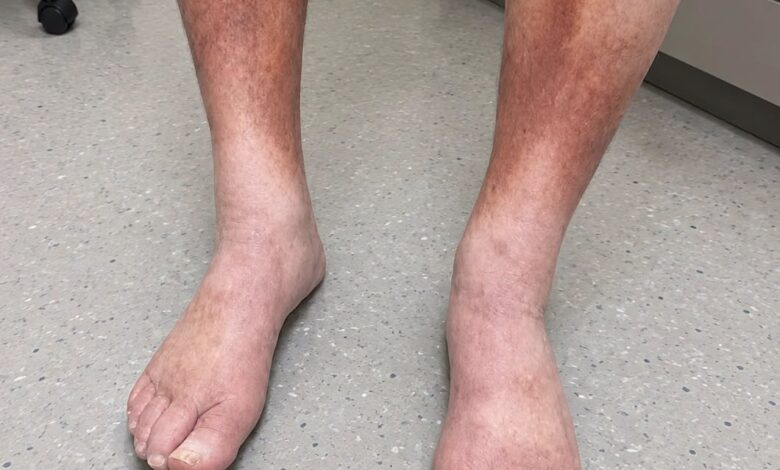
The skin around the lower legs or ankles may become darker or discolored.
It can become dry, itchy, irritated, thickened, or firmer.
Varicose veins may become more obvious.
In more advanced cases, poorly healing wounds or venous ulcers can develop, particularly around the ankle area.
These changes aren’t merely cosmetic.
Skin can become a record of what has been happening underneath it.
But there is an important caution.
Swollen legs do not automatically mean poor venous circulation.
The body has many ways of producing edema, the medical term for swelling caused by excess fluid in tissues.
Heart problems can contribute.
Kidney or liver disease can contribute.
Lymphatic problems can cause swelling.
Some medications can cause or worsen it.
Infection can produce swelling.
Injury can.
Hormonal changes can.
And sometimes a blood clot in a deep vein can cause swelling that requires urgent medical attention.
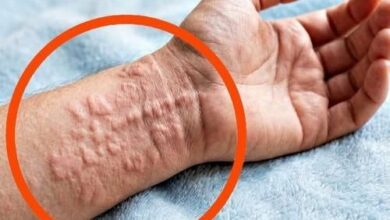
That’s why diagnosing yourself based on ankle size—or an internet photograph—is a bad idea.
The pattern matters.
Is the swelling in one leg or both?
Did it appear gradually or suddenly?
Is it better in the morning and worse at night?
Is there pain?
Redness?
Warmth?
Skin discoloration?
A wound?
Shortness of breath?
Chest pain?
Did it begin after surgery, an injury, prolonged immobility, or a long journey?
Those details can change the level of concern dramatically.
One particularly important pattern is sudden swelling in one leg, especially when accompanied by pain, tenderness, warmth, or redness.
Those symptoms can occur with a deep vein thrombosis, or DVT—a blood clot in a deep vein.
Not every painful or swollen leg is a clot.
But a possible DVT isn’t something to diagnose or dismiss at home.
A clot can become especially dangerous if part of it travels to the lungs and causes a pulmonary embolism.
That is why leg symptoms accompanied by sudden shortness of breath, chest pain, coughing up blood, fainting, or severe breathing difficulty require emergency medical attention.
In that situation, don’t wait to see whether the swelling improves overnight.
Seek emergency care.
Other warning signs deserve prompt assessment too.
A leg that becomes markedly red, hot, painful, or rapidly more swollen can indicate a serious problem, including infection or a clot.
An open sore—particularly one that isn’t healing—needs evaluation.
Skin that is becoming increasingly discolored, thickened, inflamed, or fragile should not simply be covered and forgotten.
And swelling that persists or repeatedly returns without an obvious explanation deserves a conversation with a healthcare professional.
The goal isn’t panic.
It’s investigation.
A clinician may begin with something remarkably unglamorous:
Questions.
When did this start?
What makes it better?
What makes it worse?
What medications are you taking?
Do you have heart, kidney, liver, vascular, or other medical conditions?
Have you recently traveled?
Had surgery?
Been less mobile?
Then comes the physical examination.
Depending on what is suspected, additional testing may be appropriate. For possible venous disease or a blood clot, ultrasound can sometimes provide important information about blood flow and the veins.
Treatment depends entirely on the cause.
That’s why “just wear compression socks” isn’t always sufficient advice.
Compression can be useful for certain forms of venous swelling and other conditions, but it isn’t appropriate for every person or every circulation problem. The correct type and strength may matter, and some people should be medically assessed before using it.
Similarly, water pills aren’t a universal solution to swollen legs.
Neither is simply drinking less water.
Neither is aggressively massaging a suddenly swollen, painful leg when a clot hasn’t been ruled out.
The first step is understanding what you’re treating.
For some people with venous problems, movement can be valuable.
Walking activates the calf muscles, helping them function like a pump that assists blood returning upward.
Avoiding very long periods of immobility may help.
Elevating the legs at appropriate times can reduce swelling for some people.
Weight management, regular activity, skin care, and treatment of underlying medical problems can also be part of a broader plan.
But none of those strategies should be treated as a substitute for evaluation when symptoms are persistent, changing, or concerning.
There is another reason to pay attention early.
Chronic swelling can become normalized.
You buy larger shoes.
Stop wearing certain socks.
Choose trousers that hide your ankles.
Tell yourself your legs have “always been like that.”
You adjust your life around the symptom rather than asking why the symptom is there.
Human beings are remarkably good at adapting to gradual change.
That ability helps us cope.
It can also make warning signs easier to ignore.
The body rarely communicates in dramatic speeches.
Sometimes it whispers.
A little swelling.
A new patch of darker skin.
Heaviness that wasn’t there before.
An indentation left by a sock.
A wound taking longer to heal.
One symptom may mean very little by itself.
A persistent pattern can mean much more.
And paying attention doesn’t mean assuming the worst.
It means respecting uncertainty enough to get an answer.
Most swollen ankles do not announce catastrophe.
But some forms of swelling reveal conditions worth treating before complications develop, and certain combinations of symptoms require urgent care.
So notice the pattern.
Notice whether one leg looks different from the other.
Notice pain, warmth, redness, skin changes, or sores.
And never ignore leg swelling accompanied by chest pain or difficulty breathing.
Your legs carry you through thousands of ordinary days.
When they begin repeatedly showing you that something has changed, don’t simply hide the evidence beneath longer trousers.
Ask why.
Sometimes the most important health decision isn’t discovering the diagnosis yourself.
It’s recognizing when your body has been asking the same question long enough—and finally letting a medical professional answer it.