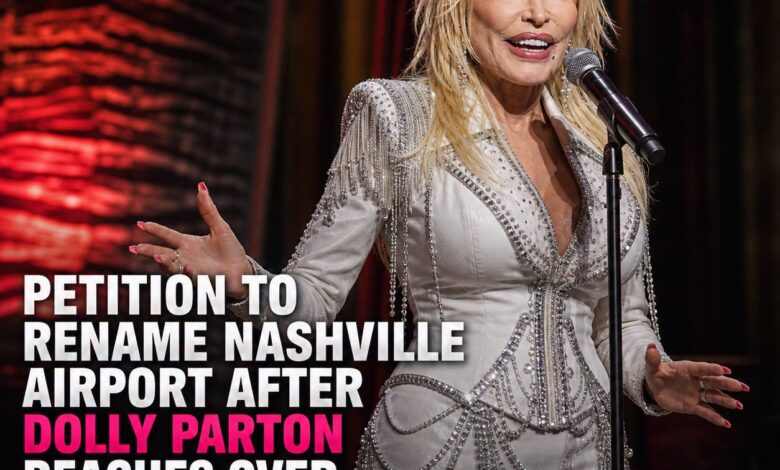
Petition to Rename Nashville Airport After Dolly Parton Reaches Over 100,000 Signatures Following Her Death..

:max_bytes(150000):strip_icc():focal(749x0:751x2):format(webp)/Nashville-International-Airport-072426-9d7369fb53bc40298049de76a521227a.jpg)
:max_bytes(150000):strip_icc():focal(791x364:793x366):format(webp)/Sheryl-Crow-Dolly-Parton-082626-232d600babfe4580ab7c5da924f76b5f.jpg)
Before Dolly Parton’s death, there was already a campaign to put her name on one of Tennessee’s most visible gateways.
After she died, that campaign exploded.
Within roughly 24 hours of the announcement that the country music legend had died at 80, more than 100,000 additional people reportedly added their names to a petition calling for Nashville International Airport to become Dolly Parton International Airport.
For supporters, the argument is simple.
If any Tennessean deserves to welcome people to Music City, why not Dolly?
The campaign didn’t actually begin with her death. Tennessee residents Lydia Popovich and Dan Dion launched the petition in January 2025, arguing that Parton’s contributions to Tennessee, music, philanthropy, and American culture deserved permanent recognition.
At the time, it was an ambitious proposal.
After her passing, it became something closer to a movement.
People flooded the petition page as grief spread around the world. The sudden surge wasn’t merely about attaching a celebrity’s name to a building. For many supporters, it was about ensuring that something permanent remained in the landscape of the state Dolly spent her life celebrating.
Popovich and Dion said the extraordinary response following her death had renewed their determination.
Their idea was that Dolly’s “light and magic” should continue greeting people arriving in Tennessee.
There is something fitting about an airport being suggested as the memorial.
Dolly’s life was, after all, a story of departure and return.
She left the Smoky Mountains as a young woman with enormous ambitions and headed to Nashville, determined to become a songwriter.
She succeeded beyond anything that girl could reasonably have imagined.
But she never really left Tennessee behind.
She sang about it.
Invested in it.
Built businesses there.
Created jobs there.
Promoted its mountains to the world.
And no matter how internationally famous she became, her Tennessee identity remained inseparable from her public image.
Now supporters want travelers arriving in Nashville to encounter that identity before they even collect their luggage.
“Dolly Parton International Airport.”
The name almost sounds as though it should have been there all along.
And the idea has attracted a particularly significant supporter.
Sheryl Crow.
Crow, a Nashville resident who had collaborated with Parton, enthusiastically backed the proposal when discussing it with Katie Couric.
She joked that she knew Nashville’s airport as BNA without even knowing exactly what the letters meant, before making her preference unmistakable.
Yes.
Make it the Dolly Parton airport.
That reaction captures part of what gives the campaign unusual momentum.
Airport codes can feel bureaucratic.
Dolly feels personal.
For generations of visitors, Nashville has been synonymous with country music, and few people carried that music farther around the world than Parton.
But another endorsement could matter even more than celebrity enthusiasm.
Tennessee State Representative Todd Warner said he was prepared to introduce legislation supporting the renaming.
And his involvement came with an unexpected twist.
Warner had previously pushed to rename the airport after President Donald Trump.
That proposal failed to advance.
According to Warner, many people contacted him afterward and argued that Nashville’s airport should instead honor someone from Tennessee.
Following Dolly’s death, he found his answer.
Parton.
His explanation focused less on her celebrity than on what she had done with it.
She was good to Tennessee.
She cared about people.
She contributed enormously to country music and the state’s economy.
And she cared about children.
“We need more Dollys in the world,” Warner said.
That sentence gets closer to the emotional heart of the campaign than any argument about tourism or branding.
Dolly Parton wasn’t simply a successful Tennessean.
She reinvested in the place that created her.
That matters.
Celebrity hometown connections can sometimes become largely symbolic once fame arrives. A star leaves, becomes wealthy somewhere else, and occasionally mentions where they grew up during interviews.
Dolly’s relationship with Tennessee was different.
She built Dollywood in East Tennessee and helped turn the surrounding area into an international tourism destination while supporting thousands of jobs connected directly and indirectly to the attraction.
She repeatedly celebrated Appalachian culture rather than treating her upbringing as something she had escaped.
And through the Dollywood Foundation and Imagination Library, she transformed childhood literacy into one of the defining missions of her later life.
The Imagination Library began in Tennessee.
Its inspiration was deeply personal.
Dolly’s father had not learned to read and write, something she said affected him throughout his life. She wanted children to have opportunities he hadn’t.
So she began sending books.
What started locally grew far beyond Tennessee, eventually reaching children across multiple countries and distributing hundreds of millions of books.
That is the other Dolly supporters want represented by the airport name.
Not merely the woman who wrote “Jolene.”
Not merely the voice behind “9 to 5.”
Not merely the performer whose image became recognizable almost everywhere.
The woman who took the wealth generated by fame and turned significant portions of it outward.
That distinction helps explain why the renaming proposal has attracted support across cultural and political boundaries.
Dolly had one of the rarest forms of celebrity in modern America.
She was difficult to turn into a partisan possession.
People disagreed about politics and still agreed about Dolly.
Conservatives loved her.
Progressives loved her.
Country traditionalists loved her.
Pop audiences loved her.
Children who had never heard one of her records knew her as the woman whose name appeared on books arriving at their homes.
That broad affection makes an airport renaming feel different from the typical argument over whose name belongs on public infrastructure.
Of course, a petition—even one attracting enormous attention—doesn’t rename an airport.
There are procedures.
Government officials have roles to play.
Airport authorities and other stakeholders may need to consider practical implications.
Changing the public identity of a major international airport involves signage, maps, marketing, digital systems, legal considerations, and money.
There may also be people who believe Nashville International Airport should retain its existing name.
Public memorials inevitably raise questions.
Why this person?
Why this building?
Why now?
Does honoring one figure diminish others?
Would changing the airport’s name create unnecessary confusion?
Those are legitimate matters for Tennessee officials and residents to debate.
But the speed with which the petition grew reveals something that bureaucratic discussions cannot easily measure.
People want somewhere to put their grief.
When a beloved public figure dies, music and photographs provide one kind of memorial.
Physical places provide another.
Fans want a marker.
A building.
A road.
A statue.
Something that says this person mattered enough that the landscape itself remembers them.
For Dolly, there are already plenty of places carrying her influence.
Dollywood may be the most obvious.
Her presence is embedded throughout East Tennessee.
But Nashville represents another chapter.
It was where the teenage dreamer went to test whether the songs she had been writing in the mountains could carry her somewhere larger.
Imagine the symbolism if the airport eventually carried her name.
Every aspiring songwriter flying into Nashville would pass beneath it.
Every tourist arriving to visit the honky-tonks would see it.
Every musician coming to chase the same impossible dream would receive a reminder that somebody from a one-room Tennessee cabin once chased it too.
That might be the strongest argument for the proposal.
Dolly Parton International Airport wouldn’t simply commemorate where Dolly ended up.
It would commemorate where she started moving.
She arrived in Nashville young, ambitious, largely unknown, and convinced she had something worth hearing.
The city eventually helped send her voice around the planet.
Decades later, travelers from around that same planet could arrive through a gateway bearing her name.
There is poetry in that.
There is also something delightfully Dolly about imagining the announcements.
Welcome to Dolly Parton International Airport.
The name is glamorous without being solemn.
Large without feeling cold.
And almost inevitably, people have already begun wondering what an airport honoring Dolly should look like.
Would there be rhinestones?
Butterflies?
A guitar?
Displays about Tennessee music?
An Imagination Library installation where travelers could donate books?
Perhaps a celebration of Appalachian artists?
The possibilities practically design themselves.
But Dolly’s legacy also suggests that the most appropriate tribute would have to be more than decorative.
She was never merely sparkle.
The sparkle got people’s attention.
What she did with that attention was the important part.
If Tennessee eventually places Dolly’s name on an airport, supporters may hope the building reflects the values that made the name meaningful in the first place.
Warmth.
Humor.
Ambition.
Music.
Generosity.
A sense that people arriving from somewhere else are welcome.
That was Dolly’s particular gift.
She could be unmistakably Tennessee while somehow belonging everywhere.
Perhaps that is why the petition feels emotionally persuasive to so many people.
Airports are places of leaving and coming home.
They contain beginnings and endings every hour.
People hug goodbye there.
Families reunite there.
Teenagers leave home for the first time.
Grandparents wait at baggage claim.
Musicians arrive carrying guitars and impossible plans.
Lives change between arrival and departure boards.
Dolly understood both sides of that journey.
She left home to chase something bigger.
Then she spent the rest of her life finding ways to give something back.
Now, after her death, more than 100,000 additional supporters have reportedly joined a campaign asking Tennessee to return the gesture.
Not with another award.
Not with another tribute concert.
With a permanent place on the map.
The proposal still has a long way to travel before any airport sign changes.
Petitions generate attention; governments make decisions.
There will be debates about cost, procedure, practicality, and precedent.
But something has already happened that doesn’t require legislation.
People heard “Dolly Parton International Airport” and immediately understood why it made sense.
Because Nashville helped launch Dolly toward the world.
Dolly spent the next six decades carrying Tennessee with her.
And now, perhaps, Tennessee’s most famous gateway could carry her name in return.
For every traveler arriving with a suitcase, a guitar, a business meeting, a family reunion, or a dream too big to explain, the first welcome to Music City would be unmistakable:
Dolly was here.
She dreamed here.
And look how far that dream traveled.