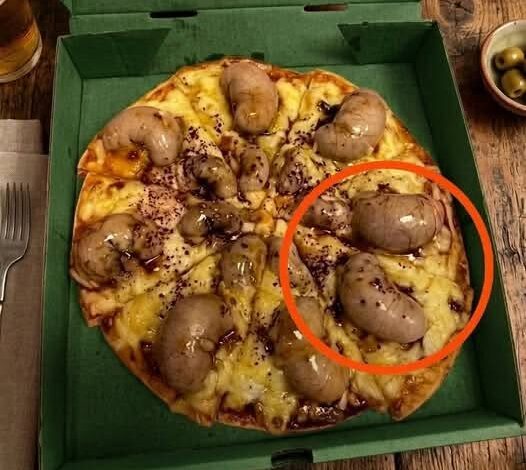
One evening, I ordered a pizza and sat down expecting a completely normal meal. But the moment I opened the box, something caught my attention. The cheese looked unusual. Across the surface were several large, smooth bubbles that seemed trapped beneath the melted cheese, creating raised pockets unlike anything I remembered seeing before. For a moment, I simply stared at it.
My first thought was that something had gone wrong during the cooking process. Maybe the pizza was undercooked. Maybe it had overheated. Perhaps the ingredients weren’t fresh. The crust appeared perfectly normal, golden brown around the edges, and the toppings looked exactly as they should. Yet those strange bubbles made me hesitate. Instead of grabbing a slice and taking a bite, I found myself inspecting the pizza like a detective searching for clues.
Curiosity got the better of me. Before eating, I decided to look into what might have caused the unusual appearance. A quick search online led me into forums, cooking websites, and discussions among pizza lovers who had noticed the exact same thing. To my surprise, I learned that the bubbles weren’t a defect at all. In fact, they were a completely normal part of the baking process.
As pizza cooks in a hot oven, moisture trapped inside the dough begins to heat up and turn into steam. At the same time, pockets of air within the dough expand. When melted cheese covers the surface, it can trap some of that steam and air underneath, creating smooth, raised bubbles. Certain types of cheese are even more likely to produce this effect because they contain higher moisture levels that release steam as they melt.
The more I read, the more fascinating it became. Professional pizza makers explained that oven temperature plays a huge role in bubble formation. Extremely hot ovens, especially those used in pizzerias, can create dramatic bubbling because the pizza cooks so quickly. The thickness of the dough, the amount of moisture in the ingredients, and even how the cheese is distributed across the pizza can influence the final appearance. No two pizzas are exactly alike, which is why one pie may have several large bubbles while another from the same restaurant looks completely smooth.
What I had initially viewed as a possible problem turned out to be evidence of the cooking process at work. Some pizza enthusiasts even consider these bubbles a sign of a properly baked pizza, particularly when it comes from a high-temperature oven. Rather than indicating poor quality, the bubbles often show that heat, moisture, and dough fermentation interacted exactly as they should.
After satisfying my curiosity, I finally picked up a slice and took a bite. The pizza tasted fantastic. The crust was crisp, the cheese was perfectly melted, and the toppings were just as flavorful as expected. There was absolutely nothing wrong with it. The strange appearance that had worried me moments earlier had no negative effect on the taste whatsoever.
As simple as the experience was, it left me thinking about how quickly we judge things based on appearance alone. Something unfamiliar often triggers concern because our brains naturally compare it to what we expect to see. Yet unfamiliar doesn’t necessarily mean bad. Sometimes it simply means we don’t understand what’s happening beneath the surface.
That pizza taught me a surprisingly valuable lesson. A few harmless bubbles led me to learn about baking science, moisture, heat, and dough chemistry. More importantly, it reminded me to stay curious before jumping to conclusions. Whether it’s food, people, or situations in everyday life, first impressions don’t always tell the full story. Sometimes the things that look strange at first turn out to be perfectly normal—and occasionally even signs that everything is working exactly as it should.