The hospital room didn’t care about the Trump name.
It didn’t care about politics, television cameras, campaign speeches, social media arguments, or the endless headlines that have followed the family for years.
Inside those walls, there was only an 18-year-old in pain—and a family frightened by how quickly an ordinary day had become a medical emergency.
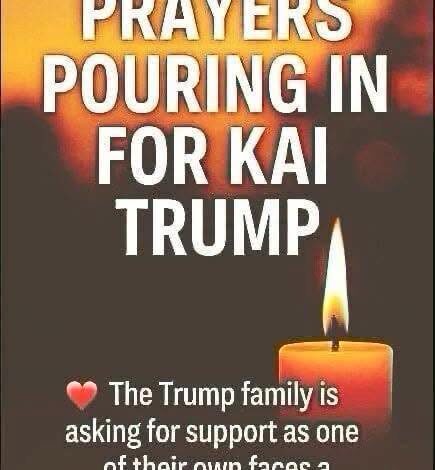
Kai Trump had reportedly suffered a ruptured appendix, turning what might initially have seemed like severe stomach pain into a situation requiring urgent medical treatment. Suddenly, the world outside the hospital became irrelevant.
There were monitors.
Nurses moving in and out.
Questions for doctors.
Waiting.
And the terrible uncertainty familiar to anyone who has watched someone they love disappear behind hospital doors.
For Donald Trump Jr. and Vanessa Trump, whatever public identities people associated with them faded into the background.
In that room, they were simply parents.
A mother watching her daughter hurt.
A father trying to remain calm.
Two people attempting to offer reassurance while likely needing reassurance themselves.
Medical emergencies have a way of doing that.
They strip life down to its most basic priorities with astonishing speed.
One moment, your attention is scattered across work, appointments, messages, disagreements, and plans for tomorrow.
The next, you would trade every one of those concerns for a doctor to walk through the door and say four words:
“She’s going to be okay.”
A ruptured appendix can be particularly frightening because appendicitis may progress quickly. When the appendix ruptures, infection can spread within the abdomen, making prompt medical treatment essential. Surgery and antibiotics are commonly part of treatment, followed by careful monitoring during recovery.
For a family experiencing it firsthand, however, clinical explanations rarely capture the emotional reality.
You don’t think in medical terminology when it’s your child.
You notice the pale face.
The trembling hand.
The exhaustion after surgery.
You watch every change in expression and wonder whether it means improvement or another problem.
You listen differently when a nurse enters the room.
You learn the rhythm of machines you never wanted to understand.
And you wait.
Vanessa’s emotional social media message following Kai’s medical ordeal appeared to capture some of that fear and relief. Rather than reading like a carefully polished public statement, it felt like something written by a mother whose emotions were still close to the surface.
Even imperfections in a message can become meaningful at moments like that.
When someone you love has just survived a frightening medical emergency, perfect grammar and carefully selected words are unlikely to be the priority.
Relief is.
Gratitude is.
Having your child safe beside you is.
The response also revealed something increasingly rare in America’s intensely divided public conversation.
People who may agree on almost nothing politically could still understand what the family was experiencing.
Messages of support arrived from people with very different perspectives, because illness does not belong to a political party.
Fear doesn’t ask how someone votes.
Neither does parental love.
Almost everyone understands, at least instinctively, the terror of receiving a phone call saying someone you love has been rushed to a hospital.
For parents, that fear can be especially overwhelming.
No matter how old a child becomes, there is often still a part of a parent that sees the toddler who once reached for their hand crossing a street, the child who needed comfort after a nightmare, or the teenager who insisted everything was fine when it clearly wasn’t.
At 18, Kai is legally an adult.
But adulthood doesn’t switch off a parent’s instinct to protect.
And perhaps that is what made images and descriptions surrounding her recovery resonate beyond the family’s usual political audience.
For a moment, people weren’t looking at a famous surname.
They were looking at something painfully recognizable.
A hospital bed.
A frightened young woman.
Parents staying close.
A family hoping the worst had passed.
That doesn’t mean political disagreements disappear.
It doesn’t require anyone to change their opinions about Donald Trump, Donald Trump Jr., or any other member of the family.
Compassion doesn’t demand agreement.
That distinction matters.
Modern public life frequently encourages people to sort one another into categories before deciding how much empathy they deserve. Politicians become symbols. Their relatives become extensions of those symbols. Eventually, it becomes easy to forget that the people inside the headlines still experience ordinary human terror, grief, illness, and love.
A medical emergency interrupts that abstraction.
Suddenly, the person isn’t an argument anymore.
They’re somebody’s daughter.
Somebody’s child.
Someone lying awake beneath hospital lights wishing desperately to go home.
As Kai’s recovery continues, the physical wounds should gradually heal. Hospital routines will eventually give way to familiar rooms, ordinary meals, conversations, and the routines that once seemed completely unremarkable.
Those ordinary things may feel different afterward.
That’s another strange effect of a medical scare.
Normal life becomes precious precisely because, for a few frightening hours, you weren’t certain you would get it back.
A quiet evening at home suddenly feels extraordinary.
Hearing someone laugh from another room becomes reassuring.
Even complaints about boredom can sound wonderful when the alternative was a hospital monitor.
The family will eventually move forward.
The headlines will move forward even faster.
Another controversy will dominate social media. Another political fight will take over television. Another viral story will capture everyone’s attention, and the hospital room will gradually disappear from public conversation.
But families rarely forget moments like these.
They remember the drive to the hospital.
The doctor’s expression.
The waiting.
The first reassuring update.
The moment they finally allowed themselves to believe recovery had begun.
And perhaps that is the lasting lesson hidden beneath all the attention surrounding Kai’s ordeal.
Fame can create distance between public figures and everyone watching them.
Politics can create even more.
But beneath the names, arguments, wealth, influence, and carefully maintained public images are human beings vulnerable to the same frightening phone calls as everyone else.
When someone you love is lying in a hospital bed, almost everything you once considered urgent becomes strangely small.
There are no political sides in that moment.
There is only fear.
Hope.
A hand held tightly beside a hospital bed.
And the silent prayer shared by parents everywhere:
Please let my child come home.