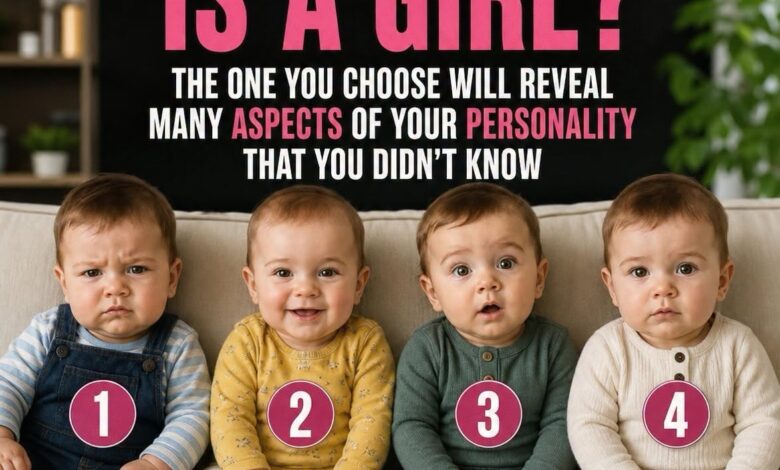
At first glance, it looks harmless.
Four babies.
Four tiny faces.
A simple question asking which one you think is the girl.
You make a choice almost instantly.
Maybe you pick the baby with softer features.
Maybe the one wrapped in a certain color.
Maybe the one whose expression seems calmer or more delicate.
Then the quiz tells you what your answer supposedly reveals about your personality.
Kind.
Intuitive.
Emotionally balanced.
Protective.
Observant.
Warm.
And because the description sounds flattering and familiar, you think:
That does sound like me.
But the real trick is not that the image uncovered something hidden inside your personality.
The real trick is how quickly your brain built a story from almost nothing.
That is what makes these viral baby tests so interesting.
The babies may look nearly identical in age and expression, yet viewers immediately begin searching for tiny differences.
A softer cheek.
A slightly different posture.
A blanket color.
A calmer face.
A feature that feels more “feminine.”
Most people do not consciously stop and ask where those associations came from.
They simply feel obvious.
That feeling is important.
Because many snap judgments work exactly that way.
They do not arrive as carefully reasoned conclusions.
They arrive as instincts.
And instincts often contain years of cultural conditioning.
From childhood, people absorb messages about what boys and girls are supposed to look like.
Girls are associated with softness.
Boys with sturdiness.
Girls with pink.
Boys with blue.
Girls with gentleness.
Boys with energy.
Those associations are reinforced through toys, advertising, clothing, television, family language, and social expectations.
So when a quiz presents four babies and asks which one is female, the mind does not begin with biological evidence.
It begins with learned visual shortcuts.
That is why someone might choose a baby because the face appears more delicate.
Another person might pick the one whose eyes seem calmer.
Someone else may rely entirely on color without realizing it.
The answer feels personal.
But much of the reasoning may be cultural.
Then comes the second part of the trick.
Once you make your choice, the quiz gives you a personality description.
This is where psychology becomes especially interesting.
Many viral quizzes rely on what psychologists often call the Barnum effect.
The Barnum effect describes our tendency to accept broad, vague personality statements as uniquely accurate descriptions of ourselves.
Consider a sentence like:
“You care deeply about others, but sometimes you need time alone to recharge.”
That could describe millions of people.
Or:
“You are stronger than people realize, although you sometimes doubt yourself.”
Again, extremely broad.
Yet when these statements are presented as the result of a test you just completed, they suddenly feel specific.
The brain connects the description to the choice.
You selected Baby Number Three.
The quiz says people who choose Baby Number Three are emotionally intuitive and loyal.
You remember moments when you were loyal.
You remember times when you understood someone’s feelings.
And suddenly the result seems strangely accurate.
What you are less likely to remember are all the moments that do not fit.
That is confirmation bias.
Human beings naturally pay more attention to information that supports what they already believe.
If the test says you are patient, you remember the afternoon you calmly helped someone through a problem.
You may forget the morning you nearly lost your mind because somebody was taking too long in front of you.
If it says you are independent, you remember moments when you solved problems alone.
You may ignore the countless times you relied on friends or family.
The result feels accurate because your brain helps make it accurate.
This does not mean people are foolish.
It means human cognition is efficient.
We are constantly sorting enormous amounts of information.
Patterns help us function.
Categories help us make quick decisions.
The problem appears when we mistake a useful shortcut for an objective truth.
That is where the baby test becomes more interesting than its creators may have intended.
The question is supposedly:
Which baby is the girl?
The deeper question is:
What made you think that?
Maybe you chose the baby with the rounder face.
Why did roundness feel feminine?
Maybe you chose the calmer-looking baby.
Why did calmness feel female?
Maybe you noticed a hint of pink.
Why did that override everything else?
Those questions are not accusations.
They are invitations.
Because all of us carry assumptions.
The important thing is not pretending we have none.
It is learning how to notice them before they become decisions.
A harmless social-media quiz may not have serious consequences.
You choose a baby.
Read a personality description.
Laugh.
Send it to a friend.
Move on.
But the mental mechanism behind that moment appears everywhere.
We see someone wearing expensive clothes and assume competence.
We hear an accent and make assumptions about education.
We see a quiet person and decide they are shy.
We see an older person struggling with technology and assume they are incapable.
We see a confident speaker and assume they know what they are talking about.
We see a child’s behavior and decide what kind of adult they will become.
These judgments happen quickly.
Sometimes before we realize we have made them.
That is the real lesson.
The viral test is not exposing whether you possess some mysterious talent for identifying gender.
It is exposing how readily the brain fills gaps.
When information is incomplete, humans rarely leave the space empty.
We invent explanations.
We create narratives.
We decide what details mean.
Then, once the story exists, we become surprisingly attached to it.
This is partly why first impressions can be so powerful.
Imagine meeting someone who seems distant during your first conversation.
You decide they are unfriendly.
The next time they speak briefly, you interpret that as confirmation.
You may not consider that they are anxious, exhausted, distracted, or dealing with something difficult.
Once the label exists, new information gets filtered through it.
The same process occurs in the baby test.
Once you decide, “That one looks like a girl,” every feature begins supporting the decision.
The eyes look softer.
The expression looks sweeter.
The posture looks more delicate.
But if someone told you the baby was actually a boy, you could probably build a completely different explanation just as quickly.
That flexibility should make us humble.
Human perception is powerful.
It is not infallible.
Social media makes these psychological shortcuts even more potent because it rewards speed.
You are not encouraged to spend five minutes studying the image.
You are encouraged to choose instantly.
Comment.
Share.
React.
The quicker the judgment, the better the engagement.
That structure mirrors much of online culture.
Someone posts a ten-second clip.
Viewers decide who is right.
Someone uploads a photograph.
Strangers infer an entire relationship.
A headline appears.
People form opinions before opening the article.
The brain loves complete stories.
The internet supplies fragments.
Together, they can create certainty without much evidence.
That does not mean every first impression is wrong.
Sometimes intuition is useful.
Humans are capable of noticing subtle patterns.
Experience can sharpen judgment.
But intuition becomes dangerous when we refuse to distinguish between:
“I noticed something”
and
“I know what it means.”
The baby quiz blurs that line deliberately.
You notice visual differences.
Then it invites you to treat those differences as evidence of gender.
Afterward, it takes your arbitrary choice and treats it as evidence of personality.
Two enormous conclusions emerge from a few seconds of looking.
That is why the flattering descriptions are so important to the format.
If the quiz told people:
“You chose Baby Two because you rely heavily on stereotypes and make careless assumptions,”
few would share it.
Instead, everyone receives something pleasant.
You’re compassionate.
You’re intelligent.
You’re loyal.
You’re emotionally perceptive.
You’re strong.
The quiz is not really evaluating you.
It is rewarding participation.
That reward makes people more likely to believe the result and send it to someone else.
Then another person takes it.
Another personality result appears.
The cycle continues.
Soon thousands of people are discussing which baby “looks like a girl,” and the image becomes viral.
But there is another way to use the test.
Instead of asking whether the result describes your personality, ask yourself how you made the original choice.
What did you notice first?
Color?
Facial structure?
Expression?
Clothing?
Posture?
Did you consciously think about gender stereotypes?
Or did the decision simply feel obvious?
That word—obvious—is worth examining.
Many beliefs feel obvious only because we encountered them so early and so often that we forgot they were learned.
Pink did not emerge from nature carrying a sign that said “girls.”
Softness is not biologically assigned to women.
Confidence is not inherently masculine.
Gentleness is not inherently feminine.
Cultures teach meanings.
Then generations inherit them.
Sometimes those meanings change.
What once seemed obvious becomes strange.
That should remind us that assumptions are not always facts.
There is something refreshing about treating the viral image as a conversation starter rather than a personality test.
Ask two people which baby they chose.
Then ask why.
Their answers may reveal completely different mental pathways.
One person may focus on eyes.
Another on clothing.
Another on facial shape.
Another may admit they guessed randomly.
That conversation tells you far more about perception than the quiz’s predetermined personality result ever could.
It can also lead to bigger questions.
Where else do we make similar judgments?
When do we associate appearance with intelligence?
Age with competence?
Gender with personality?
Clothing with morality?
Silence with weakness?
Confidence with expertise?
Those assumptions matter because real life is not a harmless picture puzzle.
Snap judgments influence hiring.
Education.
Relationships.
Medicine.
Parenting.
Policing.
Leadership.
Who gets trusted.
Who gets interrupted.
Who receives another chance.
Who is assumed to belong.
Nobody can eliminate every bias simply by knowing bias exists.
Awareness is not magic.
But awareness creates a pause.
And sometimes a pause is enough to change what happens next.
Instead of:
“She looks like the kind of person who…”
the thought becomes:
“Why am I assuming that?”
Instead of:
“He seems…”
it becomes:
“What evidence do I actually have?”
That tiny interruption is valuable.
It creates room for reality to replace the story our brain rushed to write.
So perhaps the viral baby test does reveal something about personality after all.
Just not what the result page claims.
The most revealing part is not which baby you selected.
It is whether you are willing to question why you selected that baby.
Can you notice an assumption without defending it?
Can you admit uncertainty?
Can you change your mind when new information appears?
Can you recognize that your first interpretation is only one possibility?
Those qualities say far more about judgment than any flattering paragraph generated after clicking an image.
Four babies.
One question.
A decision made in seconds.
Then an entire personality supposedly revealed.
It is silly.
It is entertaining.
And underneath the entertainment sits a surprisingly useful reminder.
Human beings are storytelling machines.
Give us incomplete information and we will rush to complete it.
Give us a vague description and we will personalize it.
Give us a first impression and we will search for evidence that confirms it.
The trick is learning when to interrupt ourselves.
Because outside a viral quiz, the people we judge are not pictures.
They are complicated human beings.
And unlike the babies on the screen, they deserve more than a guess.