Pulled my beef roast out of the slow cooker and saw these weird white stringy things poking out of the meat. They look like little worms or parasites. Is the meat infested?

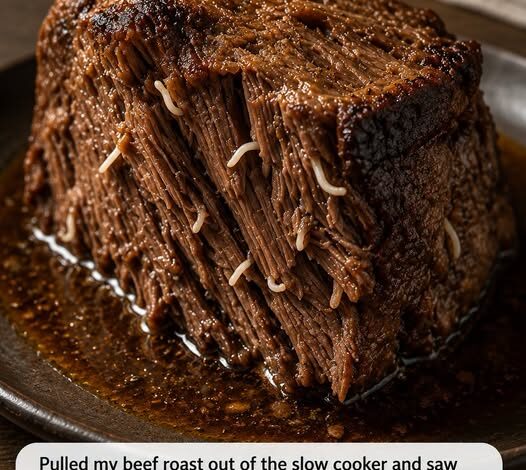
Spotting pale, string-like strands inside a slow-cooked beef roast can be enough to make anyone lose their appetite. At first glance, they may look alarmingly similar to worms or parasites, leaving many home cooks wondering whether the meat is safe to eat. Fortunately, in the overwhelming majority of cases, there’s a much less dramatic explanation.
Those whitish, thread-like pieces are almost always a completely natural part of the beef itself.
Large cuts of beef, such as chuck roast, brisket, or pot roast, are packed with connective tissue that supports and binds the muscle fibers together. This tissue is rich in collagen, a tough structural protein that gives raw meat its firmness. While collagen can make certain cuts seem chewy before cooking, it undergoes an impressive transformation when exposed to low, gentle heat over several hours.
As the roast slowly cooks, the collagen gradually breaks down into soft gelatin. During this process, it can appear as pale, stringy strands or glossy, jelly-like pieces woven throughout the meat. Although the appearance may seem unusual if you’ve never noticed it before, it’s actually one of the reasons slow-cooked beef becomes so tender, juicy, and flavorful.
Rather than being a warning sign, those strands often indicate that the roast has cooked exactly as it should.
Because the connective tissue has softened and dissolved, the meat becomes easy to shred with a fork, while the melted collagen enriches the cooking juices and gives the roast its rich, silky texture. What initially looks concerning is actually the result of the slow cooking process doing its job.
Naturally, many people worry that these strands could be parasites. Thankfully, that scenario is extremely unlikely in countries with modern meat inspection and food safety standards. Commercially sold beef undergoes rigorous inspection before it reaches grocery stores, making parasitic infections exceptionally rare.
Even in the rare event that parasites were present, they would not survive when beef is cooked to the recommended safe internal temperature. Proper cooking effectively eliminates that risk, making a well-prepared roast safe to enjoy.
There are also noticeable differences between harmless connective tissue and an actual parasite.
Collagen is typically soft, slippery, and irregular in shape. It blends naturally into the meat, pulls apart easily with a fork, and often stretches between muscle fibers as the roast falls apart. It has no organized structure because it’s simply part of the animal’s natural anatomy.
A parasite, on the other hand, would appear much more distinct. It would usually have a firm, uniform shape rather than the loose, uneven strands created by melted connective tissue. Instead of dissolving into the meat, it would stand out as a separate structure with a consistent appearance.
If your roast smells fresh, has been stored properly, and was cooked to a safe internal temperature, those pale strands are almost certainly nothing more than softened collagen.
So the next time you notice what look like tiny white “worms” in a pot roast or slow-cooked beef, there’s no reason to panic. What you’re seeing is one of the natural changes that occurs during long, slow cooking—a transformation that turns tough connective tissue into the rich gelatin responsible for the melt-in-your-mouth texture people love.
Sometimes the most surprising sights in the kitchen aren’t signs that something has gone wrong at all. They’re simply a reminder of the fascinating science behind great cooking, where patience transforms even the toughest cuts of beef into tender, flavorful meals.