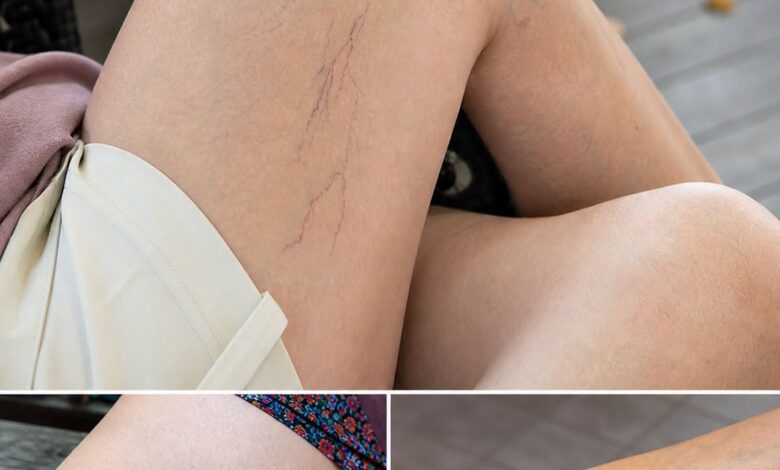
Those tiny purple, blue, or reddish lines spreading across your legs can seem to appear almost overnight.
One day, the skin around your thighs, calves, ankles, or knees looks unchanged.
Then you notice a delicate web of vessels beneath the surface.
Spider veins.
For many people, the first reaction is cosmetic.
Where did those come from?
Can I get rid of them?
Are they going to become varicose veins?
But there is another question worth asking:
What are my veins actually telling me?
The reassuring answer is that spider veins are extremely common and, by themselves, are often harmless. Many people develop them without experiencing pain, swelling, or any significant underlying medical problem.
Still, changes in your veins shouldn’t automatically be ignored.
Understanding the difference between an ordinary cosmetic change and symptoms that deserve medical attention can help you respond without unnecessary fear.
Spider veins get their name from their appearance.
Unlike larger varicose veins, which may become raised, rope-like, or twisted, spider veins usually remain flat and close to the skin’s surface.
They can form branching lines.
Tiny clusters.
Web-like patterns.
Their colors may range from bright red to purple or deep blue.
And while they can appear in different parts of the body, the legs are especially common.
There is a reason for that.
Blood traveling through your legs has a difficult job.
It must return upward toward your heart while constantly working against gravity.
Your leg veins contain one-way valves that help keep blood moving in the correct direction.
Muscle contractions, particularly from walking, also help push blood upward.
When those systems aren’t working as efficiently, pressure can build within the veins.
Small vessels near the surface may become more noticeable.
But this doesn’t mean everyone who develops spider veins has serious venous disease.
Sometimes genetics explains much of the story.
If your parents or grandparents had prominent veins, you may be more likely to develop them too.
Age also matters.
Over time, tissues and vein valves can become less efficient.
Hormonal changes may contribute as well, which helps explain why spider veins can become more noticeable during pregnancy or other periods of hormonal fluctuation.
Pregnancy creates additional pressure because blood volume increases while the growing uterus can affect circulation from the legs.
For some women, the veins improve after pregnancy.
For others, they remain.
Body weight may also influence pressure on the veins.
Then there is something many modern lives involve far too much of:
Staying in one position.
Think about a cashier standing behind a register for an entire shift.
A nurse spending hours on their feet.
An office worker sitting at a desk all day.
A traveler remaining seated through a long flight.
The problem isn’t simply standing or sitting.
It’s prolonged immobility.
Your calf muscles function partly like pumps, helping blood return from the legs.
Walking activates them.
Remaining still for long stretches doesn’t.
That’s one reason regular movement can be helpful.
If your work requires sitting for hours, getting up periodically and walking around can support circulation.
If you’re standing all day, changing position and taking opportunities to walk or rest may help.
Even simple ankle movements can keep the lower legs from remaining completely inactive.
For people whose spider veins are purely cosmetic and cause no other symptoms, that’s often where the story ends.
They may not require treatment at all.
But spider veins deserve more attention when they’re accompanied by other changes.
Suppose your legs regularly feel unusually heavy at the end of the day.
Or perhaps you experience aching.
Burning.
Itching.
Throbbing.
Swelling around the ankles.
These symptoms don’t automatically indicate something dangerous, but they provide a reason to discuss your circulation with a healthcare professional.
The pattern matters too.
A few painless spider veins on both legs are very different from one leg suddenly becoming swollen and painful.
That distinction is important.
Chronic vein problems usually develop gradually.
Someone with chronic venous insufficiency may notice persistent swelling, particularly around the lower legs and ankles.
Skin can gradually change color.
Brownish or darker pigmentation may develop near the ankles.
The skin can become irritated or thickened.
In more advanced cases, sores may appear and become difficult to heal.
Those changes deserve medical evaluation.
They aren’t simply cosmetic.
They can indicate that prolonged venous pressure is affecting surrounding tissues.
But there is another set of symptoms that should be treated much more urgently.
Sudden swelling in one leg.
New warmth.
Redness or discoloration.
Significant tenderness or pain.
Those symptoms can sometimes occur with a deep vein thrombosis—a blood clot in a deeper vein.
A clot is fundamentally different from ordinary spider veins.
It requires prompt medical assessment because a clot can potentially break loose and travel to the lungs.
If symptoms such as unexplained shortness of breath, chest pain, coughing up blood, fainting, or severe breathing difficulty occur, emergency medical attention is warranted.
The important point is not to look at every visible vein and imagine a blood clot.
That creates unnecessary anxiety.
Instead, pay attention to changes.
What is new?
Is there pain?
Is there swelling?
Is one leg suddenly different from the other?
Has the skin changed?
Are symptoms worsening?
Those details are more useful than simply asking whether veins are visible.
If a clinician evaluates your legs, they may begin with something remarkably simple:
Looking at them.
They may examine the pattern of veins, swelling, skin changes, and other symptoms.
Depending on the situation, further testing such as ultrasound may be recommended to assess blood flow and determine whether deeper veins are functioning properly.
Treatment depends entirely on what is found.
Sometimes the recommendation is reassurance.
Nothing more.
If symptoms are mild, lifestyle measures may help.
Regular walking is one of the simplest.
Movement activates the calf muscles and supports the return of blood toward the heart.
Elevating the legs can sometimes reduce swelling and pressure after long periods upright.
Maintaining a weight appropriate for your health may also reduce unnecessary strain.
Compression stockings are another common option.
But compression isn’t simply about buying the tightest socks you can find.
Different strengths and styles exist, and proper fit matters.
Depending on a person’s medical history and circulation, compression may not be appropriate in every situation.
A clinician can help determine whether it makes sense and what type should be used.
And then there are all those creams promising to erase visible veins.
Be skeptical.
A moisturizer may make skin feel better.
Cosmetic products may temporarily change how skin looks.
But a topical cream cannot simply repair a malfunctioning vein valve beneath the skin.
If someone wants spider veins treated for cosmetic reasons, actual medical procedures are available.
One of the most established is sclerotherapy.
During the procedure, a healthcare professional injects an appropriate solution into targeted veins, causing them to close so the body gradually redirects blood through healthier vessels.
Over time, treated veins may fade.
Laser and light-based treatments can also be appropriate for certain small vessels, depending on their size, location, skin characteristics, and other factors.
These treatments aren’t magic.
More than one session may be needed.
Veins can recur.
New spider veins may develop elsewhere.
And cosmetic treatment doesn’t eliminate underlying risk factors such as genetics or aging.
That is why a proper assessment can be useful before chasing whatever treatment happens to be trending online.
There is another mistake worth avoiding:
Treating visible veins as evidence that your body has failed.
Bodies change.
Skin changes.
Blood vessels become more visible.
Gravity works on us every day of our lives.
Spider veins are common precisely because the circulatory system in the legs spends decades performing an extraordinarily demanding task.
The goal isn’t to become frightened whenever something changes.
It’s to become observant.
Look at your legs occasionally.
Notice whether a pattern has changed significantly.
Pay attention to swelling.
Don’t ignore persistent pain because you’ve convinced yourself it’s “just age.”
And don’t assume every purple line beneath your skin represents an emergency.
Both extremes—panic and dismissal—can get in the way of sensible care.
Think of spider veins as information.
Most of the time, that information may simply say:
Your superficial blood vessels have become more visible.
Sometimes, especially when additional symptoms appear, the message may be:
Your circulation deserves a closer look.
Knowing the difference is where good judgment begins.
So if you notice those delicate blue or purple webs spreading across your legs, don’t immediately reach for a miracle cream or imagine the worst.
Start with the basics.
Move regularly.
Avoid remaining completely still for long stretches when possible.
Elevate tired legs when appropriate.
Talk with a healthcare professional if symptoms accompany the veins.
And seek urgent medical attention for sudden one-sided swelling, warmth, redness, or significant pain—particularly if breathing symptoms or chest pain develop.
Your veins don’t need to be beautiful to be healthy.
And visible veins don’t automatically mean something is wrong.
But your body does communicate through change.
The smartest response is neither fear nor indifference.
It’s paying attention—and knowing when a small change deserves a professional look.