The proof arrived in the smallest possible package.
Not a dramatic population boom.
Not hundreds of animals suddenly racing across the Australian landscape.
Just tiny young tucked inside a mother’s pouch.
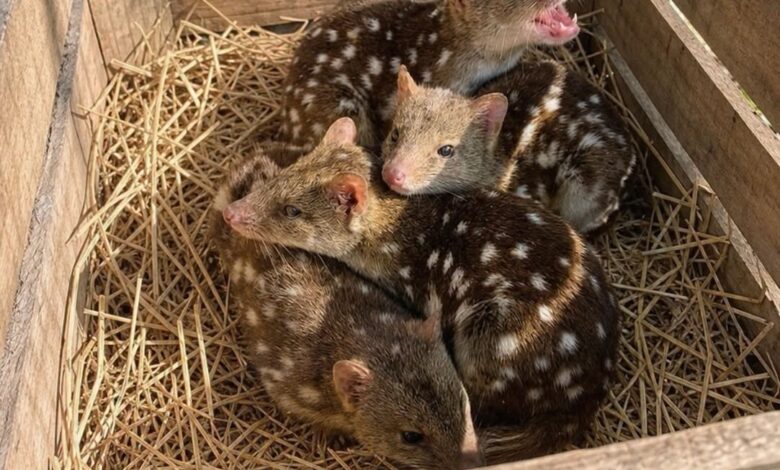
At Mt Gibson Wildlife Sanctuary in Western Australia, the discovery of newborn western quolls—also known as chuditch—carried significance far beyond their size. The animals had been returned to a landscape from which their kind had disappeared, and now they were doing the one thing conservationists most needed them to do without human assistance:
They were breeding.
That distinction matters.
Moving an endangered animal into protected habitat is one achievement.
Getting it to survive is another.
Watching it establish a functioning population that produces the next generation is something else entirely.
Because successful conservation is not ultimately about transporting animals.
It is about restoring enough of a living system that they can begin taking over the work themselves.
Western quolls once occupied an enormous portion of mainland Australia. These spotted, carnivorous marsupials lived across landscapes far beyond the restricted range in which they persisted in modern times.
Then Australia changed around them.
European colonization transformed habitats. Land clearing and other pressures reduced and fragmented suitable environments. Introduced predators, particularly foxes and feral cats, added another threat that many native mammals were poorly equipped to withstand.
Over time, the western quoll vanished from much of its former range.
Its surviving wild populations became concentrated largely in southwestern Western Australia.
A map that once represented abundance became a map of retreat.
That is how extinction often approaches.
Not always through one spectacular catastrophe.
Sometimes a species disappears quietly, district by district.
One population becomes isolated.
Then another vanishes.
People stop seeing an animal their grandparents considered ordinary.
Eventually, “common here” becomes “used to live here.”
Then conservationists are left confronting an uncomfortable question:
Can that direction be reversed?
At Mt Gibson, the answer required more than optimism.
Australian Wildlife Conservancy has worked to restore native mammals at the sanctuary, including through a large predator-free fenced area designed to protect vulnerable species from introduced predators.
That changes the equation dramatically.
If foxes and feral cats are major reasons a native mammal cannot establish itself in a landscape, simply releasing more animals without addressing those pressures can turn conservation into an expensive cycle of loss.
Remove or greatly reduce the threat, however, and the animals have a genuine opportunity to do what evolution prepared them to do.
Find shelter.
Hunt.
Explore.
Establish territories.
Find mates.
Breed.
Raise young.
That is what makes reintroduction so much more complicated than opening a transport crate and wishing an animal luck.
The landscape has to work.
Food must be available.
Shelter matters.
Predators have to be managed.
Animals must be monitored after release.
Researchers need to know whether individuals are surviving, where they are moving, whether they are maintaining healthy condition, and eventually whether reproduction is occurring.
Some of that information comes from direct monitoring.
Some comes from tracks and other signs.
And some arrives through cameras watching while humans are nowhere nearby.
Motion-activated cameras have transformed wildlife monitoring because the animals do not need to perform for an observer.
A camera waits.
Day after day.
Night after night.
Nothing may happen for hours.
Then movement triggers the sensor.
A blurred tail.
A pair of eyes reflecting infrared light.
A spotted body crossing the frame.
For researchers, an image that looks unimpressive to everyone else can contain valuable evidence.
The animal is alive.
It is moving through this location.
It appears healthy.
It may be accompanied by another quoll.
A female may be carrying young.
Individual animals can also become unexpectedly recognizable characters in the larger conservation story.
One western quoll associated with the Mt Gibson project became known as Aang, a name that gave the science something the public could immediately hold onto.
That might sound trivial.
It isn’t.
Conservation happens through population models, field surveys, genetics, predator management, habitat protection, budgets, fences, traps, cameras, and years of patient work.
But people often connect to the outcome through one animal.
Aang becomes a face.
Then the face becomes evidence of a population.
And eventually the population becomes a possibility:
Maybe this species can live here again.
That possibility became far more convincing when females were found carrying pouch young.
Those joeys were not imported.
They weren’t placed there by conservationists.
They were conceived after the adults entered their restored environment.
That means the animals were doing more than enduring relocation.
They were beginning to treat the landscape as home.
There is a temptation to turn that into a fairy-tale ending.
The quolls returned.
Babies were born.
Species saved.
Conservation is rarely that simple.
A few successful births do not erase decades of decline.
Reintroduced populations need long-term monitoring.
Genetic diversity matters.
Disease can matter.
Food availability can fluctuate.
Fire and climate conditions can reshape habitat.
Fences require maintenance.
Introduced predators remain a profound challenge outside protected areas.
And a sanctuary population, however valuable, is not the same as restoring a species across its historical range.
The newborn quolls therefore aren’t proof that the job is finished.
They are proof that the next stage is possible.
That may be more meaningful.
Modern conservation can sometimes sound relentlessly bleak.
Habitat loss.
Extinction.
Climate pressure.
Invasive species.
Population collapse.
Those realities should not be softened.
Australia has suffered an extraordinary loss of native mammals since European settlement, and protecting what remains requires sustained effort rather than occasional enthusiasm.
But hopelessness can become its own kind of distortion.
Decline is not always irreversible.
Landscapes can be managed differently.
Introduced predators can be controlled in protected areas.
Habitat can recover.
Species can be returned.
And sometimes an animal that disappeared from a region can wake beneath the stars there again.
Not because nature magically healed itself.
Because people did difficult, unglamorous work long enough for nature to regain some room to operate.
That is the crucial partnership.
Humans build the fence.
Control predators.
Study habitat.
Transport animals.
Install cameras.
Collect data.
Monitor populations.
But eventually, if the project succeeds, something must happen beyond human control.
Two quolls must find each other.
A female must become pregnant.
Young must survive.
They must grow up and establish themselves.
Then those animals must reproduce too.
At that point, restoration stops looking like humans carrying a species indefinitely and begins looking like a wild population carrying itself.
That is why a pouch containing newborn quolls can matter so much.
It represents independence in miniature.
The joeys know nothing about conservation status.
They do not know their species once occupied much more of Australia.
They do not know that humans built fences to protect their parents from introduced predators.
They do not know cameras are recording their movements or that scientists will study the evidence.
They simply emerge into the world western quolls evolved to inhabit.
Eventually, they will leave the pouch.
Explore.
Hunt.
Compete.
Hide.
Survive, if fortune and management allow.
And perhaps reproduce.
That is the future conservationists are trying to restore—not a museum population permanently dependent on human attention, but animals once again behaving as wild animals.
There is something appropriately modest about the evidence.
No ribbon cutting.
No victory speech.
Just a researcher checking an animal and discovering new life.
Just another grainy photograph from the darkness.
Just spotted bodies moving across country where their species had been missing.
Conservation victories rarely arrive with the spectacle of the losses that made them necessary.
A forest can be destroyed dramatically.
Recovery grows one plant at a time.
A species can disappear from a region and leave behind an enormous silence.
Its return begins with footsteps almost nobody hears.
At Mt Gibson, those footsteps are being heard again.
The western quoll’s story is not finished, and no responsible conservationist would pretend otherwise.
But for once, unfinished is good news.
Because after generations of retreat, these animals are writing the next part themselves.
And somewhere inside a protected piece of Western Australia, a tiny quoll opening its eyes for the first time carries something much larger than its own future.
It carries proof that “gone” and “gone forever” are not always the same thing.