The maternity suite was quiet in the strange padded way hospitals become quiet after pain has already done its worst.
Not peaceful.
Not comforting.
Just muted.
The fluorescent lights hummed softly above me while the heart monitor near my bed blinked in steady green rhythms that sounded too calm for the chaos still moving through my body.
The room smelled like disinfectant, warm blankets, melted ice chips, and that faint sterile scent every hospital carries no matter how expensive the building becomes.
Somewhere down the hallway, another newborn cried briefly before being soothed.
Mine slept against my chest wrapped in a white hospital blanket striped with faded pink and blue lines.
Her tiny lips still moved in her sleep like she was remembering the effort it took to arrive here.
Twenty hours of labor had reduced me to instinct.
My muscles trembled when I shifted.
My lower back burned constantly.
Every inch of my body felt stretched beyond recognition.
The hospital wristband scratched against my skin every time I adjusted my daughter carefully in my arms.
But when I looked down at her, the pain disappeared for a few precious seconds at a time.
She was alive.
Breathing.
Mine.
I whispered her name quietly against her soft hair.
“Emma.”
The first time I said it aloud felt holy somehow.
Mark didn’t hear me.
He sat in the corner recliner with his phone tilted sideways, thumbs moving rapidly across the screen while blue light flashed over his face every few seconds.
Game sounds chirped softly before he muted them with an irritated swipe.
He still hadn’t held her.
At first, I excused it.
Some men panic around newborns.
Some freeze under responsibility.
Some need time before understanding that a tiny person now exists who depends entirely on them.
I gave Mark every gentle explanation I could find because exhaustion makes women generous toward men who deserve honesty instead.
“Mark,” I whispered softly once.
Without looking up, he replied:
“Almost done.”
Almost done.
That sentence had followed our marriage for years.
Almost done with work.
Almost done with the game.
Almost done with the call.
Almost done with the level.
It became the invisible wall he placed between himself and anything emotionally inconvenient.
Earlier that morning, a nurse delivered the hospital billing folder.
Clear plastic.
Snap closure.
Official paperwork inside.
The private maternity suite confirmation sat visible near the top.
So did the receipt.
My name appeared clearly on every page.
Chloe Bennett.
Not Mark’s.
Mine.
I paid for the upgraded suite myself using savings I quietly protected for years because I already knew recovery after childbirth would require silence.
And boundaries.
Mostly boundaries.
Because I knew Mark’s mother would come.
Beatrice Caldwell never entered rooms quietly.
She arrived carrying perfume, criticism, and the ability to absorb all oxygen from a space within minutes.
I wanted one locked door after labor.
That was all.
For six years, I tried desperately to become easy enough for Mark’s family to love.
I remembered the first dinner at Beatrice’s house after we got engaged.
She corrected the way I folded cloth napkins while smiling pleasantly enough that everyone else pretended not to notice.
Mark squeezed my knee beneath the table and whispered:
“She means well.”
That sentence became the excuse attached to every wound afterward.
Beatrice criticized my weight before the wedding.
She meant well.
She questioned whether ambitious women made good mothers.
She meant well.
She called my savings account “adorably independent.”
She meant well.
After a while, I realized “she means well” was simply the blanket Mark used to cover every bruise his mother left behind.
My parents were supposed to visit later that morning.
They texted at 7:03 a.m.
We’re here whenever you’re ready.
That was my mother’s style of love.
Permission first.
Presence second.
I hadn’t answered yet.
Emma stirred softly against my chest.
I kissed the top of her head carefully.
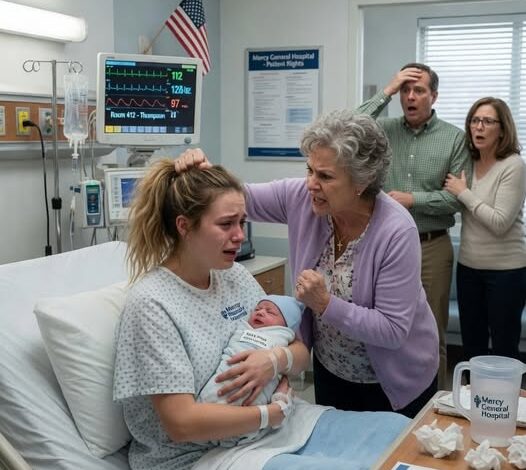
Then the door slammed open hard enough to strike the rubber wall stopper behind it.
My whole body jerked violently.
Emma startled awake instantly and began crying.
Beatrice swept into the room like she owned the hospital itself.
Pearl earrings.
Cream church coat.
Designer handbag hanging from one wrist.
She surveyed the room before acknowledging me at all.
The extra chair.
The private bathroom.
The bassinet.
The larger television.
The window view.
Only after inspecting the suite did she glance toward the baby.
And even then, she didn’t really look at her.
No mother ever forgets the first person who refuses to truly see her child.
“How dare you,” Beatrice snapped.
Her voice sliced through the room so sharply Emma cried harder immediately.
I instinctively adjusted Emma against my chest protectively.
“Please lower your voice,” I whispered.
Beatrice stepped closer.
“How dare you waste my son’s money on this ridiculous luxury suite?” she demanded. “Women give birth in regular rooms every single day. Shared rooms. Standard recovery spaces. But apparently you needed to play princess while Mark works nonstop.”
Mark sighed loudly from the chair.
Not because his mother insulted me.
Because the interruption annoyed him.
I looked at him desperately waiting for something human to rise inside him.
Husband.
Father.
Protector.
Anything.
He kept gaming.
“I paid for the room,” I answered quietly.
The silence afterward sharpened instantly.
“With my own savings,” I clarified. “Mark didn’t contribute.”
Beatrice’s face hardened immediately.
Not embarrassed.
Embarrassment softens people.
This was fury at being corrected publicly by someone she considered lower than herself.
Her eyes shifted toward the clear billing folder sitting beside my bed.
The receipt remained visible through the plastic.
PATIENT PAID — PRIVATE SUITE UPGRADE.
AUTHORIZED BY:
CHLOE BENNETT.
She saw it.
Then something ugly crossed her face.
Without warning, she grabbed the heavy water glass from the bedside table and slammed it violently against the floor.
The crack exploded across the room.
Glass shattered everywhere.
Water sprayed across the tile.
Tiny shards skidded beneath the hospital bed.
Emma screamed.
The sound tore straight through my body.
Instinct took over immediately.
I curled protectively around my daughter, one arm shielding her head while the other held her tightly against my chest.
Pain ripped through my abdomen from the movement.
I didn’t care.
For one dangerous second, rage nearly overtook exhaustion.
I imagined standing.
Shoving Beatrice backward.
Screaming every sentence I swallowed through six years of humiliation.
But Emma was in my arms.
So I stayed still.
That wasn’t weakness.
That was strategy.
“Mark,” I whispered.
My voice sounded thin and distant even to me.
Mark groaned dramatically without lifting his eyes from the screen.
“Mom, seriously,” he muttered. “Keep it down. I’m in ranked.”
Ranked.
Glass covered the floor.
His newborn daughter screamed.
His recovering wife curled protectively over a hospital bed.
And he cared about ranked mode.
Beatrice folded her arms proudly.
“She needs to learn,” she said coldly. “A woman who just had a child doesn’t get to waste family resources.”
I looked at Mark again.
I needed him to fail differently.
That’s the cruel bargaining women make inside dying relationships.
You stop hoping for goodness.
You start hoping for smaller forms of cruelty.
Finally Mark glanced up.
His face showed irritation.
Not concern.
His eyes moved across:
The shattered glass.
The crying baby.
My body curled protectively on the bed.
Then he shrugged.
“She’s right,” he said casually. “Move to a standard room. Save the money so I can top up my account. I need the expansion package before the season resets.”
The room didn’t explode.
Everything simply stopped.
Emma’s crying sounded far away suddenly.
The monitor blurred softly.
Even my heartbeat seemed delayed.
Beatrice smiled.
A tiny victorious smile.
The same smile she wore every time Mark chose her comfort over mine.
Thanksgiving dinners.
Missed birthdays.
Pregnancy arguments.
Always that smile.
That was the exact moment something inside me froze permanently.
Not numbness.
Clarity.
Women discover the truth about marriage in strange places.
Not always through affairs or screaming matches.
Sometimes beneath fluorescent hospital lights while your husband asks you to sacrifice safety for video game purchases.
“Okay,” I whispered softly.
Mark relaxed immediately assuming surrender.
Beatrice looked triumphant.
Neither noticed the doorway.
My father stood there first.
One hand gripping the frame hard enough for his knuckles to pale.
Beside him stood my mother covering her mouth with trembling fingers.
They arrived quietly because loving parents understand how to enter hospital rooms gently.
They had waited outside.
They heard everything.
My mother stared at the broken glass first.
My father stared at Mark.
Arthur Bennett was not a loud man.
He fixed fences quietly.
Checked tires before storms.
Carried heavy grocery bags without being asked.
The night before my wedding, he stood beside Mark on our porch and said:
“She is not difficult to love. Don’t make her feel like she is.”
Mark promised.
Now my father stepped fully into the room.
“Put the phone down,” he said calmly.
Mark blinked.
“What?”
“Put. The phone. Down.”
No yelling.
That made it terrifying.
Mark slowly lowered the device.
Beatrice recovered first.
“This doesn’t concern you, Arthur.”
My mother walked past her without acknowledgment and came directly to my bedside.
“Don’t move your feet,” she whispered after noticing the glass.
Then she calmly pressed the nurse call button.
That was my mother’s version of love.
Action first.
Emotion later.
My father picked up the billing folder.
Beatrice stiffened instantly.
“What are you doing?”
“Reading.”
He reviewed the payment receipt slowly.
Then turned it toward Mark.
“Your wife paid for this room herself.”
Mark crossed his arms.
“I never said she didn’t.”
“Yes,” my father answered quietly. “You did.”
Beatrice laughed sharply.
“This entire scene over a hospital room is ridiculous.”
My mother finally looked directly at her.
“No,” she replied evenly. “We’re documenting what happened to our daughter and granddaughter.”
Documenting.
That single word shifted the atmosphere instantly.
A nurse entered moments later after the call button alarm triggered.
She stopped immediately after seeing:
The shattered glass.
The crying infant.
The tension.
Professional concern replaced politeness instantly.
“I’ll need housekeeping and an incident report,” she said carefully.
Incident report.
Beatrice looked offended by the phrase itself.
“She dropped the glass,” she snapped immediately.
Nobody answered.
That silence frightened her more than accusations would have.
My mother looked directly at me.
“Chloe,” she asked gently, “did she drop it?”
For years I softened every cruelty around Mark.
Translated insults into misunderstandings.
Called neglect stress.
Renamed emotional abandonment exhaustion.
But Emma still cried in my arms.
Glass still glittered beside the bed.
And my husband still held the phone.
“No,” I answered clearly.
The room fell completely silent.
“She grabbed it and smashed it.”
The nurse’s entire posture changed.
Not emotional.
Focused.
Official.
She unclipped forms from her clipboard immediately.
“Chloe,” Mark sighed. “Don’t make this bigger than it is.”
My father’s jaw tightened.
“It became big,” he answered coldly, “when your newborn daughter screamed and you kept gaming.”
Mark flushed angrily.
For one second, the old pattern tried reassembling itself.
Beatrice attacks.
Mark minimizes.
I smooth everything over.
But there were witnesses now.
Paperwork now.
Reality becomes harder to rewrite once strangers start recording it.
Beatrice pointed sharply toward me.
“She’s emotional.”
My mother laughed once.
A terrible sound.
“She just gave birth,” my mother answered. “That should have inspired compassion, not competition.”
The nurse kept writing.
That mattered deeply somehow.
Evidence mattered.
Truth mattered.
Mark finally stood.
“This is insane.”
“No,” my father replied calmly. “This is accountability.”
Then he noticed the game still glowing faintly on Mark’s phone screen.
“Unlock it.”
Mark stiffened.
“What?”
“You played through labor. Through the glass. Through your daughter screaming. Unlock it.”
“That’s private.”
“You made it public the moment you demanded hospital downgrades for game upgrades.”
Even the nurse looked up at that.
People reveal their real priorities accidentally.
That sentence exposed Mark completely.
My mother reached into her purse slowly and removed a cream-colored envelope.
My father took it from her carefully.
Mark noticed his own name written across the front immediately.
“What’s that?”
“For later,” my father answered.
“What does that mean?”
“It means your mother can no longer pretend she raised a good man accidentally ruined by stress.”
Beatrice gasped dramatically.
“How dare you.”
“You shattered glass beside my granddaughter,” my father replied evenly. “Then lied about it.”
Each sentence landed like evidence entered into court.
Mark looked afraid suddenly.
Not remorseful.
Afraid.
Huge difference.
The nurse quietly documented every detail while my mother adjusted Emma’s blanket gently.
“Hi sweetheart,” she whispered softly to the baby.
That became Emma’s first true grandmother greeting.
Not criticism.
Not ownership.
Gentleness.
Eventually Beatrice left first after realizing nobody would rescue her version of reality anymore.
Her heels clicked furiously down the hallway.
Mark lingered longer.
Tried apologizing without accountability.
Tried blaming stress.
Exhaustion.
Pressure.
Never once mentioning:
The game.
The shattered glass.
Emma crying.
That omission told me everything.
Finally I looked directly at him.
“You need to leave.”
He stared blankly.
“I’m her father.”
“Yes,” I answered. “And this is how you began.”
That sentence emptied the room completely.
He left without touching Emma.
I watched him walk away and waited for heartbreak to arrive dramatically.
It didn’t.
It felt practical instead.
Like finally removing something unstable before it collapsed onto the baby.
Later that afternoon, the hospital social worker visited after reviewing the incident report.
She asked quietly:
“Do you feel safe allowing your husband unrestricted access right now?”
I looked toward Emma sleeping peacefully in the bassinet.
Then answered honestly for the first time in years.
“No.”
That one word changed my entire life.
By evening, my mother sat beside me writing timelines carefully inside a small grocery notebook.
9:07 a.m. — Beatrice entered.
9:09 a.m. — Glass shattered.
9:12 a.m. — Nurse notified.
Mark would have called it dramatic.
My mother called it remembering correctly.
Weeks later, people kept asking whether I was devastated.
I was.
But not because my marriage ended.
I grieved because I finally understood how long I confused endurance with love.
I grieved because my daughter’s very first morning on earth revealed truths I should have acknowledged years earlier.
And mostly…
I grieved because under fluorescent hospital lights, while his newborn daughter screamed in fear, my husband still believed the greatest emergency in the room was losing a game.
The hospital report remained part of the legal record afterward.
So did the billing receipt.
The witness statements.
The nurse’s incident form.
Not because I wanted revenge.
Because memory becomes fragile when no paperwork protects it.
Mark told people I overreacted.
Beatrice claimed my parents manipulated me.
But everyone who mattered already witnessed the truth in its simplest form:
Broken glass.
A crying newborn.
A glowing phone.
A smiling mother-in-law.
A husband choosing a game over his child.
For years, marriage taught me to stay quiet to preserve peace.
But my daughter’s first cry taught me exactly where silence must end.
And later, looking back on that hospital room, I realized something important.
My parents didn’t arrive just in time to rescue me.
They arrived just in time to witness me finally rescuing myself.