Dinner is one of the last rituals most people still perform almost entirely on autopilot.
After long workdays, crowded commutes, unread emails, school pickups, bills, errands, and the low-grade exhaustion modern life seems to generate constantly, preparing food becomes less an event than a sequence of familiar motions repeated so often they no longer require conscious thought.
Open refrigerator.
Wash vegetables.
Heat pan.
Season lightly.
Continue evening.
That familiarity is exactly why certain moments become unforgettable when something ordinary suddenly breaks in a way the mind cannot immediately process.
Because fear feels different inside kitchens.
Especially modern kitchens.
Kitchens are designed psychologically around comfort and control. Even small apartments try to make them feel safe:
warm lighting,
clean counters,
organized shelves,
sealed packaging,
predictable routines.
People associate kitchens with nourishment, not danger. Which is why one man’s routine attempt to prepare broccoli for dinner transformed almost instantly into an experience disturbing enough to permanently alter how he handled grocery store produce afterward.
The trip to Aldi had been completely unremarkable.
That detail mattered later.
Nothing dramatic happened in the store. No damaged packaging. No warning signs. No strange smell drifting from refrigerated shelves. The shopper moved through the aisles exactly the way thousands of customers do every day — grabbing practical household essentials almost mechanically while thinking about entirely unrelated parts of life.
Milk.
Eggs.
Vegetables.
Coffee.
Bread.
The broccoli bag looked perfectly ordinary among the rest.
Fresh green florets pressed against clear plastic packaging, slightly fogged from refrigeration the way produce bags often are. It carried all the visual signals consumers are trained to trust:
sealed closure,
clean appearance,
normal color,
store branding.
Nothing about it suggested there was anything hidden inside besides vegetables.
That assumption would later feel almost absurd in hindsight.
But assumptions are how routine functions.
Most people do not inspect every grocery item suspiciously because modern food systems depend psychologically on trust. Consumers trust that vegetables have passed through enough layers of harvesting, sorting, transportation, inspection, refrigeration, and stocking to separate them safely from the unpredictable realities of the outdoor world they originated from.
The broccoli sat untouched in the refrigerator for several days.
Life continued normally around it.
Doors opened and closed.
Meals were prepared.
Conversations happened nearby.
The refrigerator hummed quietly through the evenings while the sealed bag remained tucked inside the crisper drawer unnoticed and undisturbed.
Then came the evening that changed everything.
The man returned home tired from work, operating mostly through routine rather than attention. The kind of tiredness where ordinary decisions feel automatic because mental energy has already been spent elsewhere throughout the day.
Healthy dinner.
Something simple.
Broccoli would work.
He opened the refrigerator without thinking.
The kitchen itself felt calm in the way familiar domestic spaces often do at night. Overhead lighting reflected softly against counters while the outside world remained distant behind closed windows. There was no emotional warning before the moment arrived.
That is another reason experiences like this linger psychologically:
they interrupt normalcy without preparation.
He carried the broccoli to the counter and opened the bag casually.
At first glance, everything looked exactly as expected.
Fresh green florets.
Clean stems.
No visible problem.
He reached inside, intending to separate the broccoli pieces before washing them.
Then his fingers touched something alive.
The reaction happened before conscious thought.
His entire body jerked backward violently, hand recoiling instinctively as adrenaline surged through his chest with startling force. For one disorienting second, the brain struggled to interpret the sensation itself:
smooth,
cool,
moving.
Not vegetable texture.
Something else.
Something living.
He stumbled backward from the counter, heart pounding so suddenly and intensely it almost hurt. The kitchen air itself seemed to change temperature as panic flooded the room emotionally faster than logic could catch up.
For several long seconds, he simply stared at the open bag unable to process what he had felt.
Then movement inside the broccoli shifted slightly.
And suddenly the hidden shape became visible.
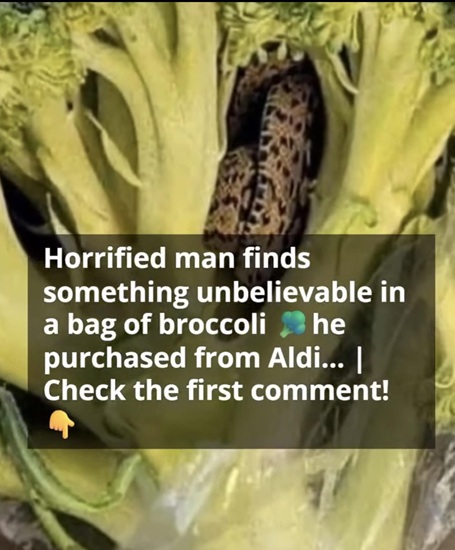
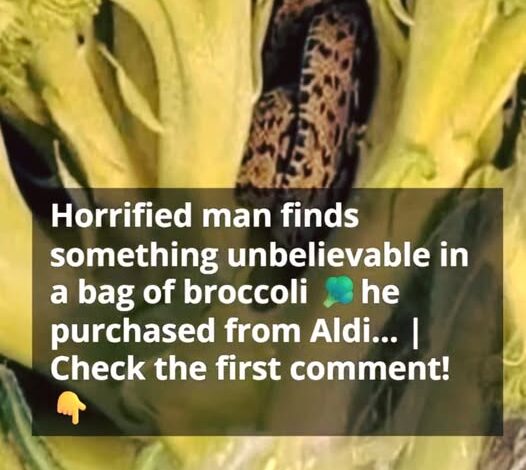
A snake.
Small.
Slender.
Perfectly camouflaged among the green florets.
That camouflage made the discovery far more psychologically disturbing than if the animal had been immediately obvious. The snake had blended naturally into the produce so effectively that it remained invisible until physical contact exposed its presence directly.
The realization shattered something deeper than comfort.
It shattered predictability.
Because modern homes operate partly on the illusion that nature remains outside where it belongs. Wildlife exists in forests, parks, documentaries, maybe gardens occasionally — but not sealed inside grocery packaging sitting quietly in suburban refrigerators.
Yet there it was.
Alive.
Hidden.
Only inches from where ordinary family food was stored.
The mind escalated instantly toward worst-case possibilities.
Was it venomous?
Could it strike?
Had it been loose inside the refrigerator?
Were there more?
How long had it been there?
Fear expands rapidly when information is incomplete.
The man later described feeling trapped between confusion and adrenaline, unable to fully decide whether to flee the kitchen or continue watching the bag carefully. The snake itself appeared equally disoriented by the encounter. Partially coiled among the broccoli, it shifted slightly beneath bright kitchen light as though confused by sudden movement after prolonged darkness and cold.
What made the moment even more surreal was imagining the creature’s journey.
The snake had somehow traveled unnoticed through an enormous industrial system designed specifically to prevent situations like this.
Fields.
Harvesting machinery.
Sorting facilities.
Packaging plants.
Transportation trucks.
Distribution centers.
Stockroom inspections.
Store refrigeration.
At no point had anyone seen it.
That detail fascinated and disturbed people later once the story spread publicly online. Because the event revealed something modern consumers rarely think about:
food systems may look industrialized, but agriculture still begins outdoors inside living ecosystems.
Broccoli fields do not exist in sterile laboratory conditions.
They exist under open skies where insects crawl through leaves, frogs hide beneath irrigation pipes, birds land between rows, and snakes move silently through vegetation searching for food or shelter.
Agricultural experts later explained that while incidents involving snakes inside produce packaging are extremely uncommon, they are not biologically impossible. Large-scale harvesting systems process enormous quantities of crops rapidly. Small animals concealed within dense vegetation can occasionally become trapped accidentally during mechanical collection.
Broccoli in particular creates ideal camouflage.
Dense florets.
Layered greenery.
Cool shade.
A small snake hidden deeply enough inside the produce could theoretically survive harvesting and transportation unnoticed if inspections failed to catch it.
Still, rational explanations offered little emotional comfort in the moment.
All the shopper knew initially was that a live reptile had emerged from his dinner ingredients.
The kitchen no longer felt safe.
That emotional shift is important psychologically. Human beings associate home environments with control. Unexpected wildlife intrusions violate that assumption sharply enough to create unusually powerful memories even when actual danger remains low.
A harmless spider discovered outdoors rarely triggers lasting distress.
A hidden snake inside a sealed refrigerator bag feels entirely different.
Because it invades a protected mental category:
domestic safety.
Trying to remain calm, the shopper avoided approaching the bag further. The uncertainty surrounding the snake amplified everything. Even people familiar with wildlife often struggle to identify species accurately under stress. Venomous or harmless? Juvenile or adult? Aggressive or frightened?
Fear fills gaps in knowledge quickly.
Animal control professionals were eventually contacted and arrived to remove the reptile safely.
Only afterward came the relief:
the snake was non-venomous.
Harmless to humans.
Experts suggested it likely belonged to a species that naturally feeds on small amphibians, insects, or aquatic prey rather than posing any real threat to people. In reality, the animal itself had probably endured a far more traumatic experience than the shopper had:
harvested accidentally,
sealed inside packaging,
transported across long distances,
stored in refrigeration,
suddenly exposed beneath bright kitchen lights by a terrified human giant.
Seen from that perspective, the encounter became strangely mutual.
Two living creatures startling each other unexpectedly inside an artificial environment neither fully understood.
Yet emotional memory rarely disappears simply because danger turns out to be minimal.
Even after learning the snake posed no threat, the shopper admitted the experience permanently changed how he handled produce afterward. Automatic habits disappeared. Every bag of vegetables now required inspection before touching anything inside.
Trust once broken rarely restores itself completely.
That reaction may sound irrational statistically.
After all, billions of produce items are consumed safely worldwide every year without hidden reptiles lurking inside them.
But emotional conditioning does not operate through statistics alone. Singular shocking experiences reshape behavior precisely because they interrupt routine so forcefully. The brain prioritizes vivid survival memories over probability calculations.
Psychologists sometimes refer to this phenomenon as “availability bias” — dramatic unusual experiences become mentally larger than their actual likelihood because the emotional memory remains highly accessible afterward.
And emotionally, the image proved unforgettable:
a hidden snake among broccoli florets beneath bright kitchen lights.
The story spread online rapidly once reported publicly.
People reacted with fascination, horror, sympathy, humor, and disbelief simultaneously. Social media thrives on stories where ordinary life suddenly collides with something primal or unexpected. A snake inside produce triggers deep instinctive reactions precisely because it combines modern domestic routine with ancient biological fear.
Many commenters admitted they immediately began inspecting their own vegetables more carefully after reading the story.
Others focused on the broader agricultural reality the incident exposed.
Modern supermarkets create an illusion of separation from nature:
clean aisles,
plastic packaging,
temperature-controlled displays,
uniform appearance.
But fruits and vegetables still originate in fields exposed constantly to weather, wildlife, soil, insects, and ecological unpredictability. Industrial systems reduce those variables enormously, but they do not erase nature completely.
Sometimes nature slips through anyway.
Food safety specialists emphasized afterward that washing and inspecting produce remains important — not because shoppers should fear hidden snakes specifically, but because fresh vegetables naturally encounter outdoor contaminants during growth and harvesting.
Dirt.
Tiny insects.
Plant residue.
Occasional wildlife contact.
That connection to natural environments is inseparable from agriculture itself.
And perhaps that became the strangest part of the entire experience:
the realization that grocery stores, despite their polished appearance, still remain linked invisibly to fields, ecosystems, and living landscapes far beyond fluorescent aisles.
For the shopper himself, however, the memory remained intensely personal rather than philosophical.
What lingered most was not necessarily fear of snakes.
It was the overwhelming shock of discovering something wild and alive in the middle of an ordinary domestic moment. The event transformed a familiar kitchen into something briefly uncertain and unpredictable.
Even afterward, preparing vegetables no longer felt entirely automatic.
Every bag required a second glance.
Every handful of leafy greens carried slight hesitation.
Not paranoia exactly.
Awareness.
And perhaps that awareness reflects something modern life often encourages people to forget:
however controlled our environments may seem, nature is never fully absent.
It waits quietly at the edges of supply chains,
beneath soil,
inside fields,
between leaves,
moving invisibly alongside human systems far more often than most people realize.
Usually those worlds remain separate enough for comfort.
But once in a while, under bright kitchen lights during an ordinary evening meal, they collide unexpectedly.
And afterward, even something as simple as opening a bag of broccoli never feels entirely routine again.