At first, almost nobody understood what they were looking at.
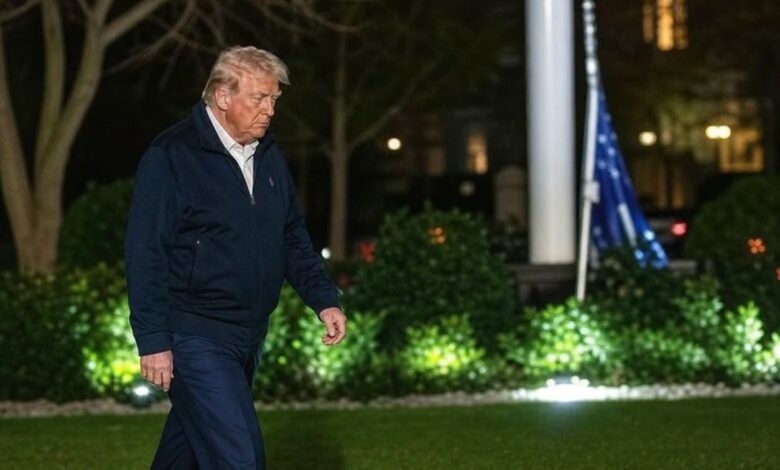
Donald Trump was recognizable instantly. Even from a distance, there was little confusion about the familiar figure moving through the crowd, surrounded by the usual mixture of security, aides, raised phones, and people trying to get close enough for a photograph.
But the person walking beside him was different.
No introduction.
No obvious explanation.
No statement telling reporters why this individual appeared to have Trump’s attention.
Just a stranger keeping pace with one of the most recognizable political figures in the world.
Within hours, that brief walk had become something much larger than the moment itself.
The photographs came first.
Some were blurry.
Others had been taken from awkward angles as people hurried to lift their phones above the crowd. A few captured only a profile or the back of a head. Video clips appeared next, often beginning too late and ending too early to provide meaningful context.
Yet that lack of clarity didn’t slow the speculation.
It accelerated it.
People zoomed in.
Screenshots circulated.
Faces were compared.
Timelines were assembled.
Social-media users began asking the question that would soon dominate discussion around the footage:
Who was walking beside Trump?
The stranger became whatever the viewer imagined.
A secret negotiator.
A wealthy donor.
A foreign intermediary.
A new political adviser.
A security figure.
A business associate.
A behind-the-scenes strategist who had finally stepped into public view.
Some theories were plausible.
Others were elaborate enough to belong in a political thriller.
None had much evidence behind them.
That didn’t matter.
Because uncertainty had created an information vacuum, and the internet hates a vacuum.
When something unusual happens around a former or sitting president, people expect an explanation almost immediately.
Names are supplied.
Titles are confirmed.
Schedules are checked.
Press offices clarify who attended meetings and why.
Political reporters call sources.
Campaign officials issue statements.
Usually, the mystery collapses quickly.
This time, according to those following the moment, clarification didn’t immediately arrive.
And silence transformed an ordinary unanswered question into something that felt significant.
Maybe nobody thought the person’s identity required explanation.
Maybe staff were busy.
Maybe the encounter was entirely routine.
Maybe the person wasn’t important at all.
Those possibilities should have reduced the temperature.
Instead, the absence of an answer had the opposite effect.
People began interpreting silence as evidence.
“If this were nothing,” some wondered, “wouldn’t somebody simply say who it was?”
That question reveals one of the strangest dynamics of modern political culture.
Silence no longer feels neutral.
It becomes content.
A missing explanation becomes an explanation.
An unanswered question becomes proof that somebody doesn’t want it answered.
And a stranger walking through a crowd can become a symbol before anyone has established the most basic facts.
The footage itself encouraged that reaction.
There was no dramatic confrontation.
No visible argument.
No podium.
No announcement.
Trump wasn’t standing before cameras introducing a new member of his team.
Nothing about the scene explicitly announced importance.
That was precisely why people found it so intriguing.
The stranger simply walked beside him.
Close enough to be noticed.
Comfortable enough to appear as though the position was natural.
And apparently important enough, at least in the eyes of viewers, not to be treated like another anonymous person in the background.
Body language became evidence.
How close were they standing?
Did Trump lean toward the person?
Did security appear familiar with them?
Was someone else making room?
Who entered first?
Who followed?
Did Trump say anything?
Was there a handshake before the recording began?
Every movement became available for interpretation.
This is where observation easily turns into projection.
A short video can tell us what happened inside the frame.
It cannot automatically tell us why.
But human beings are uncomfortable with unfinished stories.
We want motives.
We want identities.
We want beginnings and endings.
Give people ten seconds from the middle of an unexplained encounter and they will instinctively try to construct the missing hour around it.
Politics intensifies that impulse.
Power often operates outside public view.
Private meetings happen.
Advisers influence decisions without becoming famous.
Donors gain access.
Diplomats carry messages.
Lawyers negotiate.
Business leaders lobby.
Political alliances change before voters understand that anything has shifted.
Because those things genuinely happen, an unexplained figure near a powerful person can feel like a clue.
The danger is assuming every clue belongs to a conspiracy.
Sometimes a stranger is simply someone whose name hasn’t been provided yet.
But sometimes photographs do capture transitions before the public understands their significance.
History contains plenty of images that looked ordinary when they were taken and extraordinary years later.
An unknown aide standing behind a future president.
Two leaders speaking quietly before a major agreement.
A businessman entering a political circle before becoming influential.
A future decision-maker sitting unnoticed at the edge of a room.
Meaning can arrive after the photograph.
That possibility is what made this particular moment so irresistible.
What if people weren’t merely looking at somebody walking beside Trump?
What if they were seeing the beginning of something?
The question spread faster than any answer.
One account claimed the stranger had connections to international negotiations.
Another insisted the individual was involved in business.
Someone else identified an entirely different person.
Posts copied one another until speculation began masquerading as confirmation.
Soon, people weren’t merely asking who the stranger was.
They were explaining what the stranger supposedly represented.
That is how modern political mythology can form in real time.
First comes an image.
Then a question.
Then a theory.
Then somebody reposts the theory without the uncertainty attached.
Within hours, “Could this be?” becomes “This is.”
By the following day, thousands of people may be arguing over a premise nobody actually established.
The original moment almost disappears beneath the interpretations layered on top of it.
That doesn’t mean curiosity is unreasonable.
Quite the opposite.
Knowing who has access to political power is a legitimate public interest.
People surrounding presidents can influence policy, appointments, negotiations, messaging, and strategy.
Journalists are right to ask who enters those circles.
Citizens are right to care.
But there is an important difference between investigation and invention.
Investigation begins with:
Who is this?
Invention begins with:
Here’s who I think this must be, and here’s what it proves.
The first seeks information.
The second uses uncertainty as permission.
For those watching the unexplained walk, however, the emotional reaction wasn’t necessarily fear.
It was anticipation.
Something about the scene felt unfinished.
Trump moved through the crowd as he had done countless times before, yet the unknown person beside him altered the composition.
People weren’t sure whether they had witnessed something meaningful.
They only knew they couldn’t stop looking at it.
That feeling lingered after the crowd dispersed.
The footsteps ended.
Cars moved.
Security shifted.
Phones stopped recording.
Whatever conversation may have been happening continued somewhere beyond the reach of those cameras.
But online, the moment remained frozen.
Who was that?
Why were they there?
Why were they walking with Trump?
Why hasn’t anyone explained it?
Did everyone just see something important before realizing it was important?
Those questions gave an otherwise ordinary sequence an almost cinematic quality.
It felt less like a conclusion than an opening scene.
In a film, this is where the audience would understand that the unidentified character matters.
The camera would linger deliberately.
Music would change.
The person’s name would be withheld because the mystery was part of the story.
Real life doesn’t work that neatly.
There may be no reveal.
The person may eventually be identified and turn out to have a completely mundane explanation.
No secret negotiation.
No emerging power broker.
No hidden shift in Trump’s inner circle.
Just a human being who happened to be captured in an ambiguous moment.
That possibility matters.
Because uncertainty should remain uncertainty until evidence replaces it.
Yet even if the explanation proves ordinary, the reaction tells us something extraordinary about the political environment surrounding Trump.
Every unexplained gesture is scrutinized.
Every unfamiliar face becomes potentially meaningful.
Every silence invites suspicion.
That atmosphere didn’t emerge from one photograph.
It is the product of years in which politics, entertainment, social media, secrecy, leaks, conspiracy theories, genuine scandals, and relentless breaking-news cycles have collapsed into one continuous stream.
People no longer wait comfortably for context.
They analyze first.
Share second.
Conclude third.
Verification struggles to catch up.
Trump himself has always thrived inside that environment.
Few modern political figures have understood attention more instinctively.
A provocative sentence can dominate an entire news cycle.
A photograph can become a message.
A gesture can force opponents to respond.
Ambiguity can sometimes generate more attention than explanation.
Whether the mysterious walk was intentionally ambiguous is another question entirely.
There is no need to assume strategy where coincidence could explain the same thing.
But from the outside, the silence surrounding it inevitably made the image feel heavier.
And perhaps that is why people continued returning to those blurry photographs.
They weren’t really studying the stranger anymore.
They were studying power.
Power is easy to recognize when it arrives behind a podium.
It is harder to identify when it walks quietly beside someone who already possesses it.
The most influential person in a room isn’t always the person speaking.
Sometimes it’s the person being listened to.
Sometimes it’s the person nobody recognizes yet.
And sometimes, of course, it’s nobody consequential at all.
That’s what makes these moments dangerous and fascinating at the same time.
The camera captures appearance.
The audience supplies meaning.
Only evidence can tell us whether the two match.
Until then, all that truly remains is the scene itself.
Trump walking.
A stranger beside him.
People turning to look.
Phones rising into the air.
No announcement.
No explanation.
No dramatic exchange anyone could clearly hear.
Then they were gone.
The crowd returned to itself.
But the question didn’t leave with them.
It moved online, multiplying through photographs, clips, theories, and increasingly confident claims.
Perhaps an explanation will eventually make the entire episode seem obvious.
Perhaps the stranger’s identity will reveal that the public really did glimpse something consequential before understanding it.
Either outcome is possible.
For now, the most important detail isn’t who internet detectives decided the person must be.
It is how quickly uncertainty became significance.
Because political turning points don’t always arrive with flags, speeches, and breaking-news banners.
Sometimes history announces itself loudly.
Sometimes nothing historical happened at all.
And occasionally, the difference between those two possibilities begins with something as ordinary as two people walking side by side through a crowd—and everyone else wondering why.