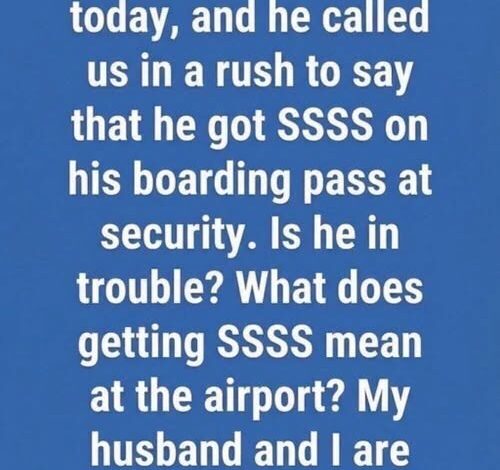
Seeing four unfamiliar letters printed on a boarding pass can be enough to make any traveler—or any parent—feel uneasy. SSSS, which stands for Secondary Security Screening Selection, often looks mysterious and intimidating, especially when it appears without explanation. Yet despite the anxiety it can cause, those letters are not an accusation, nor do they mean someone is suspected of wrongdoing.
They simply indicate that an additional security screening has been assigned before boarding.
The exact reasons someone receives an SSSS designation are not publicly disclosed in detail, and the process is designed so that no single factor guarantees it will happen. Security experts have explained that additional screening may be triggered by a variety of circumstances, including certain travel itineraries, last-minute ticket purchases, international routes, or random selection as part of ongoing aviation security procedures.
In many cases, travelers never learn why they were chosen.
That uncertainty is often what makes the experience feel so unsettling.
For a child or teenager traveling alone, the situation can seem especially overwhelming. One moment they’re standing in the regular security line like everyone else, and the next they’re asked to step aside for additional checks. Bags may be opened and inspected. Personal belongings can be examined more closely. Security officers may perform swab tests on luggage or electronic devices, and they may ask a few routine questions before allowing the traveler to continue.
To someone experiencing it for the first time, it can feel as though they’ve done something wrong.
In reality, it is a standard screening procedure carried out countless times every day at airports around the world.
For parents, however, the emotional experience is often even more difficult.
Being separated by hundreds or thousands of miles while imagining your child standing alone in an unfamiliar airport naturally creates worry. Every minute feels longer than it really is. Questions race through your mind. Is everything okay? Are they frightened? How long will it take? Should I be doing something?
That sense of helplessness is perhaps the hardest part.
As parents, we instinctively want to stand beside our children whenever they’re anxious. We want to explain what’s happening, reassure them that everything will be fine, and remind them they aren’t facing it alone.
When distance makes that impossible, even a routine security procedure can feel much larger than it truly is.
Fortunately, the overwhelming majority of travelers selected for secondary screening experience nothing more than a brief delay. Once the additional checks are complete, they continue through the airport like everyone else and board their flight without further difficulty.
For security officers, these screenings are part of everyday operations.
For the traveler, they are often a one-time experience that becomes an unexpected story to tell after arriving safely at their destination.
If your child sounds nervous during a phone call from the airport, that’s completely understandable. Airports can already feel intimidating, and unexpected attention from security personnel naturally adds to the stress. A calm voice from a parent reminding them to answer questions honestly, remain patient, and follow instructions can make an enormous difference.
Most importantly, they should remember that being selected for additional screening does not mean they are in trouble.
It does not mean they are under arrest.
It does not mean they are suspected of committing a crime.
It simply means they have been chosen for a routine security process that thousands of other passengers also experience.
Within a short time, the screening is typically finished.
The bags are repacked.
The boarding pass is returned.
The traveler heads toward the departure gate, often feeling far more relieved than when the process began.
By the time the plane lands, what seemed overwhelming at the airport has often become little more than an unusual travel memory.
Looking back, many travelers describe the experience as far less dramatic than they imagined while it was happening. The anticipation and uncertainty often prove more stressful than the screening itself.
For parents, that perspective can be comforting.
Today’s anxious phone call may very well become tomorrow’s casual text message saying, “I made it,” followed by a story shared over dinner about the unexpected delay before boarding.
In the end, those four letters carry far less meaning than they first appear to. They represent a security procedure—not a judgment of character. While the experience can certainly feel intimidating in the moment, it is designed to conclude with one simple outcome: allowing the traveler to continue safely on their journey.
And more often than not, that’s exactly what happens. Before long, the airport anxiety fades, the flight takes off, and what once felt frightening becomes just another chapter in the many adventures that come with traveling.