The apples were still rotting in our yard when the police officer arrived.
Dozens of them.
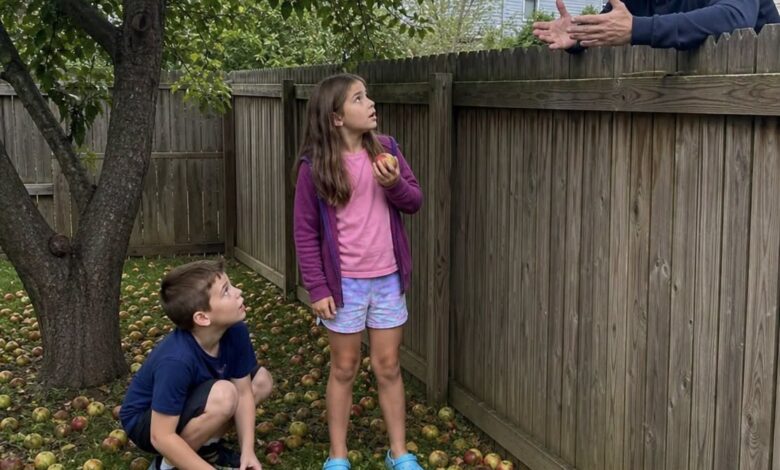
Some were freshly fallen, bright red against the grass. Others had split open in the summer heat, drawing wasps and turning the ground beneath our fence into a sour, sticky mess.
Our neighbor Dale stood on his side of the property line with his arms folded.
My husband Rob stood beside me.
And our two children watched from the kitchen window.
That was the moment I knew we couldn’t quietly clean everything up and pretend nothing had happened.
Not anymore.
For years, Dale’s apple tree had leaned over our fence.
It was enormous, probably older than either house, and every late summer its branches dropped fruit into our backyard.
At first, we didn’t mind.
When we bought the house, Dale had actually laughed about it.
“Free apples,” he’d said. “Best perk in the neighborhood.”
Our children loved them.
They’d run outside after storms looking for good ones, and sometimes we’d bake pies or make applesauce.
Dale seemed pleased.
He was in his seventies, lived alone, and had cared for that tree for decades.
I understood that it meant something to him.
That’s probably why we tolerated more than we should have.
As the tree aged, the problem grew.
More branches stretched across the fence.
More fruit fell.
And much of it wasn’t usable.
Apples hit the patio furniture.
They landed in the children’s play area.
They rolled beneath the swing set and rotted.
Rob spent hours every week raking them into bags.
Still, we tried to be neighborly.
Then one Saturday afternoon, everything changed.
Our nine-year-old son, Ben, and seven-year-old daughter, Lucy, were outside playing.
Dale saw them collecting apples.
He came to the fence and started yelling.
“You leave those alone!”
Ben froze.
Lucy dropped the apple she was holding.
Dale accused them of stealing his fruit.
Ben tried explaining that the apples had fallen into our yard.
That only made Dale angrier.
He told my children they were thieves.
Then he climbed through a loose section near the fence and entered our backyard without permission.
By the time I reached the patio, Lucy was crying.
Dale was standing several feet from them, pointing toward the ground.
“Those belong to me.”
“Dale,” I said, “get out of our yard.”
“Your kids are taking my apples.”
“They’re picking them up off our lawn.”
“They came from my tree.”
“I don’t care. You do not come onto our property and frighten my children.”
He laughed.
Actually laughed.
“You young people think property lines change common sense.”
“No. I think the property line is exactly the point.”
Rob came outside.
He’d heard enough.
“Go home, Dale.”
Something in Rob’s voice finally made him listen.
But before leaving, Dale pointed toward the scattered fruit.
“I want every one of those apples returned.”
Rob looked at him.
“No.”
Dale blinked.
“What?”
“You’re not getting them from us.”
“You can’t keep my property.”
Rob glanced at the ground.
“We aren’t keeping anything.”
Then he walked inside.
And from that day forward, Rob refused to rake a single apple.
At first, I thought he was being stubborn.
“Rob, this is disgusting.”
“I know.”
“There are wasps everywhere.”
“I know.”
“The kids can’t even play near the fence.”
“I know.”
“So why aren’t we cleaning them up?”
He looked through the window toward Dale’s tree.
“Because that’s what he expects.”
“What?”
“He frightened our kids, came into our yard, demanded we clean up the consequences of his tree, and now he expects us to make the whole problem disappear.”
Rob shook his head.
“No. Not yet.”
I understood then.
The apples weren’t the real issue anymore.
Our children were.
Ben had started asking whether he’d actually stolen something.
Lucy no longer wanted to play outside alone.
Dale had turned something innocent into something frightening, then acted as though his age and history in the neighborhood entitled him to do it.
I wasn’t willing to teach my children that keeping the peace meant accepting that.
So we documented everything.
Photographs of the branches.
Photographs of the fallen fruit.
Photographs of the damaged fence.
We wrote down what had happened with the children while everyone’s memory was fresh.
Then I contacted the appropriate local authorities and sought legal guidance about the property issue.
That’s when I first heard a phrase that made Rob laugh despite everything.
“Gravity fruit.”
The basic principle we were advised about was far less dramatic than Dale had made it sound: property and tree disputes depend heavily on local law, but fruit that naturally falls across a property boundary isn’t automatically an excuse for the tree’s owner to enter someone else’s yard whenever he chooses.
And whatever disagreement existed about apples, Dale did not have unlimited permission to trespass onto our property and confront our children.
That was the line that mattered.
When an officer eventually spoke with him, Dale’s attitude changed.
He was still defensive.
He talked about having planted the tree with his late wife.
He said he’d been collecting its apples longer than we’d been alive.
He insisted that everybody who had previously lived in our house had understood.
The officer listened.
Then he asked a simple question.
“Did the homeowners tell you to leave their property?”
Dale hesitated.
“Yes.”
“And did you?”
“Eventually.”
The conversation continued from there.
No dramatic arrest followed.
No one put Dale in handcuffs.
That wasn’t what we wanted.
What we wanted was a boundary clear enough that our children could feel safe in their own backyard.
Dale was formally told not to enter our property without permission.
Afterward, we addressed the tree through the proper channels and followed local rules concerning branches extending over the property line.
For the first time in years, the problem wasn’t being handled through assumptions and neighborly favors.
It was being handled clearly.
Dale hated that.
For several weeks, he wouldn’t look at us.
The apples continued falling.
Rob continued leaving them.
By September, the strip of lawn beneath the tree looked terrible.
Then something unexpected happened.
One evening, Dale knocked on our front door.
He wasn’t angry.
He looked tired.
“I’d like to speak to the children.”
My entire body tightened.
“Why?”
“To apologize.”
I didn’t immediately let him in.
Neither did Rob.
We asked Ben and Lucy whether they wanted to hear him.
Ben said yes.
Lucy stood behind her father.
Dale remained on the porch.
He looked at Ben first.
“I shouldn’t have called you a thief.”
Then Lucy.
“And I shouldn’t have scared you.”
She stared at him.
“You were really loud.”
“I know.”
“You came into our yard.”
“I know that too.”
Dale looked down.
“I was wrong.”
There was no speech about his age.
No excuse about his wife.
No demand that we understand how special the tree was.
Just:
“I was wrong.”
Ben asked the question only a nine-year-old would think to ask.
“So can we eat the apples?”
For the first time in months, Dale smiled.
“If they fall in your yard, I suppose you’d better.”
Lucy wasn’t convinced.
“Even the red ones?”
“Especially the red ones.”
The tension broke.
Not completely.
But enough.
The following weekend, Dale hired someone to prune the tree properly.
Rob helped move a ladder.
I made coffee.
Nobody pretended the previous month hadn’t happened.
That was important to me.
Forgiveness didn’t require rewriting history.
Dale had frightened our children.
We had needed outside help to establish a boundary he should have respected from the beginning.
His apology mattered precisely because accountability came first.
A few weeks later, I looked outside and saw Lucy standing near the fence.
An apple dropped.
She picked it up.
Dale was gardening on the other side.
Lucy held it toward him.
“This one’s good!”
He inspected it through the fence.
“Looks like pie material.”
She ran inside.
That evening, we baked one.
Ben insisted on adding too much cinnamon.
Lucy decorated the crust.
Rob cut four pieces.
Then he stopped.
“Five.”
He carried the extra slice next door.
I watched through the window as Dale opened his door.
They spoke for a moment.
Then Dale accepted the plate.
That pie wasn’t surrender.
It wasn’t us admitting we’d overreacted.
And it certainly wasn’t permission for Dale to ignore our boundaries again.
It was kindness offered after the boundary had become clear.
There’s a difference.
For a long time, I’d believed being a good neighbor meant absorbing inconvenience quietly.
Rake the apples.
Smile.
Don’t make trouble.
Excuse the older man because he’d lived there first.
But my children taught me something different.
They were watching what we tolerated.
If we’d immediately cleaned the yard, apologized to Dale and told them to forget what happened, what would they have learned?
That adults can frighten you if they’re older?
That someone’s sentimental attachment gives them authority over your space?
That maintaining peace matters more than saying, “You crossed a line”?
Instead, they saw their parents stop.
Document what happened.
Ask for help.
Set a boundary.
And then, when the person responsible finally acknowledged the harm, they saw us accept an apology without pretending the harm had never existed.
The apple tree is still there.
Every August, fruit still lands on our side of the fence.
We rake it now.
Some goes into the compost.
Some becomes applesauce.
The best ones become pie.
Dale occasionally receives a slice.
But he knocks before entering our yard.
Every single time.
And our children don’t flinch when they see him anymore.
That’s the part I care about.
The law didn’t magically repair our relationship with our neighbor.
An officer couldn’t undo what my children had felt.
A property line couldn’t manufacture respect.
But clear boundaries shifted the burden back where it belonged.
My children stopped wondering whether they’d done something wrong.
Dale had to confront the fact that he had.
And when he finally apologized, the apples became apples again.
Not evidence.
Not weapons.
Not a neighborhood war.
Just fruit falling from an old tree.
I used to think kindness meant avoiding conflict.
Now I know better.
Sometimes kindness comes after the uncomfortable part.
After someone hears no.
After the boundary holds.
After responsibility is accepted.
Because kindness without boundaries can become permission.
But kindness after accountability?
That’s something entirely different.
That’s how neighbors begin again.