Storage Wars star Darrell Sheets’ autopsy report reveals heartbreaking new details about his death

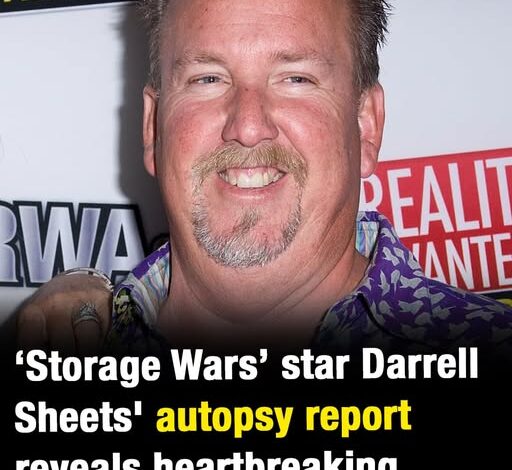
The final report offered answers, but not the kind anyone truly wanted.
When investigators completed the autopsy of Darrell Sheets, the findings were clinical, precise, and devoid of emotion. Pages of medical terminology and toxicology data painted a factual picture of his final hours. Yet beneath the technical language lay a devastating reality that struck family members, friends, fans, and colleagues with renewed force.
Darrell Sheets, known to millions as “The Gambler” from the hit television series Storage Wars, had no drugs in his system when he died.
No cocaine.
No fentanyl.
No benzodiazepines.
No intoxicants.
No substances capable of impairing judgment or obscuring awareness.
The toxicology report was unequivocal.
He was sober.
Completely sober.
And for many people following the tragedy, that detail proved particularly difficult to process.
In the aftermath of any high-profile death, speculation tends to spread quickly. Social media platforms fill with theories. Comment sections become battlegrounds of assumptions. Strangers search for explanations that make painful events easier to understand.
Some wondered whether addiction played a role.
Others speculated about hidden medical conditions.
Still others suggested an impulsive decision influenced by substances.
The autopsy effectively eliminated those possibilities.
What remained was something more unsettling.
The realization that whatever burden Darrell carried, he faced it with a clear mind.
According to the report, he was a well-developed, well-nourished 67-year-old man. The language was routine, the same terminology used in countless examinations every year. Yet many who read the findings found themselves reflecting on the contrast between physical appearance and emotional reality.
The report described a body that appeared strong.
A body that had endured decades of work, travel, television production, and public attention.
A body that showed no obvious signs of neglect.
Yet no medical examination can fully measure emotional suffering.
No autopsy can quantify loneliness.
No laboratory test can calculate despair.
No toxicology report can explain what a person feels when they reach a breaking point.
That distinction became increasingly important as investigators turned their attention toward another possibility—one that exists not in the physical world but in the digital one.
In the weeks surrounding his death, allegations emerged suggesting Darrell may have been subjected to sustained online harassment and cyberbullying.
What initially seemed like isolated comments soon attracted greater scrutiny.
Investigators reportedly seized and examined his phone, searching for communications, messages, social media interactions, and digital records that might provide additional context.
The effort reflected a growing recognition of a modern reality.
Emotional harm often arrives through screens.
Cruelty no longer requires physical proximity.
A person can be surrounded by millions of viewers, followers, and fans while simultaneously feeling isolated beneath waves of criticism, ridicule, or abuse.
The internet has transformed communication in extraordinary ways.
It has connected people across continents.
Created communities.
Shared stories.
Built careers.
Yet it has also created environments where hostility can multiply with frightening speed.
Words written in seconds can linger for years.
Anonymous comments can inflict very real pain.
Digital attacks can follow a person into every corner of their life.
Investigators sought to determine whether such pressures contributed to Darrell’s emotional state.
Whether they ultimately establish a direct connection remains uncertain.
But the inquiry itself highlights a question society continues to confront.
How much weight do online words carry?
And how often do we underestimate their impact?
For viewers of Storage Wars, Darrell Sheets often appeared larger than life.
He was bold.
Confident.
Outspoken.
A gambler in every sense of the word.
His television persona projected toughness and resilience.
Audiences watched him make high-risk bids, negotiate fiercely, and celebrate major discoveries hidden inside abandoned storage units.
Over time, he became one of the show’s most recognizable figures.
Many fans felt they knew him.
Yet public personas rarely tell the complete story.
Television captures moments.
Not entire lives.
Audiences see edited episodes measured in minutes.
They do not see private struggles.
Personal disappointments.
Moments of vulnerability.
The quiet battles that unfold far from cameras.
In the days following his death, that distinction became increasingly apparent.
The public conversation gradually shifted.
At first, attention centered on facts.
The investigation.
The autopsy.
The circumstances.
The unanswered questions.
But eventually something deeper emerged.
Grief.
Not speculation.
Not controversy.
Grief.
Family members mourned.
Friends shared memories.
Former colleagues reflected on years spent working alongside him.
Fans revisited favorite episodes and unforgettable moments.
The man behind the television character slowly moved back into focus.
Perhaps nowhere was this more visible than in the tributes that followed.
Storage Wars honored Darrell by dedicating an episode to him.
For longtime viewers, the gesture carried emotional significance.
Television programs often feel temporary.
Episodes air.
Seasons end.
New content replaces old.
Yet dedicating an episode preserves a person’s place within the history of a show.
It transforms entertainment into remembrance.
For many fans, seeing “The Gambler” honored in that way felt appropriate.
After all, Darrell was not merely part of the program.
He helped define it.
His personality, confidence, and unpredictability contributed significantly to the show’s success.
The tribute acknowledged that reality.
But perhaps the most heartbreaking remembrance came not from television producers or industry colleagues.
It came from his son.
Brandon Sheets had spent years in the public eye alongside his father.
Viewers watched their relationship evolve across multiple seasons.
They witnessed disagreements, lessons, humor, and moments of genuine affection.
The dynamic between father and son became familiar to audiences.
After Darrell’s death, Brandon’s words resonated deeply with many people.
On what should have been a celebratory occasion, he instead found himself marking his father’s birthday without him.
His tribute was simple.
Honest.
Painfully human.
He thanked the father who raised him.
The father who shaped him.
The father who remained central to his life.
And like so many grieving children throughout history, he expressed a wish that can never be fulfilled.
One more day.
Just one more conversation.
One more laugh.
One more opportunity to say the things left unsaid.
The request was impossible.
Yet universally understood.
Because grief often reveals itself through ordinary desires.
Not grand gestures.
Not dramatic speeches.
Just simple wishes.
One more hug.
One more phone call.
One more meal shared together.
One more chance.
Those wishes linger because love does.
As the weeks passed, the noise surrounding the case gradually faded.
News cycles moved on.
Speculation diminished.
Public attention shifted elsewhere.
Yet for those closest to Darrell, life had permanently changed.
The reality of loss does not follow media timelines.
It does not end when headlines disappear.
It continues quietly.
Day after day.
Month after month.
Year after year.
The autopsy provided answers regarding physical facts.
Investigators established what substances were present.
What substances were absent.
Medical findings were documented.
Official conclusions were recorded.
Yet even the most thorough report has limits.
Certain questions cannot be answered through science alone.
Why was he hurting?
What thoughts occupied his mind during his final days?
Which moments weighed most heavily on him?
What private struggles remained invisible to others?
These questions exist beyond the reach of laboratories and medical examiners.
They belong to the complex territory of human experience.
And often, they remain unanswered.
That reality can be frustrating.
People naturally seek explanations.
We want causes.
Reasons.
Narratives that create order from tragedy.
Yet some losses resist simplification.
Some stories refuse neat conclusions.
The death of Darrell Sheets appears to be one of them.
The official documents tell part of the story.
The toxicology findings tell part of the story.
The investigation tells part of the story.
But the complete picture exists only within the memories of those who knew him best.
The family members who shared holidays.
The friends who shared conversations.
The colleagues who shared years of work.
The son who shared a lifetime.
In the end, the autopsy established facts.
Necessary facts.
Important facts.
But facts alone cannot measure absence.
They cannot describe the silence left behind when a familiar voice disappears.
They cannot explain the emptiness at family gatherings.
They cannot account for birthdays that arrive without celebration.
They cannot quantify the weight carried by loved ones forced to continue living after a loss they never wanted.
That burden belongs to the people left behind.
And while official reports eventually become archived documents, grief remains active.
Living.
Changing.
Persisting.
Long after investigations conclude.
Long after television tributes air.
Long after public attention fades.
Because in tragedies like this, the final report may close a case.
But for the people who loved him, the story never truly ends.
It simply becomes a different kind of journey—one measured not by evidence or headlines, but by memory, healing, and the enduring hope that the people we lose continue to matter through the lives they touched.
And for those who knew Darrell Sheets not as a television personality but as a father, friend, colleague, and loved one, that legacy remains far more important than any document ever could.