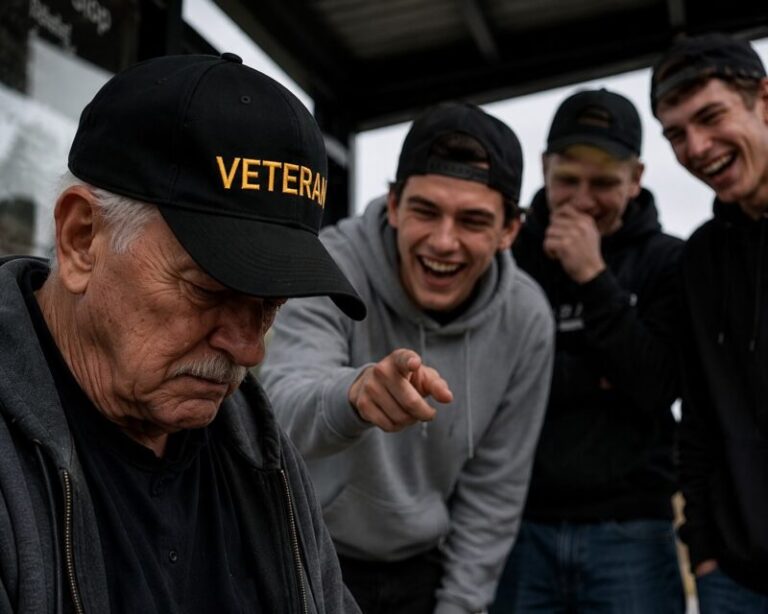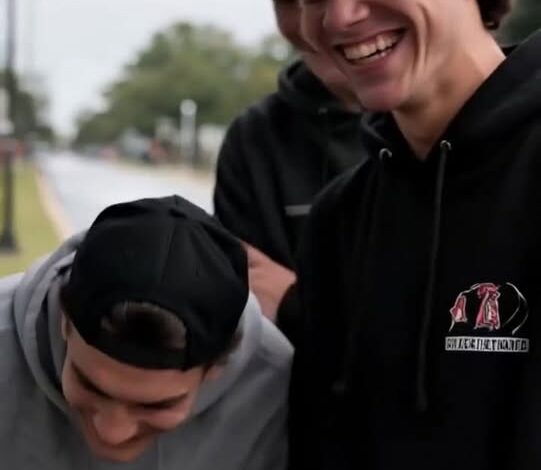
The old man said nothing when they laughed at him.
He simply sat on the cold metal bench, his hands folded over the handle of his cane, his faded cap pulled low against the morning wind. Around him, the city was waking slowly beneath a dull gray sky. The pavement still glistened from an earlier drizzle, reflecting headlights, traffic signals, and the hurried footsteps of people who had somewhere to be.
It was the kind of morning most people forgot before lunch.
But for everyone at that bus stop, it would become something they remembered.
The bus stop stood near a busy intersection, tucked between a storefront with fogged-up windows and a narrow strip of wet sidewalk. Cars rolled through puddles. Buses groaned in the distance. Pedestrians moved quickly with their collars raised and their eyes fixed ahead, each person wrapped inside the private urgency of an ordinary weekday.
The elderly man did not move with urgency.
He had learned, over the years, that life did not always reward rushing.
So he waited.
Quietly.
Patiently.
He wore a worn brown jacket that had clearly seen too many winters. The cuffs were frayed, and one button near the front had been replaced with another that did not match. His shoes were polished but old, the kind a man keeps wearing long after others would have thrown them away. On his head was a faded cap with one word stitched across the front.
Veteran.
The letters were slightly crooked now, softened by time and weather, but still visible.
He did not wear the cap to invite praise.
He wore it because it belonged to him.
Because it represented a part of his life that had never really ended, even after the uniform came off.
When he shifted slightly on the bench, the bottom of one trouser leg lifted just enough to reveal the metal curve of a prosthetic leg beneath it.
It was not dramatic.
It was not something he displayed.
It was simply there.
A quiet fact.
A permanent reminder of a chapter he rarely discussed.
Long before that morning, long before the bus stop, long before the city had learned to pass by him without looking twice, he had been a different man.
He had once stood straight-backed and broad-shouldered in places where the nights were never truly quiet. He had followed orders, carried weight, learned discipline, and watched fear turn young men into strangers. He had served in conditions most people would never understand, and when people thanked him for that service, he usually nodded and changed the subject.
Because gratitude was easier to accept than memory.
And memory was not always kind.
The injury had changed his body first.
Then it changed everything else.
Returning home had not felt like returning to peace. It had felt like being dropped into a world that had continued without him. People expected him to be grateful, relieved, healed. They expected him to know how to become ordinary again.
But ordinary life was harder than it looked.
The routines that had once guided him were gone. The voices that had once surrounded him faded. Friends moved away. Family members became busy. Neighbors changed. Conversations grew shorter. Invitations stopped coming.
And over time, his life became smaller.
Not meaningless.
Just quieter.
He found comfort in simple things.
The same grocery store.
The same morning bus.
The same bench.
The same route through a city that barely noticed him.
He was used to being overlooked.
He was also used to being stared at.
There were always different kinds of looks. Some people glanced at his prosthetic leg and quickly looked away, embarrassed by their own curiosity. Some offered soft smiles filled with pity. Others stared openly, as though his injury were a puzzle they had permission to study.
He had grown used to all of it.
That morning, he sat silently as the wind moved through the street and lifted the edges of his jacket.
The bus was late.
He checked the road once, then lowered his eyes again.
That was when the three young men arrived.
They came in loud.
Not violent.
Not angry.
Just loud in the way young men sometimes are when they believe the world belongs to them and everyone else is only background.
They were laughing before they reached the bus stop, shoving each other lightly, talking over one another, their sneakers splashing through shallow puddles. One of them carried a half-empty drink. Another had his hood pulled up, his hands buried in his pockets. The third walked with the careless swagger of someone who enjoyed being watched.
At first, they did not notice the old man.
They stood near the shelter, still joking among themselves.
Then one of them looked down.
His eyes landed on the prosthetic leg.
The laughter faltered for half a second.
Then his mouth curled.
He nudged the friend beside him.
“Yo,” he said, not quietly enough. “Look at that.”
The second young man followed his gaze.
The third did too.
For a brief moment, none of them spoke.
The veteran kept looking forward.
He knew that pause.
He had felt it many times before.
It was the silence people entered before deciding what kind of person they were going to be.
Then one of them laughed.
Not loudly at first.
Just a short, sharp sound.
Enough to make the others join in.
The first comment came disguised as a joke.
Then another followed.
Then another.
Each one was a little bolder than the last.
They spoke about the prosthetic leg as though the man attached to it could not hear them. As though age had made him invisible. As though silence meant permission.
The veteran did not turn.
He did not defend himself.
He did not ask them to stop.
His jaw tightened once, barely enough for anyone to notice, and then his face settled again into stillness.
He had survived worse than words.
But that did not mean words could not hurt.
The young men mistook his silence for weakness.
Their laughter grew louder.
A woman standing nearby looked up from her phone, saw what was happening, and quickly looked away.
A man in a dark coat slowed his steps, frowned, then continued walking.
Another commuter shifted uncomfortably but said nothing.
The city, as it often does, pretended not to see.
That was what made the moment feel colder than the weather.
It was not only the mockery.
It was the silence around it.
The old man sat alone on the bench, surrounded by people, while three strangers made sport of a wound they did not understand.
Across the sidewalk, near the entrance of a small storefront, another man had been standing with a paper coffee cup in his hand.
He had arrived a few minutes earlier and had been waiting under the awning to avoid the drizzle still dripping from the edge of the roof. He looked ordinary at first glance—dark jacket, simple trousers, tired eyes, the posture of someone on his way to work.
But he was watching.
At first, he only glanced toward the group.
Then he looked again.
His expression changed slowly.
The casual softness left his face.
His eyes fixed on the young men, then on the veteran, then back again.
He did not move immediately.
He listened.
He gave them one chance to stop on their own.
They did not.
One of the young men made another remark, this one crueler than the others. The kind of remark that turns a person’s pain into entertainment.
The group burst into laughter.
That was when the man by the storefront stepped away from the awning.
He set his coffee down on the ledge behind him.
Then he walked toward them.
Not fast.
Not aggressively.
Just steadily.
The change in the air was immediate.
One of the young men noticed him first. His laughter faded.
The others turned.
The man stopped directly in front of them.
For a second, no one spoke.
Traffic rushed behind them. Rainwater slipped from the bus shelter roof in slow, steady drops. The veteran remained seated, his eyes still lowered, though now his fingers had tightened around the top of his cane.
The man looked at the three young men and said calmly, “Are you proud of yourselves?”
The question landed harder than shouting would have.
The young man in the hood frowned. “What?”
“You heard me,” the man said. “Are you proud of yourselves?”
The group exchanged glances.
The one with the drink gave a nervous laugh. “Man, we were just joking.”
“No,” the man replied. “You were not joking. You were humiliating an old man in public because you thought he would not answer back.”
His voice remained controlled.
That made it more powerful.
People nearby began paying attention now. The woman with the phone lowered it. The man who had nearly walked away slowed down. Even the cars seemed less important for a moment.
The young men shifted uneasily.
The confident one lifted his chin. “It’s not that serious.”
The man took one step closer.
“It is exactly that serious.”
The young man’s smirk faded.
The man pointed—not at the prosthetic leg, but at the veteran himself.
“That man has lived a life you know nothing about. He has carried pain you cannot see and loss you probably could not imagine. And instead of showing basic respect, you stood here laughing at him.”
No one interrupted.
Even the wind seemed to pause.
“You think it makes you look strong?” the man continued. “Mocking someone who is sitting alone, minding his own business? Making fun of a person’s injury? That does not make you strong. It makes you small.”
The words struck exactly where they needed to.
The young man with the drink looked down.
The one in the hood swallowed but said nothing.
The third glanced toward the veteran for the first time without amusement.
The veteran did not look back at them.
His face remained calm, but something in his shoulders had changed. The tension was still there, but so was something else.
Recognition.
Not of praise.
Not of rescue.
But of the simple fact that someone had decided he was worth defending.
The man’s voice softened slightly, though it lost none of its firmness.
“Humor is not cruelty. A joke is not a joke when the only person laughing is the one causing harm. If you want to be funny, be funny without stripping someone else of dignity.”
The young man in the hood muttered, “We didn’t mean anything.”
The man looked at him.
“Then learn to mean better.”
That silenced him.
For a while, nobody moved.
The bus stop, which had been filled with laughter moments earlier, now held a heavy quiet.
It was not the same silence as before.
This silence had weight.
It demanded thought.
The three young men no longer looked proud. Their shoulders had lowered. Their eyes moved anywhere except toward the man standing in front of them.
Finally, the one who had made the first comment turned slightly toward the veteran.
His voice came out low.
“Sorry.”
It was not perfect.
It was awkward.
It was embarrassed.
But it was real enough to matter.
The veteran lifted his eyes.
For the first time, he looked directly at the group.
His face revealed no anger.
Only exhaustion.
And a depth of patience that made the apology feel even heavier.
After a moment, he gave a small nod.
Not forgiveness exactly.
Not absolution.
Just acknowledgment.
The man who had intervened stepped back.
He did not lecture further.
He did not threaten them.
He did not try to turn the moment into a performance.
He had said what needed to be said.
That was enough.
A few minutes later, the bus arrived with a hiss of brakes and a sigh of opening doors.
The ordinary sounds of the city returned.
People moved forward, adjusted bags, checked passes, and formed a loose line near the curb.
The veteran stood slowly.
The movement took effort.
He planted his cane carefully, shifted his weight, and rose from the bench with the practiced control of someone who had done difficult things alone for a long time.
The man who had spoken stepped forward, not too close, not in a way that suggested pity.
“Would you like a hand?” he asked.
The veteran looked at him.
For a moment, something unreadable passed across his face.
Then he gave the faintest smile.
“I’ve got it,” he said.
His voice was rough but steady.
The man nodded respectfully.
“I figured you did.”
That small exchange said more than a dramatic speech ever could.
The veteran boarded the bus.
The young men stayed back, quiet now.
One of them stared at the wet pavement. Another rubbed the back of his neck. The third watched the old man climb aboard, and for the first time that morning, he seemed to understand that the person he had mocked was not a punchline.
He was a man.
A man with a past.
A man with scars.
A man who had given parts of himself to a world that now often hurried past him without noticing.
The doors began to close.
Before they did, the veteran turned his head slightly and looked through the window.
His eyes found the man near the curb.
He lifted two fingers in a small gesture.
Not a salute exactly.
Not quite a wave.
Something in between.
The man returned the gesture.
Then the bus pulled away.
Water sprayed from its tires as it merged back into traffic, carrying the veteran into the gray morning.
The bus stop slowly returned to normal.
People checked their phones again.
Cars honked.
The drizzle began to fall lightly once more.
But something had changed.
Not loudly.
Not dramatically.
Still, it had changed.
The young men did not resume laughing. They stood in silence until another bus arrived, each trapped in his own thoughts. Perhaps by the end of the day, they would try to forget the embarrassment. Perhaps they would joke about it later to make themselves feel better.
Or perhaps one of them would remember the old man’s face.
Perhaps one of them would remember the question.
Are you proud of yourselves?
And perhaps, the next time cruelty disguised itself as humor, they would recognize it before joining in.
That is how change sometimes begins.
Not with a grand speech.
Not with punishment.
Not with applause.
Sometimes it begins at a bus stop on a cold morning, when one person decides that silence is no longer acceptable.
Because disrespect survives when good people look away.
It grows in the space between discomfort and action.
It thrives when people convince themselves that it is not their business.
But dignity is everyone’s business.
The veteran did not ask to become a lesson that morning. He had only wanted to catch a bus. He had only wanted to move through the city quietly, carrying his history the way he always did.
But the moment revealed something important.
Respect is not proven in ceremonies, speeches, or carefully chosen words spoken on special days.
It is proven in ordinary places.
On sidewalks.
In bus stations.
In grocery lines.
In the small, passing moments when no one is being rewarded for doing the right thing.
The man who stepped forward did not change the world that morning.
But he changed that moment.
And sometimes, changing one moment is enough.
Enough to remind a lonely old man that he is not invisible.
Enough to make three young men confront the ugliness of their own behavior.
Enough to show every silent witness that courage does not always roar.
Sometimes it simply asks a question.
Sometimes it stands calmly in front of cruelty and refuses to move.
And sometimes, on a gray morning in a busy city, it gives dignity back to someone who should never have had to lose it in the first place.