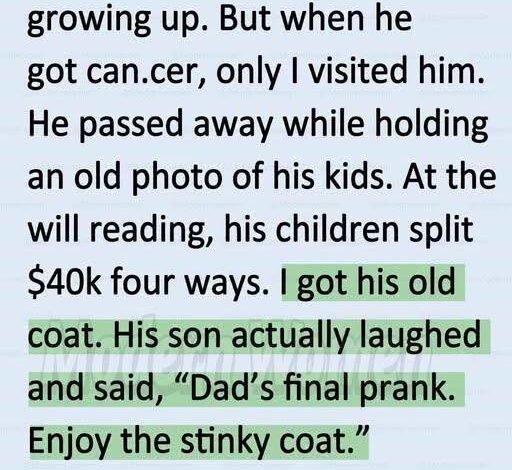
The old coat still hangs in the same corner of the closet.
Its fabric has faded with age, the cuffs are worn smooth, and one button has long since disappeared. Anyone else would probably see nothing more than an outdated jacket that should have been donated years ago.
But he has never been able to throw it away.
Because its value was never measured by the cloth it was made from.
It was measured by what it carried.
Sometimes, on quiet evenings, he opens the closet door and lets his eyes rest on it for a moment. He doesn’t touch it often. He doesn’t need to.
The memories arrive on their own.
He remembers the antiseptic smell of the hospital room.
The steady rhythm of medical monitors.
The pale afternoon light slipping through half-closed blinds.
Most of all, he remembers the silence.
Not the peaceful kind.
The uncomfortable silence shared by two people separated by years of misunderstandings neither knew how to repair.
His uncle looked impossibly small beneath the blankets.
The man who had once filled every room with opinions, sharp words, and stubborn certainty now struggled to hold a single photograph in trembling hands.
For a long time, neither of them spoke.
There wasn’t much left to argue about.
He hadn’t gone there expecting gratitude.
He certainly hadn’t gone hoping for an inheritance.
The visit had happened for one simple reason.
His mother had quietly asked him to go.
“Whatever happened between him and the rest of the family,” she had said, “no one should have to leave this world believing they’ve been completely forgotten.”
So he went.
Not as a potential beneficiary.
Not as someone hoping old wounds might suddenly disappear.
But as a son honoring his mother’s request.
And as a human being unwilling to let another person face the end of life entirely alone.
His uncle never offered a dramatic apology.
He wasn’t that kind of man.
Instead, he reached into the pocket of the old coat folded beside the hospital bed.
“I’ve been meaning to give you this.”
Inside the pocket rested a sealed envelope.
His hands shook as he accepted it.
“I don’t deserve forgiveness,” his uncle said quietly.
“I know.”
It wasn’t cruel.
It was simply honest.
The older man nodded.
“I just wanted you to know…”
He stopped, searching for words that had apparently spent decades refusing to come.
“…I was lonelier than I ever admitted.”
Those few sentences explained more than years of arguments ever had.
The anger.
The criticism.
The impossible standards.
The habit of pushing people away before they had the chance to leave first.
What had always looked like hardness now revealed itself as something far sadder.
Fear.
Pride had become armor.
Harsh words had become walls.
And behind them stood a man who had spent years convincing himself that distance hurt less than disappointment.
After the funeral, he finally opened the envelope.
The letter inside was written in careful, uneven handwriting.
Every sentence felt heavier than the last.
His uncle admitted mistakes he had never spoken aloud.
He acknowledged birthdays missed, conversations cut short, and opportunities for reconciliation that pride had quietly destroyed.
Then came the final page.
There were instructions.
A property deed.
Information about a safety deposit box.
Financial documents.
Together they revealed assets totaling nearly six hundred thousand dollars.
He stared at the papers in disbelief.
For a long time, he couldn’t understand why.
There were relatives wealthier than he was.
Others who had maintained more frequent contact.
Some who had openly expected to inherit.
Yet none of them had received what rested inside that envelope.
Only later did the answer become clear.
The inheritance wasn’t a reward.
It was an act of trust.
His uncle had chosen the only person who arrived with empty hands.
The one who never asked for anything.
The one who sat beside his hospital bed without mentioning money, property, or wills.
Someone who came because compassion mattered more than expectation.
The property.
The safety deposit box.
The savings.
Those things changed his financial future.
But they were never the most valuable part of what his uncle left behind.
The true inheritance was hidden inside the letter itself.
An apology too difficult to speak aloud.
A confession of loneliness carefully folded between legal documents.
A final attempt to become honest before time ran out.
Money can purchase security.
It cannot rewrite the past.
It cannot restore missed holidays or repair years spent apart.
But it can become something else.
A final gesture.
A way of saying, I should have trusted you sooner.
Years later, visitors occasionally notice the old coat still hanging in the closet.
They ask why he keeps something so worn.
He usually smiles.
“It’s not just a coat.”
And he leaves it at that.
Because some stories belong not to objects, but to the people who carried them.
Every thread reminds him that appearances can be astonishingly misleading.
What seemed worthless concealed extraordinary value.
What appeared to be a bitter, difficult man had quietly carried regret for years without knowing how to set it down.
The fortune eventually found its place in practical things—a secure home, charitable gifts, college funds for the next generation, and a future his uncle probably always hoped someone in the family would have.
The coat remained exactly where it had always been.
Not because of sentiment alone.
But because it represented the moment he learned that the greatest inheritances are rarely counted in dollars.
They are measured in understanding.
In forgiveness offered without obligation.
In compassion given before it is earned.
And in the quiet realization that sometimes the person who spent a lifetime pushing everyone away is simply waiting for one soul willing to walk through the door without expecting anything in return.
His uncle left behind property, savings, and a letter that changed everything. Yet those were only the visible gifts. The one that mattered most was invisible: the knowledge that kindness offered with no thought of reward can reach places that pride never could. In the end, the old coat became more than a keepsake. It became proof that even at the very end of life, love can still find the courage to speak—and that the person who arrives with empty hands sometimes leaves carrying the richest inheritance of all.