The Day Respect Walked Through Our Door After a Public Outburst at a Young Pregnant Waitress Changed Everything I Believed About My Partner

For years, he carried himself with the quiet confidence of someone convinced the rules were written for people like him.
Success had become more than something he achieved—it had become part of his identity. An expensive suit, a prestigious title, and a generous paycheck reinforced the belief that he belonged at the center of every room he entered. He spoke loudly because he assumed people would listen. He interrupted because he expected to be heard. And when someone challenged him, he treated it as an inconvenience rather than a possibility that he might be wrong.
It was a mindset that had gone unchecked for years.
Until one ordinary afternoon, when a knock at our front door changed everything.
When I opened it, I almost didn’t recognize Evelyn.
The last time we’d seen each other, she’d been wearing a stained apron, cleaning supplies tucked beneath one arm after finishing a long shift. She had smiled despite obvious exhaustion, thanked everyone for their kindness, and quietly disappeared before drawing much attention to herself.
Today was different.
She stood in our hallway with her shoulders back and her head held high, dressed simply but with unmistakable confidence. There was no trace of hesitation in her expression.
She hadn’t come to defend herself.
She had come to tell the truth.
Standing beside her was another unexpected visitor.
Claire.
The woman whose signature appeared on every paycheck my husband proudly brought home.
The executive whose approval could shape careers with a single conversation.
The color drained from his face the instant he recognized her.
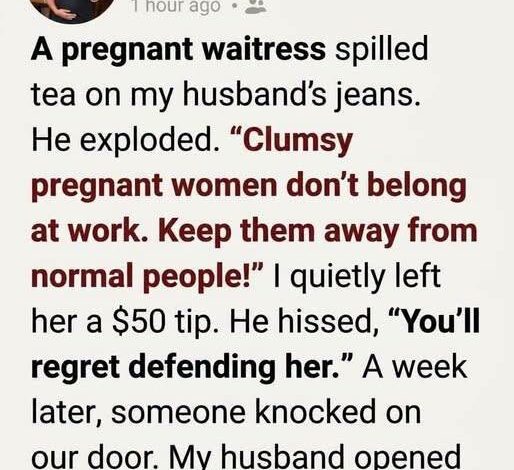
Only days earlier, he’d mocked Evelyn over an accident so small it should have been forgotten within seconds. A spilled drink had somehow become an excuse for ridicule, and he’d treated her as though her job made her less deserving of respect.
Now the room had shifted.
The confidence that usually filled his voice disappeared.
The man who could dominate boardroom meetings suddenly couldn’t seem to find a complete sentence.
“What… what are you doing here?” he finally managed.
Claire answered before Evelyn could.
“We’re here because I wanted to hear this conversation myself.”
Her tone wasn’t angry.
It didn’t need to be.
It carried the calm authority of someone who had already reached a conclusion.
Silence settled over the room.
No one rushed to fill it.
Evelyn stepped forward.
She didn’t point a finger.
She didn’t shout.
She didn’t insult him the way he’d insulted her.
Instead, she spoke with remarkable composure.
“You probably don’t remember every word you said,” she began softly.
“I do.”
She paused just long enough for the weight of that sentence to settle.
“You embarrassed me in front of strangers.”
“You made assumptions about my intelligence because of my job.”
“You acted as though treating someone with kindness depended on what they earned.”
Her voice never cracked.
It never rose.
It simply told the truth.
“I went home wondering why a simple mistake gave someone permission to make me feel small.”
No one interrupted.
Not even him.
For perhaps the first time in years, he had no clever comeback waiting.
No excuse sounded convincing enough.
No joke could dissolve the discomfort hanging in the room.
Claire looked directly at him.
“I’ve always evaluated employees on performance,” she said.
“But performance isn’t the only thing that matters.”
She took a slow breath.
“The way you treat people who can’t advance your career says more about your character than the way you treat your supervisor.”
Every word landed with quiet precision.
“You don’t stop representing this company when you leave the office.”
“You certainly don’t stop representing yourself.”
The room remained painfully still.
I watched my husband searching for something—an explanation, a defense, a reason why this somehow wasn’t who he really was.
But every excuse dissolved before he spoke it.
Because he knew.
We all knew.
This wasn’t a misunderstanding.
It wasn’t stress.
It wasn’t a bad day.
It was a choice.
One he’d made repeatedly without expecting consequences.
His shoulders slowly lowered.
The certainty that had defined him for so long seemed to disappear.
When he finally spoke again, his voice was almost unfamiliar.
“I’m sorry.”
No one answered.
Not immediately.
Perhaps because apologies are easy.
Understanding why they’re necessary is much harder.
He looked at Evelyn.
Not past her.
Not through her.
At her.
“I treated you as though your job determined your worth.”
“I was arrogant.”
“I embarrassed you.”
“There isn’t an excuse for that.”
The words came slowly, each one sounding heavier than the last.
“I can’t undo what I said.”
“But I wish I could.”
It wasn’t polished.
It wasn’t rehearsed.
For once, it didn’t sound like someone trying to escape consequences.
It sounded like someone finally recognizing the person he’d become.
Evelyn studied him for a long moment.
Then she gave a small nod.
“Thank you,” she said quietly.
“That’s the first time I believe you’ve actually seen me.”
No dramatic confrontation followed.
No celebration.
No triumphant speech.
Claire simply turned toward the door.
“I hope,” she said before leaving, “that this is the beginning of becoming the person your résumé has always claimed you are.”
Then she was gone.
Evelyn offered one final smile before following her into the hallway.
The house felt strangely different after the door closed.
Nothing inside it had changed.
The furniture remained where it had always been.
The photographs still hung on the walls.
Yet something invisible had shifted.
For years, respect had been treated like a privilege to distribute selectively—reserved for executives, clients, influential people, and anyone considered important enough to deserve it.
That illusion ended in a single afternoon.
It became painfully clear that genuine character isn’t measured by how we treat those who hold power over us.
It’s revealed by how we treat those who have nothing to offer us except their humanity.
My husband apologized that day.
Not because he feared losing his position.
Not because someone more powerful was watching.
But because, perhaps for the first time, he understood what his words had done.
Real change doesn’t begin with punishment.
It begins the moment someone stops protecting their pride long enough to face the truth.
Respect never knocked politely before entering our home.
It arrived uninvited, carried by the quiet courage of one woman and the unwavering integrity of another.
And after that day, none of us—not him, not Evelyn, not even me—ever looked at dignity quite the same way.