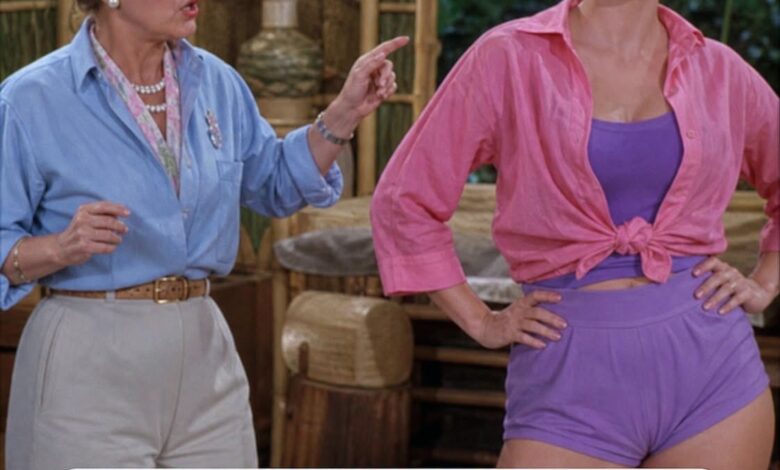
For millions of viewers, Gilligan’s Island looked like a tiny tropical world cut off from civilization.
Seven castaways.
One wrecked boat.
Palm trees.
Blue water.
And apparently an endless supply of coconuts.
But watch the classic sitcom closely today—especially on a large, high-definition television—and something wonderful begins to happen.
The island starts falling apart.
Not literally.
The illusion does.
A building appears where untouched wilderness is supposed to exist.
Equipment can occasionally be glimpsed beneath water meant to represent the open Pacific.
People appear where no extra passengers should be.
Continuity slips.
Props move.
Clothing changes.
And sometimes the actors themselves accidentally reveal details belonging not to their characters, but to the real people playing them.
These moments are often called mistakes.
But decades later, they may be among the most charming parts of the show.
Because once you notice them, you’re no longer seeing only Gilligan, the Skipper, the Professor, Ginger, Mary Ann and the Howells.
You’re seeing the television crew behind them.
You’re seeing how an imaginary island was constructed under the pressure of a weekly production schedule.
And occasionally, you’re seeing real American history slipping quietly into the background.
Consider the Minnow.
The little charter boat is central to the entire premise.
Its passengers depart on what should have been a harmless three-hour tour before a storm strands them on an island.
The opening sequence had to sell that adventure quickly.
Ocean.
Boat.
Passengers.
Departure.
Disaster.
But television productions are complicated things, and footage isn’t always captured exactly as viewers imagine.
Look closely at some shots associated with the Minnow and you may notice details that don’t perfectly fit the story being told.
Background people can appear where the fictional passenger count should be tightly controlled.
Elements of real locations creep into shots.
The world outside the show’s carefully constructed fantasy sometimes refuses to disappear.
At the time, most viewers never noticed.
And there was a practical reason.
Television used to be watched very differently.
Audiences weren’t pausing individual frames.
They weren’t zooming into the corner of a 4K screen.
They weren’t uploading screenshots to online communities where thousands of people could examine three seconds of footage.
People watched an episode once, on a comparatively small television, and moved on.
A tiny background inconsistency could survive for decades.
Modern viewing has changed the game.
Now every frame can become evidence.
And Gilligan’s Island provides plenty of evidence that its tropical paradise wasn’t always as remote as it appeared.
Sometimes buildings or other signs of civilization can seemingly sneak into places where there should be nothing except untouched island.
It’s funny precisely because the characters’ isolation is the foundation of the series.
These people spend episode after episode trying desperately to escape.
Meanwhile, the modern viewer wants to point at the background and shout:
“Gilligan! There’s civilization right there!”
Of course, the characters couldn’t see what the camera accidentally saw.
The fictional island existed inside carefully selected angles, sets, locations and editing.
Move the camera too far in one direction and paradise could become a studio environment again.
The lagoon itself had similar limitations.
On screen, water could represent an expansive natural environment.
Behind the scenes, however, controlled filming locations offered enormous advantages.
Lighting could be managed.
Actors could be positioned safely.
Cameras could be placed where needed.
Scenes could be repeated.
But controlled water also brings equipment.
And equipment occasionally catches light.
Something glints.
A piece of production machinery becomes visible.
Suddenly the “Pacific Ocean” looks suspiciously like what it really was:
A place where television professionals were working very hard to make water look like somewhere else.
That isn’t incompetence.
It’s filmmaking.
The extraordinary thing isn’t that mistakes occurred.
It’s that audiences believed the illusion so completely despite the limitations.
Gilligan’s Island premiered in 1964.
There were no digital environments.
No modern computer-generated oceans.
No invisible digital cleanup team erasing unwanted objects after filming.
If something shouldn’t appear in frame, the production generally had to hide it physically, avoid it with the camera or hope nobody noticed.
Sometimes nobody did.
For sixty years.
But perhaps the most fascinating background detail connected with the show’s early production isn’t funny at all.
Some footage used around the series’ beginnings was captured during a period of national mourning following the assassination of President John F. Kennedy in November 1963.
Flags visible at half-staff can anchor what appears to be carefree television imagery to one of the darkest moments in modern American history.
Think about that contrast.
On screen, viewers are entering a comedy about seven ridiculous castaways trapped on an impossible island.
Behind that imagery is a real country grieving.
Suddenly a background flag becomes more than scenery.
It becomes a timestamp.
Television often works like that.
Fiction tries to seal itself away from reality, but reality leaks through.
A car in the background.
A building.
A newspaper.
A hairstyle.
A flag.
Something nobody considered important at the time becomes historically fascinating decades later.
The actors left similar fingerprints.
Take the Professor.
Roy Hinkley’s intelligence was practically superhuman.
Give the man coconuts, bamboo and several hours and he’d seemingly construct anything except a functioning rescue device.
The Professor also came with character traits that episodes occasionally treated inconsistently.
Viewers who track the series carefully have pointed out moments when established facts—including reactions or supposed sensitivities to certain things—don’t always align neatly with later behavior.
In one episode, a character might establish a limitation.
Later, the script needs a joke or plot device.
Continuity loses.
That’s hardly unique to Gilligan’s Island.
Television before streaming wasn’t necessarily designed for forensic binge-watching.
Writers couldn’t assume viewers would remember a tiny line from an episode broadcast months earlier.
Episodes needed to work individually.
The joke happening now often mattered more than perfect continuity with something said long ago.
Then there’s Gilligan himself.
Bob Denver became so inseparable from the character that it’s easy to forget there was a real man underneath that sailor’s cap.
Occasionally, tiny personal details could betray that reality.
Fans have long delighted in spotting moments where a ring or other detail seems to belong more naturally to the actor than to the perpetually hapless bachelor audiences thought they knew.
For a modern viewer, catching something like that feels like finding a secret message.
For one second, Gilligan disappears.
Bob Denver is standing there.
The same thing happens with the rest of the cast.
Natalie Schafer’s Mrs. Howell was supposed to be a magnificently wealthy society woman stranded absurdly far from her natural habitat of servants, luxury and cocktail parties.
Yet Schafer herself inevitably remained visible beneath the performance.
An actor’s natural movements, expressions and physical details cannot always be transformed completely into a fictional person.
Close observation reveals the human being.
That’s what makes old television uniquely intimate.
The production wasn’t polished into digital perfection.
Faces weren’t endlessly corrected.
Backgrounds weren’t automatically cleaned.
Continuity errors weren’t erased decades later because someone noticed them on social media.
The imperfections survived.
And so did the people inside them.
Alan Hale Jr. throwing himself into the Skipper’s enormous reactions.
Bob Denver giving Gilligan his nervous physical comedy.
Russell Johnson making the Professor sound completely reasonable while explaining something utterly ridiculous.
Jim Backus delivering Mr. Howell’s wealthy indignation.
Natalie Schafer making Lovey elegant even in the jungle.
Dawn Wells giving Mary Ann her warmth.
Tina Louise turning Ginger into a character whose glamorous wardrobe seemed capable of surviving circumstances that should have destroyed every piece of luggage on board.
None of it was realistic.
That was the point.
The premise itself was absurd.
Seven people go on a three-hour tour and somehow bring enough clothing, talent and miscellaneous supplies to sustain years of adventures.
The Professor can build advanced devices from island debris but apparently cannot engineer a durable route home.
Visitors repeatedly manage to reach the island.
Rescuers somehow fail to solve the larger problem.
Logic bends constantly.
Yet audiences didn’t tune in for documentary realism.
They tuned in because they liked these people.
That affection changes the way mistakes feel decades later.
When a modern blockbuster contains a continuity error, audiences may treat it like a failure requiring explanation.
When an old Gilligan’s Island episode accidentally exposes the edge of its illusion, it often feels more like opening the backstage door.
You can almost imagine the crew standing just beyond the frame.
Someone holding a reflector.
Someone dragging cables.
Someone checking a watch because another scene still has to be completed.
A prop department trying to make ordinary materials look tropical.
Writers attempting to produce another story from a premise that begins and ends with:
They’re still stuck.
That’s the real miracle of Gilligan’s Island.
Not that it contained mistakes.
That such a small fictional world became so enormous in popular memory.
The series ran for only three seasons in its original network run, yet syndication gave it a cultural life vastly larger than those original years.
Children discovered it long after the first broadcasts.
Then their children found it.
Characters became archetypes.
The theme song became nearly impossible to forget once heard.
People who couldn’t name five current television characters could still identify Gilligan and the Skipper.
Time changed something else too.
The cast grew older.
One by one, the performers audiences associated with that impossible island passed away.
Bob Denver died in 2005.
Alan Hale Jr. had died years earlier.
Natalie Schafer, Jim Backus, Russell Johnson and Dawn Wells also eventually left us.
Tina Louise, who played Ginger Grant, became the last surviving member of the show’s central seven castaways.
That knowledge changes the viewing experience.
The episodes don’t.
Everyone is still young.
The Skipper still shouts.
Gilligan still ruins something.
Mary Ann still smiles.
Ginger remains glamorous.
The Professor still has an answer.
Mr. and Mrs. Howell still behave as though wealth should somehow function on an uninhabited island.
Nobody inside the frame knows time is moving.
We do.
And suddenly those little production imperfections don’t seem irritating.
They become precious.
The wedding ring that wasn’t supposed to show.
The background object that shouldn’t exist.
The reflection.
The equipment.
The continuity slip.
The flag lowered because a real nation was grieving outside the fictional lagoon.
Each one says the same thing:
Real people were here.
They stood beneath hot studio lights.
They forgot things.
They improvised.
They worked against schedules and budgets.
They created something imperfect.
And millions of people loved it anyway.
Perhaps that’s why spotting mistakes in old television can feel so different from catching errors in modern productions.
We’re not merely exposing what went wrong.
We’re discovering how it was made.
The seams are visible.
The trick isn’t ruined.
The trick becomes more impressive.
You realize that the tropical paradise existed because dozens of people agreed to pretend together.
A tank became an ocean.
A set became a hut.
A carefully framed location became an uncharted island.
Seven actors became castaways.
And viewers supplied the final ingredient:
Belief.
So the next time you watch Gilligan’s Island, don’t only follow the story.
Watch the edges.
Look behind the actors.
Notice the water.
Study the backgrounds.
Pay attention to clothing, hands, props and details that weren’t intended to survive microscopic inspection sixty years later.
You may catch something the original audience never saw.
But don’t think of it merely as catching the show making a mistake.
Think of it as seeing through the island for a second.
Behind the palm trees are cameras.
Behind the lagoon are technicians.
Behind the characters are actors with marriages, histories, personalities and lives continuing after the director yelled cut.
And behind one of television’s most famous fantasies is a group of people doing their best to manufacture laughter week after week.
The mistakes remain because the people remained inside the work.
Most of those people are gone now.
The island isn’t.
Every time the theme song begins, the Minnow sets sail again.
The storm arrives again.
The castaways wash ashore again.
And if you watch closely enough, somewhere in the corner of the frame, you can still see the real world trying to peek through.
That’s no longer something worth correcting.
It’s something worth preserving.