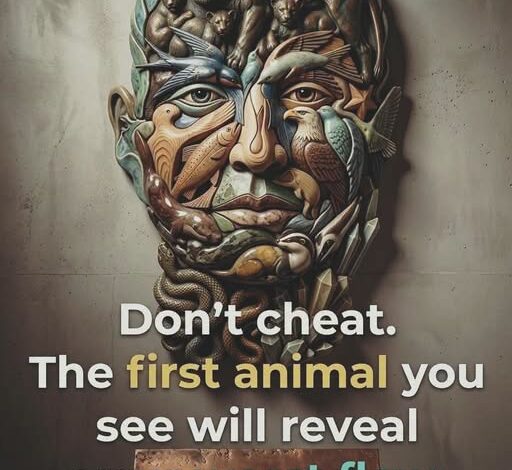
Visual personality quizzes and “first animal seen” challenges have become some of the most popular forms of entertainment on social media. Millions of people enjoy these images because they are simple, engaging, and often spark curiosity about how the mind works. A single picture may contain multiple animals, shapes, or hidden figures, and participants are asked one straightforward question: what did you notice first?
The appeal of these puzzles comes from the fascinating way human perception operates. Every moment, the brain processes enormous amounts of visual information. To make sense of the world efficiently, it prioritizes certain details while filtering out others. As a result, two people can look at the same image and immediately focus on completely different elements.
Psychologists have long studied how attention and perception influence what people notice. Factors such as personal experiences, interests, expectations, emotions, and even current mood can affect how an image is interpreted. Someone who loves animals may quickly identify animal shapes, while another person may first notice patterns, colors, or background details.
Although many online quizzes claim to reveal hidden personality traits based on what someone sees first, experts generally view these challenges as entertainment rather than scientific assessments. Professional personality evaluations are developed through extensive research, testing, and validation. Viral image quizzes, by contrast, are usually designed to be engaging, fun, and easy to share.
One reason these tests often feel surprisingly accurate is a psychological phenomenon known as the Barnum Effect. This occurs when people accept broad, general statements as highly personal and uniquely descriptive. Phrases such as “you value loyalty” or “you sometimes struggle with self-doubt” can apply to a wide range of individuals, making the interpretations feel meaningful even when they are not scientifically tailored to a specific person.
Despite their limitations, these quizzes remain popular because they encourage self-reflection. Many people enjoy thinking about their strengths, habits, goals, and personality traits. Even if the results are not scientifically valid, the questions they raise can inspire useful conversations and personal insight.
Another factor contributing to their popularity is the symbolic meaning often assigned to animals. Across different cultures and traditions, animals have long been associated with certain characteristics. Lions are commonly linked to confidence and leadership, owls to wisdom, rabbits to caution and sensitivity, elephants to memory and strength, and birds to freedom and independence. These symbolic associations add an extra layer of intrigue to the experience.
Social media has amplified the reach of these challenges because they are highly shareable. People enjoy comparing results with friends and family members, discussing whether the descriptions seem accurate, and debating what different answers might mean. In many cases, the conversations generated by the quiz are more valuable than the result itself.
Scientists who study perception emphasize that seeing different things in the same image is entirely normal. Human perception is not a passive recording of reality. Instead, the brain actively interprets information using previous experiences, expectations, and context. This explains why different people often remember the same event differently or focus on different details within a scene.
Understanding this process can help people appreciate the complexity of the human mind. Rather than revealing hidden truths about personality, visual puzzles highlight how uniquely each person experiences the world. They demonstrate that perception is influenced by countless factors working together behind the scenes.
Experts generally recommend approaching these quizzes with curiosity rather than certainty. They can be enjoyable tools for reflection and discussion, but they should not be considered accurate measures of personality or character. Their greatest value lies in encouraging people to think, observe, and engage with others in a fun and lighthearted way.
Ultimately, the enduring popularity of “first animal seen” challenges reflects a universal human desire to understand ourselves better. People are naturally curious about what makes them unique, how they think, and how they relate to the world around them. While no image can fully define a person, these visual puzzles can inspire moments of self-discovery and conversation.
Whether you spot a lion, a rabbit, a bird, or another hidden figure first, the real lesson is not about the animal itself. It is a reminder that perception is personal, attention is selective, and every individual views the world through a unique lens shaped by experience, memory, and perspective. In that sense, the most interesting part of the challenge may not be the answer—but the opportunity to reflect on how we see both the world and ourselves.