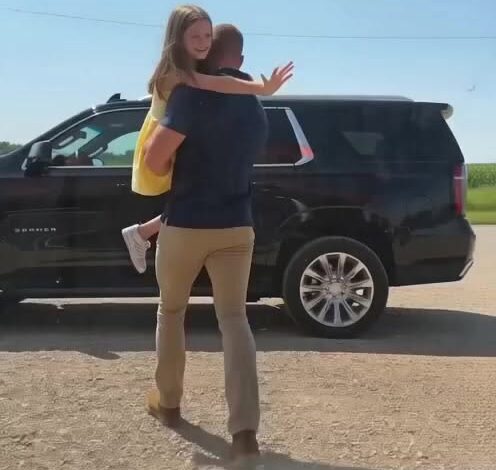
John Miller never completely left the Marine Corps behind.
Years after returning to civilian life, he still moved through the world with the same quiet vigilance that had once kept him alive. He noticed details other people overlooked. A nervous glance. A change in someone’s posture. The subtle tension hidden beneath an ordinary conversation.
Most days, those instincts simply blended into the background of his life.
One afternoon in Jacksonville, North Carolina, they would change everything.
It began inside a small roadside diner.
John sat alone in a corner booth, nursing a cup of coffee while half-listening to the familiar soundtrack of clinking dishes, murmured conversations, and country music drifting softly from an old speaker near the kitchen.
Nothing seemed unusual.
Until a black SUV rolled into the parking lot.
At first glance, it was just another expensive vehicle.
But something about it caught his attention.
The SUV didn’t stop naturally. It paused, almost hesitated, before settling into a parking space. The driver remained inside for several seconds longer than necessary, as though mentally rehearsing something before stepping out.
The moment lodged in John’s mind.
A man wearing a tailored navy suit eventually emerged from the driver’s side.
Confident.
Well-groomed.
The kind of man who knew exactly how to appear trustworthy.
He walked around the vehicle and opened the passenger door.
A young girl climbed out.
That was when John’s instincts sharpened.
The man guided her toward the diner with one hand resting on her arm.
Not gently.
Not protectively.
Firmly.
Possessively.
The girl kept her head down and held a blue sketchbook tightly against her chest.
She didn’t speak.
She didn’t look around.
She simply followed.
Inside, the man greeted staff with effortless charm.
“Afternoon,” he said with a practiced smile. “Richard Vance.”
Several employees recognized the name. Richard Vance was a successful local real estate developer. Respected. Wealthy. Well connected.
At least on the surface.
John watched from across the room.
The man smiled often.
The girl never smiled at all.
They settled into a booth near the window.
The contrast between them was impossible to ignore.
Richard spoke comfortably with servers and patrons.
Maya—the girl—sat unnaturally still.
Her shoulders remained tense.
Her eyes rarely lifted from the table.
Every few moments, she glanced toward the exit before quickly looking away again.
To most people, it might have seemed like shyness.
To John, it looked like fear.
Years of training had taught him to recognize stress responses long before they became obvious.
And Maya displayed nearly all of them.
Then something happened.
Richard stood up to answer a phone call near the entrance.
The moment he turned away, Maya’s posture changed.
Subtly.
Almost imperceptibly.
She slowly lifted her head and scanned the diner.
Her gaze moved from table to table until it found John’s.
For a brief second, neither looked away.
Then Maya lowered one hand beneath the edge of the table.
Carefully.
Deliberately.
She made a gesture.
Open palm.
Thumb tucked inward.
Fingers folded over it.
John immediately recognized the signal.
The silent hand sign used by people who cannot safely ask for help.
A silent plea.
A warning.
A message.
Help me.
His pulse quickened.
But outwardly, he didn’t react.
That was important.
If Richard noticed anything, the situation could become far more dangerous.
So John simply picked up his coffee and took a sip.
Nothing more.
When Richard returned, Maya instantly withdrew her hand and resumed her previous posture.
A few minutes later, he paid the bill.
They left.
As Maya passed through the doorway, her sketchbook slipped from her hands.
The book struck the floor.
Richard’s expression changed for a fraction of a second.
The smile disappeared.
His jaw tightened.
Irritation flashed across his face before vanishing behind another carefully crafted grin.
Maya retrieved the sketchbook.
They walked outside.
John waited thirty seconds before rising from his booth.
Then he followed.
The SUV traveled farther and farther from town.
Neighborhoods disappeared.
Traffic thinned.
The roads narrowed.
Eventually, the vehicle turned onto a gravel lane hidden among dense trees.
John parked at a distance and continued on foot.
Ahead stood an isolated property.
An unfinished house occupied one side of the clearing.
A weathered cabin sat nearby.
Another vehicle was parked behind it.
That second vehicle concerned him.
It suggested someone else was already there.
Moving carefully through the tree line, John observed the property.
A shadow appeared briefly at one of the cabin’s windows.
Maya.
Even through the glass, she looked like she was searching for something.
Or someone.
The sight erased any remaining doubt.
This wasn’t a misunderstanding.
Something was wrong.
Very wrong.
John contacted an old friend, Marcus, a former investigator he trusted.
While Marcus quietly began digging into Richard Vance’s background, John maintained surveillance.
The information that emerged over the next few hours painted an unsettling picture.
Questionable business dealings.
Prior complaints.
Legal disputes that never seemed to reach a courtroom.
Nothing definitive.
But enough to establish a pattern.
Then came the scream.
A woman’s voice.
Sharp.
Terrified.
John didn’t wait any longer.
He sprinted toward the cabin.
Inside, chaos greeted him.
A woman—later identified as Sarah, Maya’s mother—sat injured and visibly distressed.
Documents littered the table.
Richard stood nearby, his composure finally cracking.
His polished public persona had vanished.
In its place stood a man desperate to maintain control.
John moved immediately.
“Maya,” he said calmly.
“Go into the other room and stay there.”
The girl obeyed without hesitation.
Richard protested.
Raised his voice.
Demanded explanations.
But the situation had already shifted beyond his control.
When he attempted to escalate the confrontation, John intervened physically, preventing further harm until authorities arrived.
Minutes later, flashing lights illuminated the property.
Deputy Tom Reynolds and Detective Frank Gallow were among the first responders.
Paramedics rushed to assist Sarah.
At first, she insisted her injuries were accidental.
A fall.
Nothing more.
But investigators weren’t convinced.
The evidence surrounding them told a different story.
As authorities secured the scene, Maya never let go of her sketchbook.
Inside were dozens of drawings.
Some depicted people.
Others showed locations.
Several appeared to illustrate incidents and interactions that investigators had never known about.
The sketches weren’t formal evidence.
But they provided valuable insight and generated important leads.
As the investigation expanded, more questions surfaced regarding Richard’s activities, finances, and relationships.
Sarah was transported to a hospital.
Richard was taken into custody.
And for the first time in what seemed like a very long time, Maya was safe.
Hours later, inside a quiet hospital room, a small moment unfolded that few people would ever forget.
Sarah sat beside her daughter.
Neither had spoken much since arriving.
Then Maya finally broke the silence.
She looked up.
Reached for her mother.
And whispered a single word.
“Mommy.”
Sarah immediately wrapped her arms around her.
Tears flowed freely.
Doctors, nurses, and investigators quietly stepped back.
Some victories don’t arrive with headlines.
Sometimes they arrive in a single word.
John stood outside the room and watched through the window.
He didn’t feel heroic.
He felt grateful.
Grateful that he had noticed.
Grateful that Maya had found the courage to ask for help.
And grateful that one small gesture had been understood before it was too late.
Years earlier, the Marines had taught him that danger rarely announces itself.
It hides in ordinary places.
Behind ordinary faces.
Inside ordinary moments.
That lesson stayed with him long after he left the service.
And on an otherwise unremarkable afternoon inside a roadside diner, it made all the difference.
Because sometimes the most important cry for help is the one that makes no sound at all.