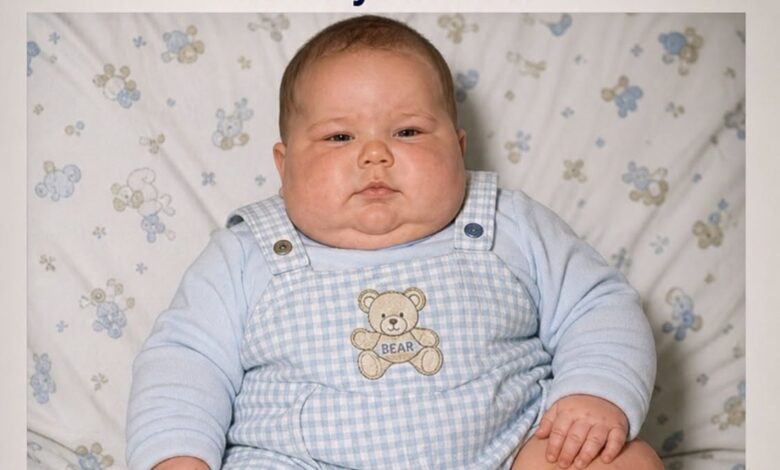
Kevin became famous before he had any idea what fame was.
He had not spoken a word.
Had not taken a step.
Had not even left the hospital.
Yet people were already talking about him.
His arrival was so unusual that what should have been an intimate family moment quickly became something closer to a public event. Nurses had to improvise around his extraordinary size, adapting ordinary newborn routines to a baby who did not fit comfortably into expectations—or, in some cases, equipment designed for typical infants.
Then word spread.
Reporters became interested.
Cameras appeared.
Questions multiplied.
How big was he?
Was he healthy?
Had anyone seen a newborn like him before?
What would happen as he grew?
Kevin’s first days became a story strangers felt entitled to examine.
Everyone wanted measurements.
Photographs.
Predictions.
His body had become news before it had even become familiar to him.
For his family, however, beneath all the attention was simply a baby.
Their baby.
A child who needed feeding, changing, comforting, and protecting like any other newborn.
The headlines eventually faded.
Kevin kept growing.
And that was when being unusually large stopped being an amusing news story and became something he had to live with every day.
Childhood is difficult enough when you desperately want to belong.
Kevin could rarely disappear into a crowd.
He entered rooms and was noticed.
At school, children stared.
Some whispered.
Others simply pointed.
Adults were not always better.
People who would never dream of questioning a stranger about other physical characteristics seemed comfortable asking Kevin about his height.
“How tall are you?”
It became less a question than a greeting.
Before people knew what he liked, they knew he was big.
Before they knew his personality, they wanted a number.
Before asking about his interests, they asked whether he played basketball.
His body arrived in conversations before Kevin did.
At first, that was difficult to understand.
Children learn who they are partly through the reactions of other people. When everyone reacts to one characteristic first, it becomes easy to believe that characteristic must be the most important thing about you.
School made the difference impossible to ignore.
Desks could feel ridiculously small.
Clothing did not always fit the way it did on other children.
Group photographs highlighted the contrast.
Standing in line could become another reminder.
Every growth spurt brought more attention.
Every new school year meant meeting another collection of people who would ask exactly the same questions.
Kevin could not control being noticed.
So eventually, he learned to control what happened after people noticed him.
Humor became one of his most useful tools.
A joke could interrupt an awkward moment before it became cruel.
A quick answer could turn someone’s stare into laughter.
If people were going to comment on his height anyway, sometimes Kevin could get there first.
That strategy did not magically make every experience painless.
There is a difference between laughing because something is genuinely funny and learning to laugh because it keeps someone else from hurting you.
Kevin had to discover that distinction for himself.
But humor gave him something important.
Control.
Instead of allowing every stranger to decide what his difference meant, he could participate in defining it.
Gradually, confidence began replacing embarrassment.
Not the loud confidence of someone pretending never to feel insecure.
Something quieter.
The confidence that comes when you realize other people’s surprise does not require your apology.
Kevin was tall.
Very tall.
That was a fact.
It did not need to become a problem.
The transformation did not happen overnight.
There were still awkward moments.
People still stared.
Questions kept coming.
He still encountered spaces designed for bodies considerably smaller than his.
Cars.
Beds.
Doorways.
Seats.
Clothing.
Everyday objects occasionally seemed determined to remind him that the world had been designed around an average he did not match.
But as Kevin grew older, something shifted.
The same body that had made him feel conspicuous as a child became familiar.
His height stopped feeling like something happening to him.
It was simply part of him.
That distinction mattered.
When you are young, difference can feel like an accusation.
Why aren’t you like everyone else?
Why can’t you fit?
Why do people keep looking?
Adulthood can offer another question:
Why should fitting be the goal?
Kevin began building a life in which his measurements were increasingly irrelevant to the things that actually mattered.
Friendships.
Relationships.
Work.
Home.
Routine.
Love.
The enormous newborn who had attracted journalists eventually became an adult who wanted many of the same things everyone else wanted.
Peace.
Privacy.
Someone to come home to.
A comfortable place to live.
A dog waiting at the door.
Laughter that had nothing to do with being the tallest person in the room.
Today, Kevin stands more than 6 feet 6 inches tall.
That number still catches people’s attention.
It probably always will.
But it no longer defines the entire story.
The most striking part of Kevin’s adult life may be how ordinary it became.
There are no nurses improvising around him.
No journalists waiting outside.
No crowds gathering to marvel at his measurements.
There is a partner.
A dog.
Groceries to carry.
Bills to pay.
Meals to make.
Errands.
Walks.
Quiet evenings.
The small repetitions that actually make up most of a human life.
There is something almost poetic about that outcome.
Kevin entered the world as a spectacle.
He grew up and claimed the right to become ordinary.
That may sound like a strange achievement until you understand what it means to have strangers treat your body as public property.
People who are visibly different often become accustomed to unsolicited curiosity.
Some questions are harmless.
Others are invasive.
Some come from children who genuinely do not understand why staring might hurt.
Others come from adults who should know better.
Over time, the person on the receiving end can feel as though they owe everyone an explanation.
Kevin learned that he did not.
His body was not a public exhibit.
He did not exist to satisfy someone’s curiosity.
And being unusual did not obligate him to perform unusualness for anybody.
That realization changed the meaning of his size.
As a child, height could feel like something separating him from everyone else.
As an adult, it became simply one characteristic among hundreds.
Kevin could be tall and funny.
Tall and irritated.
Tall and affectionate.
Tall and boring.
Tall and tired.
Tall and completely uninterested in discussing height.
That sounds obvious.
But it is exactly what stereotypes erase.
People often take the most visible thing about someone and allow it to swallow everything else.
The tallest person becomes “the tall guy.”
The person with an unusual birth becomes “that giant baby.”
The individual disappears behind the curiosity.
Kevin’s life quietly resisted that reduction.
He was not frozen inside the photograph of the remarkable newborn.
He grew.
Not merely physically.
He became a person the original headlines could never have predicted.
And perhaps that is the flaw in every story that treats a baby as a phenomenon.
Measurements can tell you how large a child is.
They cannot tell you who that child will become.
A scale cannot measure humor.
A tape measure cannot predict resilience.
A photograph cannot capture the confidence someone will build after years of being stared at.
Statistics cannot describe the feeling of finally becoming comfortable inside the body everyone else once treated as extraordinary.
Kevin had to discover those things himself.
For years, other people told him he was different.
Eventually, he stopped hearing difference as criticism.
Different from what?
An average?
A chart?
A desk designed for someone else?
A stranger’s expectation?
None of those things determine a person’s worth.
That lesson is easy to repeat and much harder to live.
Kevin had to live it every time someone pointed.
Every time clothing did not fit.
Every time another stranger asked the same question.
Every time a photograph emphasized what he already knew.
And slowly, experience changed the question from “Why am I like this?” to something closer to “Why should I be anything else?”
That is where acceptance becomes powerful.
Not when you convince yourself that every difficult experience was secretly wonderful.
Some weren’t.
Being singled out can hurt.
Cruelty is still cruelty even when disguised as curiosity.
Childhood teasing does not become harmless simply because someone eventually learns to laugh about it.
Acceptance means those experiences no longer get to dictate the conclusion.
Kevin’s story did not end with the children who pointed at him.
It did not end with the reporters.
It did not end with the awkward school desks.
It continued long enough for him to decide what his own body meant.
Today, that body carries groceries through the door.
It bends down to greet a dog.
It sits beside someone he loves.
It moves through a home where nobody needs a measurement before knowing who Kevin is.
Those ordinary details are more meaningful than they appear.
Because ordinary life was once something the world seemed determined not to give him.
From birth, people wanted Kevin to be extraordinary.
They wanted the unbelievable number.
The photograph.
The curiosity.
The headline.
But a person cannot live forever as somebody else’s fascinating fact.
Eventually, the cameras go away.
And perhaps that is when the real life begins.
The world once looked at Kevin and saw size.
Kevin eventually looked at himself and saw a person.
There is freedom in that.
The feature that once made him feel impossible to overlook no longer needs to be hidden or explained.
He occupies his space.
Literally and otherwise.
And he does so without apology.
Maybe that is the most beautiful reversal in his story.
As a boy, Kevin learned humor partly because he needed a defense against other people’s reactions.
As a man, he can laugh simply because something is funny.
As a child, his body could feel like a burden he carried into every room.
Now it is simply home.
The same height.
The same difference.
A completely different meaning.
The baby who entered the world surrounded by astonishment did not spend his life trying to become smaller.
He learned something better.
He learned that other people’s expectations were the things that needed resizing.
Not him.
The world had spent years telling Kevin that he was “too much.”
Too big.
Too noticeable.
Too unusual to blend in.
But perhaps adulthood finally gave him the answer he had needed all along.
There was never anything wrong with taking up space.
Sometimes being more than the world expected is not a burden at all.
Sometimes it is exactly enough.