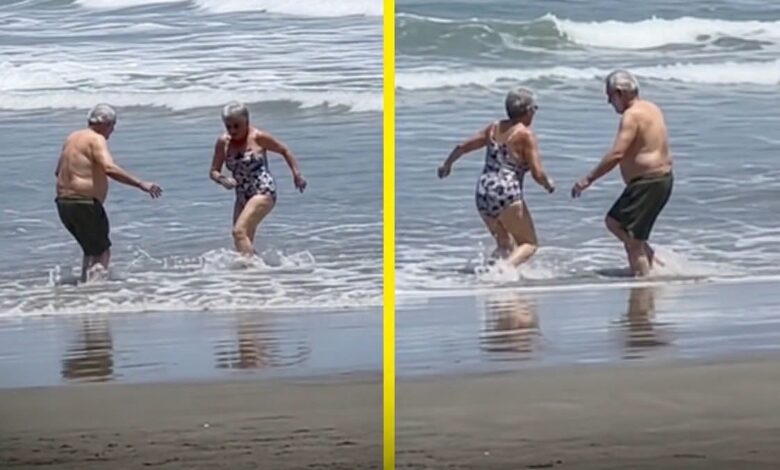
They weren’t posing.
That may be why the video touched so many people.
There was no carefully arranged anniversary dinner, no dramatic marriage proposal, no expensive vacation montage edited to emotional music.
Just two older people standing beside the water.
Then one of them splashed the other.
For a moment, they seemed to forget everything else.
Their age.
The camera.
The people nearby.
Whatever aches had followed them out of bed that morning.
Whatever years had taken from them.
The other splashed back.
They laughed.
And eight ordinary seconds became something millions of people couldn’t stop watching.
At first glance, there wasn’t much to explain.
An elderly couple was playing near the shoreline.
That was it.
But people replayed the clip anyway.
Again.
Again.
Again.
Maybe because what they were watching wasn’t really about water.
It was about time.
The couple’s bodies carried evidence of it.
Their movements weren’t as quick as those of the children running nearby. Their steps were measured. Their posture reflected decades that could not be hidden by filters or flattering angles.
But when the water hit and the laughter started, something changed.
For a few seconds, age became irrelevant.
There was only play.
One person teasing another.
A reaction.
A laugh.
A familiar closeness that seemed to require no explanation.
Perhaps that familiarity was what made the moment feel so intimate.
You could imagine that this wasn’t the first time one had surprised the other.
Maybe there had been water fights decades earlier.
Maybe kitchen towels snapped across counters.
Maybe flour thrown during baking.
Maybe ridiculous dances in living rooms when nobody else was watching.
Maybe there had been private jokes repeated so many times that their children groaned whenever they heard them.
Long relationships are built from thousands of moments outsiders never see.
People tend to celebrate the milestones.
The wedding.
The first home.
Babies.
Anniversaries.
Retirement.
But those aren’t necessarily the moments that make two lives feel intertwined.
Sometimes it’s knowing exactly how the other person takes their coffee.
It’s reaching automatically for their hand while crossing a street.
It’s hearing them cough from another room and knowing whether it’s an ordinary cough or one worth checking.
It’s saving the better piece of dessert.
It’s arguing over the thermostat for forty years.
It’s laughing at the same terrible joke because somehow it still works.
And sometimes it’s splashing each other at the beach when you’re old enough that strangers find the playfulness remarkable.
That last part is worth thinking about.
Why should it be remarkable?
We often treat youth as the natural home of spontaneity.
Young couples are expected to flirt.
To chase one another.
To laugh loudly.
To behave foolishly.
Older people are often expected to become quieter versions of themselves.
Responsible.
Reserved.
Almost invisible.
The couple in the video refused that expectation without appearing to know it existed.
They weren’t making a statement.
They were having fun.
Yet there was something rebellious about it.
Their bodies had aged.
Their capacity for delight had not disappeared with them.
That distinction matters.
Growing older changes people.
There is no point romanticizing that reality.
Bodies become less forgiving.
People we love disappear.
Health can become complicated.
Energy changes.
Plans shrink.
Aging can contain grief alongside gratitude.
And a relationship lasting decades does not survive simply because two people once fell in love.
Time tests affection.
There are bills.
Exhaustion.
Illness.
Disappointment.
Family conflict.
Career pressures.
Mistakes.
Apologies that come too late.
Arguments nobody wins.
There are seasons when romance feels effortless and others when commitment is mostly the decision not to walk away from something worth repairing.
We don’t know the story of the couple in those eight seconds.
That is important.
A short video cannot tell us whether their relationship was perfect.
It cannot show every difficult year.
It cannot prove that they never hurt one another or doubted themselves.
But perhaps perfection isn’t what viewers saw.
Perhaps they saw endurance.
Two people had arrived at this shoreline together.
Whatever road led them there, they were still capable of making each other laugh.
That is a quieter dream than the ones we’re usually sold.
Popular culture often presents love through beginnings.
The first glance.
The first kiss.
The proposal.
The wedding.
Everything glows because everything is new.
But beginnings are easy to photograph.
What happens thirty, forty, or fifty years later is harder to package.
The flowers wilt.
The wedding clothes disappear into storage.
The photographs fade.
People change.
The face across the breakfast table becomes so familiar that you can read its mood before a word is spoken.
And somewhere in that familiarity lies the real question:
Do you still enjoy each other?
Not every minute.
Not in some impossible fairy-tale sense.
But beneath the responsibilities and accumulated history, is there still a person there who can make you laugh?
Can you still surprise them?
Can they still make the world feel lighter?
The shoreline clip seemed to answer yes.
That was enough.
Comments beneath videos like this often reveal more about the viewers than the people being filmed.
“I want this.”
“This is the dream.”
“May we all find someone like this.”
“Growing old together.”
Those reactions aren’t really about beaches.
They’re expressions of hope.
People aren’t necessarily longing for a particular partner or destination.
They’re longing for continuity.
For the possibility that love might survive familiarity.
That somebody could know your flaws, your worst moods, your changing body, your embarrassing habits and the parts of your history you wish you could edit—and still look at you with mischief in their eyes.
There is profound comfort in that possibility.
Modern life offers endless reminders of impermanence.
Relationships begin and end publicly.
People disappear from one another’s lives with a message.
Dating can feel like browsing.
Social media constantly suggests that somewhere else there is a better person, a better life, a more photogenic version of happiness.
Against that backdrop, two elderly people splashing each other looks almost radical.
They aren’t searching.
They aren’t optimizing.
For those eight seconds, at least, they are simply there.
Together.
That doesn’t mean longevity automatically equals successful love.
People can remain together for decades and still be lonely.
A long marriage is not necessarily a happy one.
Years alone don’t prove tenderness.
What made this moment compelling wasn’t merely that the couple appeared old.
It was that they appeared alive to each other.
There was responsiveness.
Playfulness.
Recognition.
One moved, the other answered.
One laughed, the other joined.
A tiny conversation without words.
Perhaps that is what intimacy eventually becomes.
Not constant declarations.
Not elaborate gestures.
Recognition.
You know this person.
They know you.
And somehow there are still new moments inside all that knowing.
There is another reason the clip may have landed so deeply.
Many people fear aging not only because of physical decline, but because of loneliness.
We imagine empty rooms.
Children living far away.
Friends disappearing.
A world moving faster while we become slower.
Then a scene like this appears.
Two people near the water.
Still companions.
Still irritating each other for fun.
Still laughing.
Suddenly old age doesn’t look like an ending.
It looks like another afternoon.
That is a powerful reframing.
We spend so much of life rushing toward the next milestone that ordinary happiness can feel insufficient.
We photograph the extraordinary and overlook the routine.
Yet ask older people about someone they’ve lost and notice what they remember.
Often it isn’t the grand vacation.
It’s the sound of keys in the door.
A particular laugh.
The chair where someone always sat.
How they mispronounced a word.
The way they reached across the bed in their sleep.
The irritating habit that suddenly becomes precious once it’s gone.
Grief teaches brutally what love sometimes forgets:
Ordinary moments are not filler.
They are the substance.
That splash of seawater probably meant nothing when it happened.
Neither person likely thought, We are creating a profound metaphor for lifelong companionship.
One of them probably just saw an opportunity to annoy the other.
That’s what makes it beautiful.
Meaning arrived afterward.
The camera preserved something that otherwise would have vanished almost immediately.
Water flew.
They laughed.
The wave disappeared.
Life continued.
But somewhere online, strangers kept replaying it because they recognized something they wanted to believe was possible.
That love can age without becoming lifeless.
That tenderness doesn’t have to become solemn.
That intimacy can still contain silliness.
That being someone’s safe place doesn’t mean you can’t occasionally splash them when they aren’t looking.
Perhaps that’s the secret hidden inside the scene.
We often talk about lasting relationships as though they survive through seriousness alone.
Commitment.
Sacrifice.
Loyalty.
Patience.
Those things matter enormously.
But maybe play matters too.
The willingness to remain ridiculous together.
To create moments with no purpose.
To laugh even after you’ve heard each other’s laugh ten thousand times.
Life supplies enough seriousness on its own.
There will be hospitals.
Funerals.
Financial worries.
Family crises.
Bad news.
Bodies that stop cooperating.
Days when one person has to carry more because the other simply cannot.
If a couple lasts long enough, they will eventually encounter things neither imagined when they first fell in love.
Perhaps that makes the silly moments more important, not less.
A splash.
A joke.
A dance in the kitchen.
An unnecessary detour for ice cream.
A hand squeezed beneath a restaurant table.
Small acts that say:
We’re still here.
I still see you.
We’re not finished enjoying this.
And maybe that is why eight seconds were enough.
The video didn’t need their names.
It didn’t need their wedding date.
It didn’t need a narrator explaining how long they’d been together.
Viewers supplied their own stories because the emotion was universal.
They saw parents.
Grandparents.
Partners.
Someone they had lost.
Someone they hoped to meet.
Or perhaps the future version of themselves they desperately wanted to become.
Two people standing at the edge of an enormous body of water, with most of their lives behind them and still finding a reason to laugh.
There is something almost defiant about that image.
Time takes plenty.
Youth.
Strength.
Certainty.
People.
Opportunities.
Eventually, everything changes.
But perhaps time doesn’t have to take wonder.
Perhaps it doesn’t have to take humor.
Perhaps love, when cared for, doesn’t simply resist age.
It changes with it.
Young love often asks, “Will you choose me?”
Mature love may ask something quieter:
“After everything, are you still here?”
And sometimes the answer isn’t spoken.
Sometimes it’s a hand reaching for yours.
Sometimes it’s coffee waiting in the kitchen.
Sometimes it’s a familiar body beside you in the dark.
And sometimes it’s a splash of cold water followed by laughter at the shoreline.
Years from now, nobody who watched that video will remember every clip they scrolled past that day.
Most will disappear into the endless digital current.
But some people may remember those two.
Not because they were famous.
Not because anything extraordinary happened.
But because, for eight seconds, they made growing old look less frightening.
They made lasting love look less like an achievement and more like a friendship that never stopped playing.
And perhaps they reminded us of something we tend to discover too late:
The moments that become precious rarely announce themselves.
They happen while dinner is cooking.
While you’re walking to the car.
While someone is teasing you.
While you’re standing beside the person you’ve known for half a lifetime, watching waves arrive and disappear.
One second you’re simply living.
Years later, you realize that was the good part.
So splash the person you love.
Laugh too loudly.
Take the ridiculous photograph.
Hold the hand you’ve held a thousand times.
Stay a little longer beside the water.
Because if you’re fortunate enough to grow old with someone who can still make you feel young for eight seconds, you may already possess the kind of wealth people spend their entire lives searching for.
Not endless youth.
Not perfect romance.
Something better.
A person who has watched time change you and still wants to play.