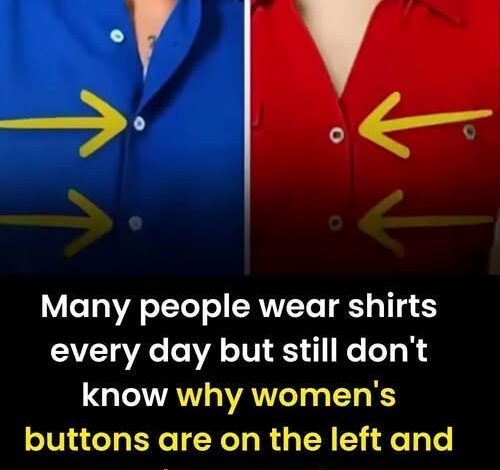
Every morning, millions of people button their shirts without giving the process a second thought. Few ever notice that men’s and women’s shirts fasten in opposite directions—and even fewer realize that this seemingly insignificant detail is a relic of centuries-old social divisions.
The difference isn’t the result of fashion alone. It’s a surviving trace of a world built around class, gender roles, and unequal expectations.
During the 18th and 19th centuries, wealthy women’s clothing was often extraordinarily elaborate. Dresses featured layers of fabric, corsets, intricate stitching, and rows of buttons that could make getting dressed a lengthy process. For affluent women, dressing was not a private routine but a visible display of status and privilege.
Most importantly, many of these women weren’t expected to dress themselves.
They had servants.
Because the vast majority of maids were right-handed, clothing manufacturers began placing buttons on the wearer’s left side. This arrangement made fastening garments easier for the servant standing opposite the woman. The design wasn’t created for the comfort of the person wearing the clothes—it was created for the convenience of the person helping her put them on.
Over time, that practical adjustment evolved into a social signal.
Left-sided buttons became associated with wealth, refinement, and upper-class fashion. Even as fewer women relied on servants, the tradition remained. What began as a marker of privilege eventually became a standard feature of women’s clothing, surviving long after the original reason had faded from everyday memory.
Men’s clothing followed a very different path.
Historically, many men carried swords or weapons on their left side, allowing them to draw quickly with their dominant right hand. In situations requiring speed—whether military, defensive, or ceremonial—clothing needed to stay out of the way.
Placing buttons on the right side made it easier for a right-handed man to unfasten his coat or reach across his body when necessary. As military uniforms heavily influenced men’s fashion throughout the centuries, this arrangement became firmly established.
The symbolism behind the two styles was striking.
Women’s clothing reflected a culture in which many affluent women were expected to be dressed by others.
Men’s clothing reflected a culture that emphasized independence, action, and readiness.
One design was shaped by service and appearance.
The other was shaped by utility and control.
Although society has changed dramatically since those days, the buttons never moved.
Today, few women employ personal maids, and almost no one carries a sword through daily life. Yet modern shirts continue to follow conventions created hundreds of years ago. Most manufacturers preserve the distinction simply because it has become tradition, and changing it would disrupt long-established expectations within the fashion industry.
As a result, millions of people continue wearing a subtle reminder of a social order that no longer exists.
The fascinating part is how easily such details disappear into the background. We rarely question why everyday objects are designed the way they are. Once a habit becomes normal, its origins often fade from view.
Yet history has a way of hiding in plain sight.
Sometimes it isn’t found in monuments, government records, or famous events. Sometimes it’s stitched into a collar, sewn beside a buttonhole, or preserved in the design of a shirt hanging quietly in a closet.
The next time you fasten a button, you may notice something that most people overlook. What appears to be a simple design choice is actually a centuries-old echo of class structures, gender expectations, and social traditions that shaped everyday life for generations.
It’s a reminder that even the most ordinary objects carry stories.
And sometimes, those stories reveal just how much of the past continues to travel with us, one button at a time.