The Same Bouquet Arrived Every Year After My Husband Died — This Year I Saw the Invoice: “Order 4 of 20, Prepaid”

At 4:40 that afternoon, I found my dead husband’s final surprise underneath a six-year-old pot roast.
I was standing in my kitchen with the freezer door open, cold air spilling over my slippers, wondering why I’d apparently been protecting a 2019 roast like a family heirloom. An index card had sent me looking there, though I still wasn’t convinced I’d find anything.
Then I moved the roast.
Behind it sat an old Maxwell House coffee can.
The lid was taped shut. The whole thing had been wrapped in two freezer bags. Across the front, in Bill’s unmistakable handwriting, were the words:
DO NOT THROW OUT. PROPERTY OF WILLIAM T. KELLER. YES JOYCE THIS MEANS YOU.
I laughed so hard I had to grab the counter.
That label was forty-four years of marriage compressed into one sentence.
Bill labeled everything. He issued instructions on labels. Sometimes he argued with me through labels.
And somehow, even while dying, that man had known me perfectly.
He knew grief would make me empty drawers, donate clothes, sort closets, and reorganize cabinets.
But the deep freezer?
Never.
That was Bill’s territory. The stove was mine.
Inside the coffee can was a savings passbook in both our names from a bank two towns away.
There was also a life-insurance policy dated 1991.
I’d never seen either one.
Around them was one final index card.
Now call Whitmore’s office. He’s expecting you, whenever this is. Sorry for the cloak and dagger, honey. I didn’t want you making any of these decisions the year I died. You always overwater the garden right after a storm.
I sat down.
And suddenly I had to reconsider the spring of 2018.
Bill received his diagnosis that February.
We handled it the way people of our generation often handle terrible things: we told the children as little as possible, maintained our routines, and behaved very bravely at each other across the dinner table.
What I didn’t know was that Bill had begun planning.
His “Tuesday coffee group” had apparently become something closer to a project-management meeting.
Bill was dying on a schedule, so naturally Bill opened a project file.
The florist was part of it.
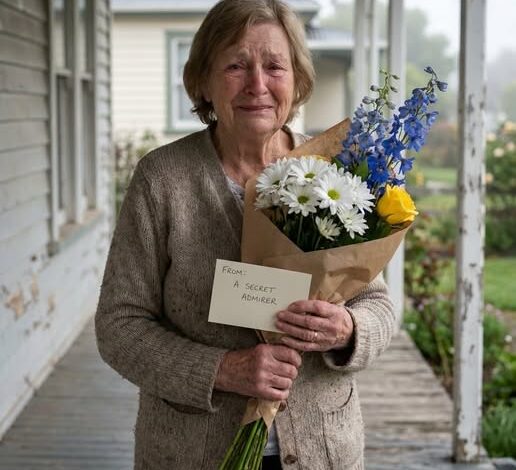
For years after his death, yellow roses kept arriving every October.
I thought he’d simply prepaid a few orders.
No.
Wren, the florist, eventually showed me his instructions.
They were handwritten.
And laminated.
Of course they were laminated.
Bill had written that the flowers must never depend on anyone’s memory, anyone’s marriage, or anyone’s opinion about what Joyce needed.
He had funded them using money from the secret passbook.
The life-insurance policy went back even further.
He’d bought it in 1991, the year I’d had my health scare. In 1994 he’d written a note to our son directly in the margin:
Your mother panics about premiums.
There had been clues everywhere.
That final spring, Bill kept “reorganizing” the freezer.
He made me promise never to change florists.
“Even when I’m too old for flowers, Joycie. Especially then.”
I thought he was being sentimental.
Then one April afternoon he casually asked what I’d do if I ever came into “a little extra.”
“I’d finally see the ocean from the other side,” I said.
That was our old joke.
We’d planned Niagara Falls for our honeymoon in 1974, but the transmission died the same week as the wedding. The choice became romantic vacation or functioning automobile.
The automobile won.
I didn’t realize Bill was interviewing me.
He wrote my answer down.
Eight years later, it was waiting at Whitmore’s office.
Whitmore was Bill’s attorney, now semi-retired and visibly delighted that a plan he’d been sitting on for nearly a decade had finally worked.
That Thursday, he placed a folder bearing my name on his desk.
The first page was another letter.
“Joyce,” Whitmore began reading, “if Whitmore’s reading you this, you found the can, which means eight years went by, which means the flowers worked and you’re standing up straight. Good.”
I was already crying.
Whitmore continued.
“Now don’t argue with the next part. I’m dead and I win automatically.”
That finished me.
The folder contained practical matters.
The old insurance policy was modest but substantial enough to matter. Because nobody had known about it when Bill died, it had never been claimed.
Resolving it required paperwork.
Whitmore obtained a certified death certificate, submitted the original policy with an affidavit explaining its late discovery, and handled the procedural reopening necessary because probate had closed years earlier without anyone knowing the asset existed.
The insurance adjuster called the document “freezer-fresh.”
Apparently that was a first.
The whole process took about six weeks.
The savings account was easier. It had been quietly earning interest since the first Bush administration and was payable directly to me upon Bill’s death.
No probate.
No fight.
No decisions required from the woman who’d buried her husband in 2018.
That was the design.
“He sequenced it,” Whitmore told me, tapping Bill’s folder.
Bill had arranged everything so grief couldn’t force me to decide what came next.
Then Whitmore showed me the part that wasn’t practical at all.
An envelope read:
NIAGARA, IN REVERSE.
Inside was a hand-drawn road map.
Bill had researched the honeymoon route we’d never taken, apparently from his hospital bed using the tablet he claimed to despise.
He’d found diners that somehow still existed from 1974.
Beside one he’d written:
Pie place survived, Joycie. It’s a Yelp thing now. 4.5 stars. We always knew.
Then came the instruction, underlined twice:
Take the granddaughter. Nora drives too fast, which is correct for this trip.
I laughed until I cried again.
But Whitmore wasn’t finished.
There was a reason Bill had chosen eight years.
During that last spring, he’d asked his doctor how long it took a widow to reach the point where she could receive something wonderful without the gift hurting more than the loss.
The doctor told him grief didn’t follow a timetable.
Bill, engineer to the end, apparently responded:
“Give me a number anyway.”
The doctor mentioned that some descriptions of acute grief extend across years, varying greatly from person to person.
Bill chose eight.
His explanation was waiting in the letter.
I rounded up. You never do anything on schedule, Joycie. It’s your best quality. See attached flowers.
That September, Nora and I drove the route.
She was twenty-three.
She drove too fast.
Bill had been correct.
We did Niagara in reverse.
We found the 4.5-star pie place and left another five-star review under:
KELLER, PARTY OF THREE, COUNTING GRANDPA.
We stayed two nights in a motor lodge whose sign looked unchanged since 1974.
I swear the bedspreads were unchanged too.
At Niagara Falls, Nora photographed me at the railing holding one yellow rose.
Later, over funnel cake, I told her everything.
Bill’s diagnosis.
The freezer.
The insurance policy.
The secret account.
The flowers.
The trip he planned but never got to take.
Nora usually texts in fragments and describes serious emotions as “a lot.”
This was apparently a lot.
When we returned home, she had one of the florist invoices framed.
ORDER 4 OF 20.
It hangs in my hallway beside our wedding photograph, the one with the daisies.
Sixteen more Octobers are already paid for.
Wren says that after those run out, “we’ll discuss terms.”
We both know exactly what that means.
I wouldn’t be surprised if her freezer contains instructions too.
People think love is the bouquet.
I’ve learned differently.
Love is the order form.
Love is a frightened, sick man sitting somewhere on a Tuesday morning during the worst spring of his life, arranging flowers for Octobers he knows he will never see.
Love is laminating the florist instructions because apparently death itself is no excuse for administrative sloppiness.
It’s hiding an old policy behind a pot roast because you know your wife well enough to understand where she’ll look immediately—and where she won’t look until she’s ready.
Bill couldn’t stay.
So he did the next thing he knew how to do.
He prepared.
He left instructions.
He covered my Octobers.
And eight years after I buried him, he finally sent me on our honeymoon.
So if you’re lucky enough to have that kind of love, label something for them today.
The labels may become the love letters that survive.
And if you’ve lost someone who knew you better than anybody else ever could, I have one piece of advice.
Check the freezer, honey.
I mean that kindly.
And in my case, I mean it literally.
Sometimes the good news left for us in this life isn’t sitting somewhere obvious, waiting to be discovered.
Sometimes it’s buried beneath the old pot roast, exactly where the person who loved you knew you wouldn’t look until your heart was finally ready to find it.