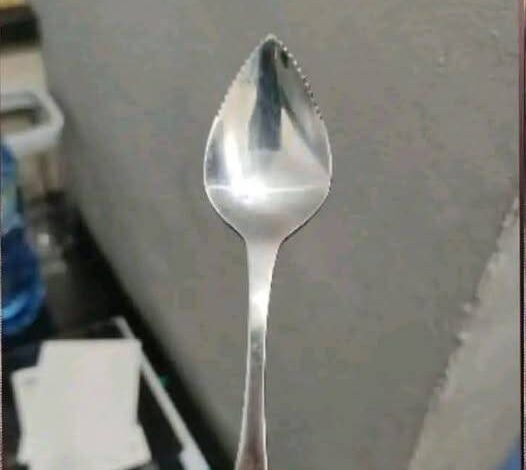
Most people encounter a grapefruit spoon the same way they encounter many oddly specific kitchen tools: with suspicion.
It sits quietly in the drawer beside ordinary silverware, slightly narrower than a regular spoon, its edges lined with tiny serrations that make it look halfway between elegant and unnecessary. Younger generations often mistake it for some antique relic from grandparents who also owned crystal candy dishes and embroidered napkins nobody was allowed to touch.
At first glance, it seems absurdly specialized.
A spoon… just for grapefruit?
Surely a normal spoon could do the same job.
Then you use one.
And suddenly the strange little utensil reveals itself as something unexpectedly brilliant.
Because grapefruit fights back.
Anyone who has tried eating one neatly understands the problem immediately: the membranes cling stubbornly to every segment, juice runs unpredictably down your wrists, and ordinary spoons slide uselessly across the fruit’s structure instead of through it. Knives help, but only awkwardly. Fingers become sticky. The experience turns messy faster than expected.
The grapefruit spoon solves all of that with one deceptively simple adjustment.
Its serrated edges.
Tiny teeth line both sides of the spoon’s bowl, sharp enough to glide cleanly between membrane and flesh without tearing the fruit apart completely. Instead of hacking awkwardly at citrus sections, you simply trace the spoon along the natural seams.
The spoon does the delicate cutting for you.
One smooth motion:
slide,
lift,
scoop.
Perfect little jewel-like segments rise cleanly from the peel, intact and glistening.
No wrestling.
No shredded fruit.
No balancing knives over breakfast plates while juice drips onto your shirt.
Just clean, satisfying bites released exactly where they’re supposed to separate.
That small elegance explains why grapefruit spoons survived decades after many other hyper-specific kitchen gadgets disappeared entirely.
Because unlike gimmicky tools that promise convenience while creating more clutter, this one genuinely changes the experience of eating difficult fruit.
And its usefulness quietly extends far beyond grapefruit.
That’s the secret longtime owners already know.
The same serrated edges that slip neatly through citrus membranes also happen to perform beautifully against countless other soft or slippery foods.
Kiwis become effortless.
Instead of peeling awkwardly with a knife or trying to scoop fruit cleanly from delicate skin using an ordinary spoon, the grapefruit spoon slides around the edge perfectly, separating bright green flesh in smooth, satisfying curves.
Passion fruit?
Ideal.
Avocados?
Surprisingly excellent.
The spoon traces cleanly along the inside of the skin, releasing buttery flesh without mangling it into uneven chunks.
Peaches, nectarines, mangoes — anything tender, juicy, or structurally awkward suddenly feels easier to handle.
Even desserts benefit.
Some people quietly use grapefruit spoons for soft-boiled eggs, custards, chilled melon, or delicate pastries because the serrated edge cuts gently while scooping simultaneously.
It turns messy jobs into controlled ones.
That’s the real genius.
Not extravagance.
Precision.
Good kitchen tools rarely announce themselves dramatically. Their brilliance hides inside how naturally they fit human movement once someone understands them. The grapefruit spoon belongs to that category of design: simple enough to overlook, useful enough to become indispensable afterward.
And yet many people still ignore them entirely.
Partly because modern kitchens increasingly prioritize minimalism over specificity. We’re encouraged to believe every task should be solved using multipurpose tools only:
one knife,
one spoon,
one pan.
Anything more begins looking excessive.
But older kitchen culture understood something modern efficiency sometimes forgets:
small comforts matter.
Especially repeated ones.
If a tiny adjustment can make breakfast easier every single morning for decades, perhaps that tool earns its place honestly.
There’s also something strangely satisfying about using an object designed thoughtfully for one particular experience. In an era of disposable convenience and endless digital abstraction, the grapefruit spoon feels tactile and intentional.
Its shape reflects understanding.
Someone once studied the frustrating geometry of citrus fruit and thought carefully about how human hands actually interact with it. Then they solved the problem quietly through design rather than complication.
That kind of craftsmanship feels increasingly rare.
Perhaps that’s why people often become unexpectedly attached to grapefruit spoons after finally trying one.
At first it remains “that weird little spoon.”
Then one morning you instinctively reach for it while slicing fruit because nothing else works quite as cleanly.
Soon it migrates from forgotten drawer clutter into regular rotation:
resting beside coffee cups,
appearing next to breakfast bowls,
becoming one of those oddly personal kitchen objects guests occasionally ask about.
“What’s this little thing for?”
And suddenly you hear yourself explaining it passionately like someone converted into a tiny culinary cult.
Because once experienced properly, the grapefruit spoon reveals a quiet truth about good design in general:
the best tools do not complicate life.
They remove friction from ordinary moments so smoothly you almost forget struggle existed before.
A slippery avocado becomes manageable.
A grapefruit becomes enjoyable instead of tedious.
Breakfast becomes slightly cleaner, simpler, calmer.
Tiny improvements perhaps.
But life is often shaped by accumulations of tiny improvements more than grand transformations.
And somewhere inside kitchen drawers across generations, this humble little serrated spoon continues waiting patiently for people to discover that what looked old-fashioned and unnecessary was actually clever all along.