The afternoon had begun so normally that I barely remember most of it.
It was a hot Saturday in Richmond, Virginia, the kind of late-summer day when the heat settles over everything like a heavy blanket. The parking lot outside the grocery store shimmered beneath the sun. Families pushed carts toward their cars, children complained about the temperature, and the steady hum of traffic drifted from the nearby road.
Nothing about that day suggested it would stay with me forever.
Inside the store, cool air rushed over us as the automatic doors slid open. The scent of fresh bread mixed with citrus from the produce section, creating that familiar grocery-store atmosphere everyone knows.
My wife, Danielle, headed straight for the peaches.
She always inspected fruit carefully, turning each piece in her hands as though she were evaluating a priceless treasure. It was one of those small habits I’d come to love over our thirty-two years together.
I stood beside the shopping cart and watched her smile softly as she searched for the perfect peaches.
Moments like that never felt ordinary to me.
People often assume long marriages lose their spark. They’re wrong.
Love changes.
It deepens.
The excitement of youth becomes something stronger—trust, loyalty, and appreciation built through decades of shared experiences.
Looking at Danielle that afternoon, I felt exactly what I had felt the day I married her.
Grateful.
Then something shifted.
The feeling arrived before the reason did.
Anyone who has spent years in the military understands what I’m talking about.
Sometimes your instincts notice danger before your eyes do.
A subtle tension.
A change in energy.
An awareness that suddenly sharpens every sound around you.
I glanced across the aisle.
A group of young men stood nearby.
At first they were laughing among themselves.
Then they started looking our way.
The laughter changed.
Their expressions changed.
The mood changed.
I watched as one of them whispered something.
The others snickered.
Danielle noticed them too.
I could tell by the slight tightening of her shoulders.
But she kept examining peaches.
Kept pretending not to hear.
Over the years, she’d developed that survival skill many people never have to learn.
Ignore it.
Stay calm.
Don’t engage.
Maybe they’ll get bored and move on.
I hoped they would.
Instead, the comments became louder.
More deliberate.
Cruel.
The words weren’t aimed at me.
They were aimed at her.
At her skin.
At her identity.
At things no decent human being should ever attack.
Each insult landed with surgical precision, designed not merely to offend but to humiliate.
Danielle never responded.
Not once.
She simply continued shopping.
But I knew her well enough to recognize the hurt she refused to show.
People often mistake silence for weakness.
In reality, silence can require incredible strength.
Especially when you’ve spent a lifetime enduring ignorance.
We finished gathering our groceries and headed toward the checkout line.
Neither of us mentioned what had happened.
There seemed little point.
We’d dealt with ugliness before.
Unfortunately, it wasn’t new.
After paying, we walked toward the exit.
The doors opened.
The heat hit us again.
For a moment, I thought the incident was over.
I was wrong.
As we crossed the parking lot, footsteps sounded behind us.
Fast.
Purposeful.
I turned slightly.
One of the young men had followed us outside.
His voice echoed across the rows of parked cars.
Another insult.
Even uglier than the first.
Then, before either of us could react, he hurled his drink.
The cup struck the pavement beside Danielle.
Ice scattered across the asphalt.
Sticky liquid splashed against her clothes.
For a second, everything went silent.
Not literally.
Cars still moved.
People still talked.
But inside my mind, the world narrowed to a single moment.
I looked at Danielle.
And what I saw broke my heart.
It wasn’t anger.
It wasn’t fear.
It was exhaustion.
The kind that accumulates over decades.
The exhaustion of someone who has repeatedly been forced to prove their worth to people who never intended to see it.
The exhaustion of carrying wounds nobody else notices.
That expression hurt far more than any insult ever could.
Years earlier, the Marines had taught me many things.
Discipline.
Patience.
Awareness.
But perhaps the most important lesson was this:
Real strength isn’t about aggression.
It’s about control.
Anyone can lose their temper.
Anyone can lash out.
The difficult part is maintaining composure when every emotion demands the opposite.
I slowly turned toward the group.
I didn’t raise my voice.
I didn’t curse.
I didn’t threaten anyone.
I simply faced them.
They looked amused at first.
Then uncertain.
What they saw was a middle-aged man with gray beginning to show around his temples.
What they didn’t see were decades of discipline and training.
What they didn’t understand was that confidence doesn’t need volume.
One of the young men stepped forward.
He puffed out his chest.
Tried to appear intimidating.
I recognized the posture immediately.
People who truly understand conflict rarely advertise it.
He reached out and shoved toward my shoulder.
The movement was obvious long before it arrived.
Instinct took over.
I redirected his momentum.
Nothing dramatic.
Nothing violent.
Just a simple adjustment.
A shift in balance.
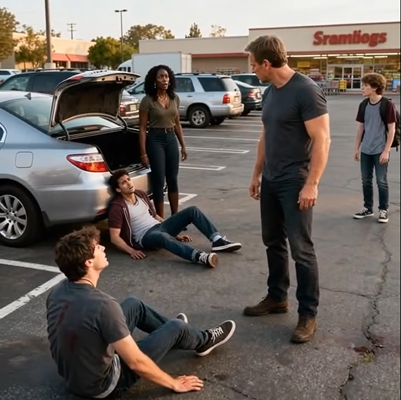
Suddenly he was lying on the pavement staring upward in complete disbelief.
The entire encounter lasted less than a second.
Another young man rushed forward.
Trying to help.
Trying to intervene.
Trying to save face.
Instead, he caught his foot on an abandoned shopping cart and stumbled awkwardly onto the asphalt.
The situation almost looked ridiculous.
One moment they were laughing.
The next they were sprawled across the parking lot.
I hadn’t thrown a punch.
Hadn’t struck anyone.
Hadn’t lost control.
And somehow that seemed to unsettle them even more.
Silence settled over the area.
The arrogance vanished.
The laughter disappeared.
People nearby stopped what they were doing.
Watching.
Waiting.
Store security arrived moments later.
Their expressions suggested they expected chaos.
Instead, they found something very different.
Before anyone could ask questions, one of the young men stepped forward.
He wasn’t one of the loud ones.
In fact, I barely remembered noticing him earlier.
His hands shook slightly as he spoke.
He told security exactly what happened.
Everything.
The insults.
The drink.
The confrontation.
Most importantly, he told the truth.
He admitted that his friends had crossed the line.
He admitted that I hadn’t attacked anyone.
He admitted that I had simply defended my wife without escalating the situation.
His honesty changed everything.
The tension dissolved almost immediately.
No arrests.
No charges.
No dramatic ending.
Just accountability.
We drove home believing the matter was finished.
Two days later, someone knocked on our front door.
When I opened it, I found the same young man standing there.
He looked nervous.
Almost frightened.
In his hands was a large envelope.
For several seconds, he couldn’t seem to find the words.
Then he finally spoke.
“Sir,” he said quietly, “I came to apologize.”
I nodded but said nothing.
He continued.
“Not just for them. For me too. I should have stopped it. I knew it was wrong.”
He handed me the envelope.
Inside was a handwritten essay.
Apparently, it had been written for one of his college classes.
The title immediately caught my attention:
What I Learned About Strength.
I sat down and read every word.
The essay wasn’t about fighting.
It wasn’t about winning.
It wasn’t about intimidation.
It was about restraint.
He wrote that he had expected violence.
Expected revenge.
Expected rage.
Instead, he witnessed something he hadn’t understood before.
Control.
He described how seeing someone remain calm under pressure had affected him more than any punch ever could.
He wrote about responsibility.
About speaking up.
About how silence can become participation when injustice unfolds in front of you.
That evening, Danielle and I sat together on our porch reading the essay again.
The sun dipped below the horizon as she carefully folded the pages.
For a long moment, neither of us spoke.
Then she smiled softly.
“The lesson wasn’t for them,” she said.
I looked at her.
“What do you mean?”
She touched the essay gently.
“It was for him.”
I thought about that for a long time.
She was right.
Sometimes people learn from consequences.
Sometimes they learn from failure.
And sometimes they learn by witnessing a better example.
The truth is, there are moments when anger feels completely justified.
Moments when retaliation seems deserved.
Moments when every instinct screams for revenge.
But true strength isn’t measured by what you’re capable of doing.
It’s measured by what you choose not to do.
That day didn’t make the news.
There were no viral videos.
No interviews.
No public recognition.
Just an ordinary grocery store parking lot and a lesson that stayed with everyone involved.
Because some of life’s most important battles aren’t fought on distant battlefields.
They’re fought in everyday moments.
Moments that reveal character.
Moments that test discipline.
Moments that force us to decide who we truly are.
And sometimes the strongest response isn’t anger.
It isn’t violence.
It isn’t revenge.
Sometimes the strongest thing a person can do is stand firm, remain calm, and demonstrate that dignity is far more powerful than hatred.
That is the lesson I carried home that day.
And judging by the essay that arrived on my doorstep, I wasn’t the only one.